Champagne’s Alto Recusal Needs Receipts Before Ottawa Hits Fast-Forward
Recusal is not transparency. If Ottawa wants Parliament to move fast on fiscal legislation while a $90B Crown-corporation rail file sits under an ethics screen, Canadians deserve the paper trail.
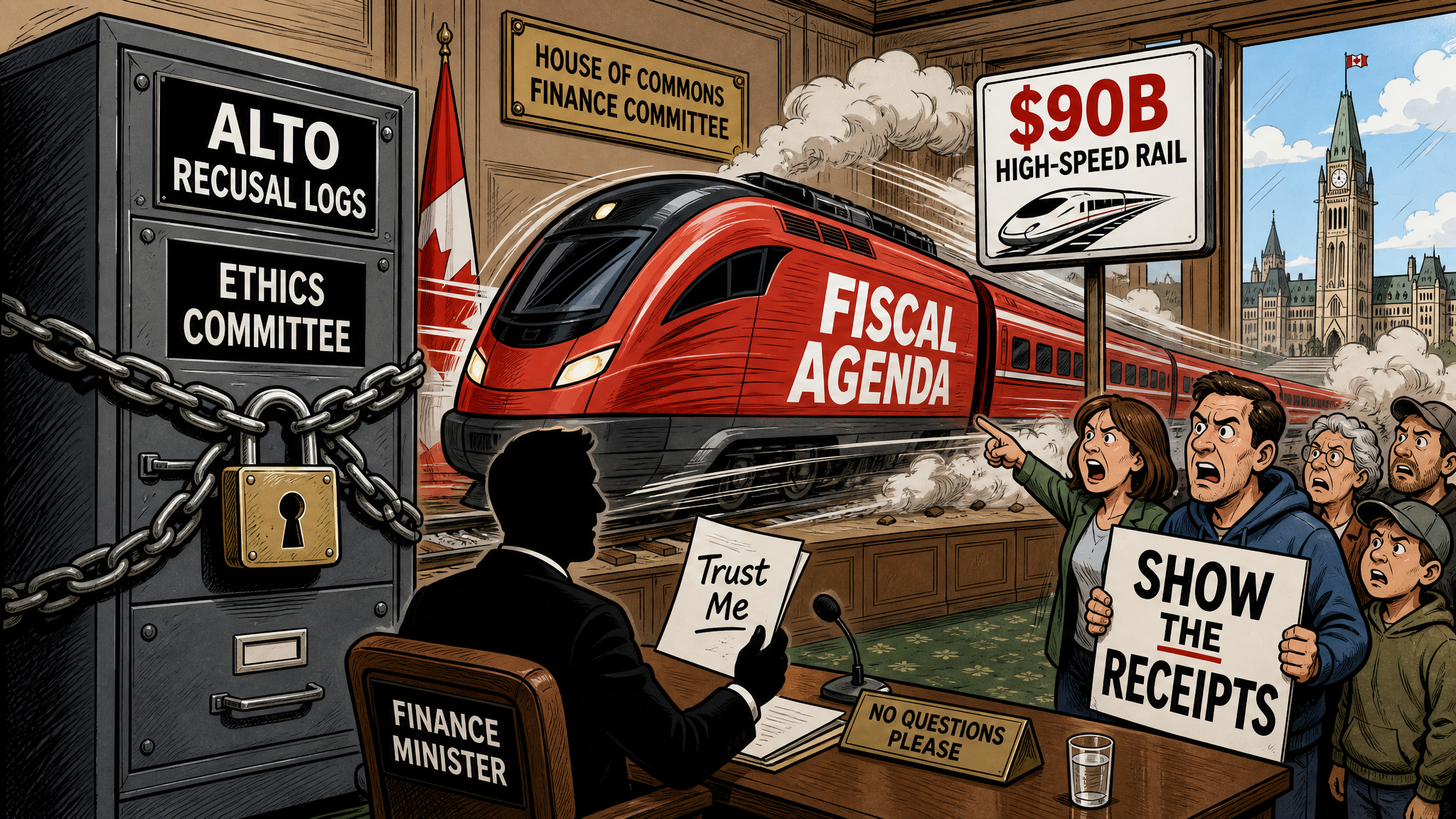
Finance Minister François-Philippe Champagne’s Alto recusal is back where it belongs: in front of Parliament, not buried in private assurances.
The facts require care. No public finding says Champagne broke the law. Canadian Press reported in April that Conservatives wanted the ethics committee to summon Champagne and Ethics Commissioner Konrad von Finckenstein over Champagne’s personal relationship with an Alto executive. The same coverage said Champagne recused himself from Alto decisions in September after his partner, Anne-Marie Gaudet, became Alto’s vice-president of environment. Journal de Québec likewise reported that Champagne would be questioned on the ethics file.
That is already enough to trigger a basic accountability standard. Alto is not a minor program. It is the federal Crown corporation responsible for the proposed Toronto-to-Quebec City high-speed rail project, and Canadian Press has put the project’s value at about $90 billion. When a cabinet minister’s household connection touches a Crown corporation tied to a nation-scale infrastructure plan, “the commissioner is satisfied” cannot be the end of the story.
Champagne has argued there is no conflict and no risk because Alto is a Crown corporation that reports to Parliament. That answer raises the real issue. If Parliament is the safeguard, Parliament needs documents, testimony and a timeline. A recusal screen only protects public trust when citizens can see what files were screened, when the screen started, who administered it, what meetings were avoided, what briefings were received and whether any votes or cabinet discussions still touched the project.
The timing makes the transparency test sharper. iPolitics reported May 24 that, with four weeks left in the sitting, the no-longer-minority Liberals were poised to accelerate a deadline vote on Champagne’s spring fiscal update implementation measures. The same preview said the ethics committee was expected to discuss Champagne’s response to an invitation to appear that week about the Alto recusal. Ottawa is asking for speed on money while asking for trust on ethics. That combination should make taxpayers suspicious.
Conservative ethics critic Michael Barrett alleged in the House that Champagne still voted on and participated in Alto-related matters and that Liberal MPs filibustered committee scrutiny. Those are allegations, not findings. The way to resolve them is not another Liberal talking point. It is a public record.
Before Parliament is asked to hurry through fiscal legislation connected to major spending, Champagne should publish the Alto recusal screen, the commissioner correspondence, the dates it applied, the list of Alto-related cabinet, Treasury Board, caucus, briefing and voting matters he attended or avoided, and the officials responsible for enforcing the firewall. If some lines must be redacted for legitimate cabinet confidence, say exactly why.
A $90 billion project deserves more than “trust us.” It deserves receipts before the train leaves the station.
- iPolitics: With just four weeks left in the sitting, Liberals aim to accelerate vote on latest budget bill
- Canadian Press mirror: Champagne says Conservative probes into Alto connection are just politics
- Journal de Québec: Éthique: Champagne sera questionné sur Alto
- OpenParliament: Michael Barrett statement in the House, April 20, 2026
- Parliament of Canada LEGISinfo: Bill C-31, Budget 2025 Implementation Act, No. 2
This article argues for transparency around recusals, committee testimony and fiscal scrutiny. It does not allege a proven legal conflict or personal wrongdoing by Champagne.