Carney’s Conflict Screen Needs June 15 Receipts
A conflict screen only works if Canadians can see enough of the process to know it is more than a black box around the Prime Minister’s former financial world.
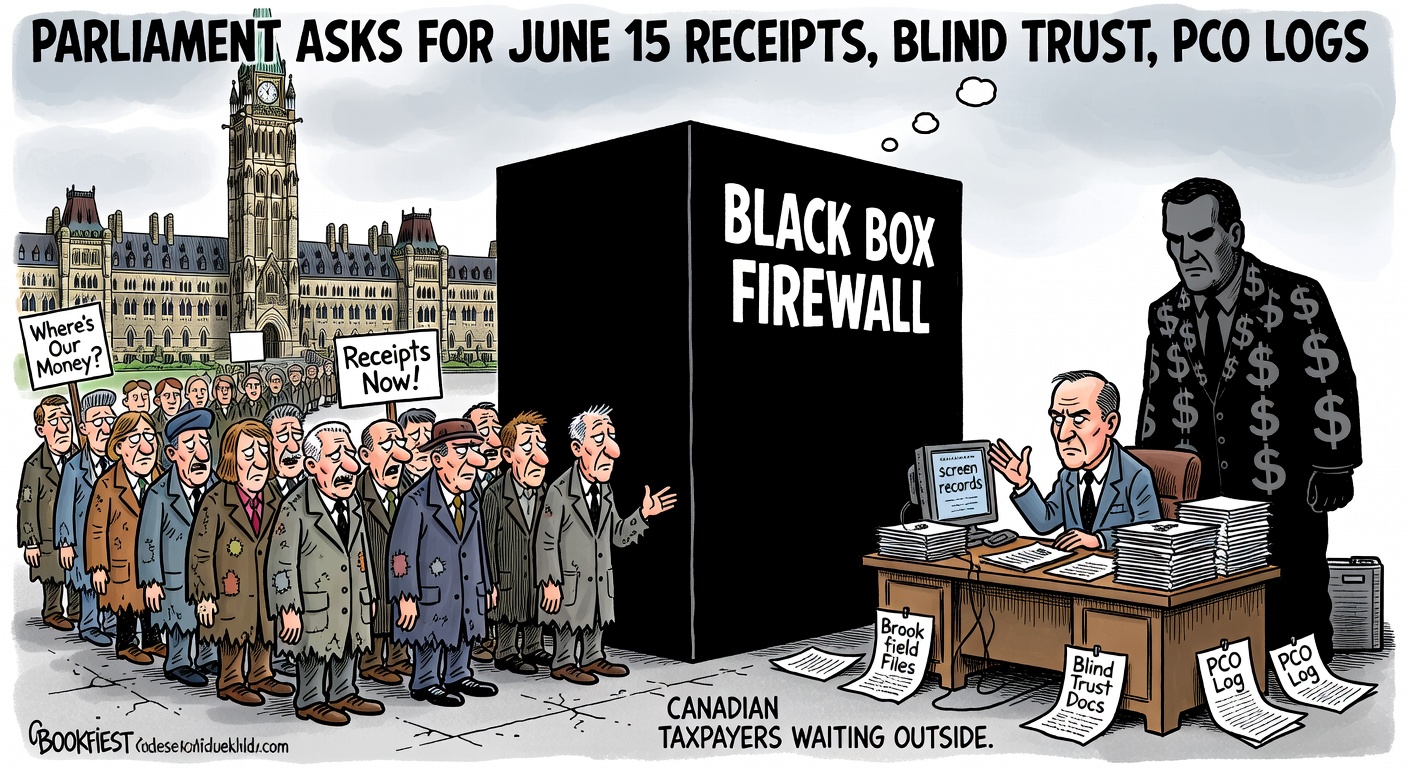
Mark Carney’s conflict-of-interest problem is not that he once worked in high finance. It is that Ottawa now asks Canadians to trust an invisible screen while the Prime Minister makes decisions in sectors where his former orbit matters: infrastructure, climate finance, energy transition, public-private capital and industrial policy.
The House ethics committee’s latest Conflict of Interest Act report put the weakness plainly. It recommended that prime ministers be required to divest controlled assets through sale within 60 days of taking office, and said a blind trust does not amount to true divestment. That is not a conservative talking point. It is a parliamentary accountability warning aimed at the highest office in the country.
The same report records the uncomfortable Carney-specific fact pattern: controlled assets were placed into a blind trust, including Brookfield-related interests, but the Prime Minister necessarily knows what originally went into that trust. The Ethics Commissioner also acknowledged the obvious risk that government decisions affecting those companies could increase their value. None of that proves wrongdoing. It does prove why “trust us” is not enough.
The screen itself raises another problem. According to the committee record, Carney’s conflict screen is administered by the Clerk of the Privy Council and the Prime Minister’s chief of staff. Those may be serious people, but they are not independent outsiders. One serves the government; the other is the Prime Minister’s top political operator. A firewall policed from inside the same power structure is a firewall Canadians should be allowed to inspect.
That is why the June 15 receipts test matters. At ETHI meeting 40, MPs dealt with committee business around requiring the Privy Council Office to provide monthly reports on assessments made under the Prime Minister’s conflict screen, with an initial June 15, 2026 production date covering assessments since the screen took effect. Whether government members embrace or resist that level of disclosure will tell Canadians plenty.
The minimum standard should be straightforward: publish the number of screened files, the policy areas involved, the departments or Crown entities touched, whether Brookfield-linked sectors appeared, who made each assessment, and what the outcome was. Sensitive market details can be redacted. The existence of the screen, its dates, its triggers and its decisions should not be.
Carney markets himself as the competent adult in the room. Good. Competence should welcome audit trails. If the Prime Minister’s blind trust and conflict screen are strong, the records will show it. If Ottawa refuses to provide the logs, Canadians will be left with the same old Liberal standard: private assurances for public power.
- House of Commons ETHI report: Review of the Conflict of Interest Act — recommendations on prime ministerial divestment and blind trusts
- House of Commons ETHI evidence: Meeting 40 evidence and committee business on Carney conflict-screen reporting
- Democracy Watch: Submission highlighting federal ethics-law loopholes
- News mirror: Ethics report called on Mark Carney to sell investments
This article argues for disclosure and independent accountability. It does not allege a finding of illegality or personal misconduct.