Bill C-31 Creates a $1B Procurement Shortcut Test
Faster military procurement is defensible. A new shortcut regime without public receipts is not.
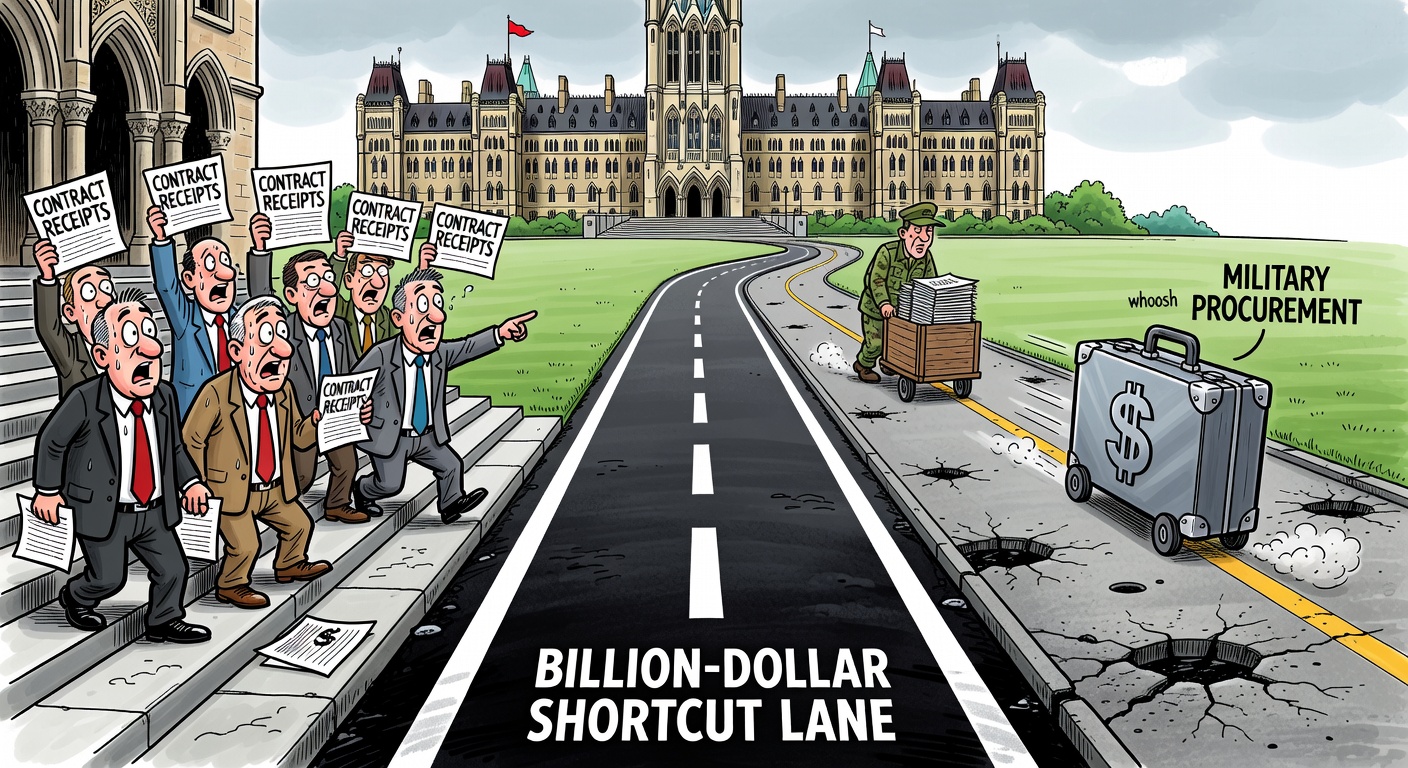
Canada’s soldiers should not have to wait years for basic equipment while Ottawa shuffles paper between departments. But Bill C-31 now gives Parliament a hard accountability test: can the Liberal government speed up defence buying without turning “urgent procurement” into a billion-dollar patronage lane?
The government’s pitch is attractive. Its Defence Investment Agency page says the new agency is meant to centralize expertise, cut red tape and streamline decisions so essential equipment gets delivered faster, “without compromising accountability.” After years of procurement embarrassment, that promise will sound reasonable to many Canadians.
The problem is that accountability is not a slogan. It is a paper trail.
Bill C-31’s Division 16 would enact the Defence Investment Agency Act and amend the Defence Production Act. In plain English, Ottawa is building a new agency with a central role in production, procurement and investment for national defence and national security. It would also expand the Defence Production Act beyond traditional defence supplies into national-security-related supplies, projects and services.
That may be necessary in a dangerous world. It also moves enormous discretion into a file where contracts are often complex, classified, technically specialized and politically valuable. Those are exactly the conditions where taxpayers need more disclosure, not less.
Refdesk’s bill explainer flags the core risk: the package could broaden exceptions to competitive procurement and create up to $1 billion in standing financial authority for loans, advance payments, guarantees, grants and share acquisitions tied to defence or economic security. Even if every one of those tools has a legitimate use, Parliament should not wave them through on trust.
A conservative accountability standard is not anti-military. It is pro-soldier and pro-taxpayer. The Canadian Armed Forces need gear that works. Canadian taxpayers need proof that contracts are awarded for capability, price, delivery and security — not because a firm has the best lobbyist, the right former official, or the most fashionable industrial-policy pitch.
Before Bill C-31 advances, the government should commit to five safeguards. First, publish a public exception log whenever competition is bypassed, with the legal reason and a plain-language justification. Second, disclose beneficial ownership for firms receiving major DIA-backed contracts or financing. Third, release lobbyist-contact summaries for high-value procurements. Fourth, require contract-by-contract reporting to Parliament on cost, delivery milestones and amendments. Fifth, mandate an independent review after the first year, before shortcut powers become Ottawa habit.
If the Liberals truly believe speed and accountability can coexist, they should welcome those receipts. If they resist them, Canadians should ask why a government that says it is fixing procurement is so nervous about showing how the new shortcut lane will be used.
National defence is too important for slow failure. It is also too important for secretive spending experiments. Bill C-31 should be judged by one simple rule: faster for the troops, visible for the taxpayers.
- OpenParliament: Bill C-31 parliamentary page
- Government of Canada: Defence Investment Agency overview
- Government Publications: Bill C-31 PDF, including Division 16
- Refdesk: Defence Investment Agency Act explainer
This article supports faster procurement for the Canadian Armed Forces while arguing that expanded shortcut powers require public logs, ownership disclosure, lobbying transparency and parliamentary review.