Surrey’s Extortion Numbers Are a Public-Safety Receipt Test
The police table is no longer a talking point. It is a warning light — and Ottawa should have to prove its laws and enforcement plan are keeping up.
Surrey families and business owners do not need another round of federal talking points. They need a government that treats extortion like the organized-crime crisis local police are documenting.
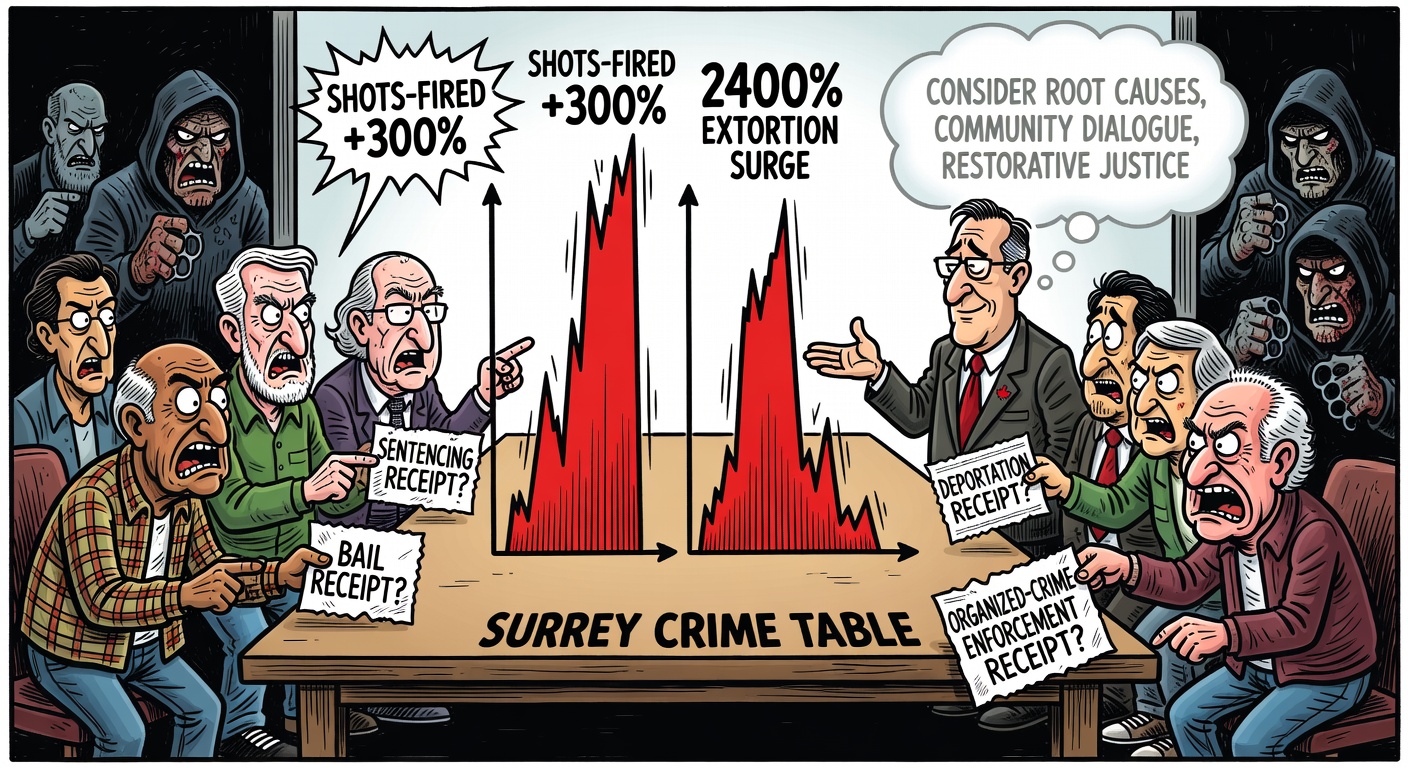
The Surrey Police Service’s March 2026 crime statistics report lists “Extortion: South Asian Series” at 75 citywide year-to-date files, compared with 3 at the same point in 2025 — a reported 2,400 per cent increase. The same table records 28 shots-fired files citywide year-to-date, up from 7 a year earlier, a 300 per cent increase. Police properly caution that the data are preliminary, file-based and subject to reclassification. But “preliminary” does not mean “irrelevant.” When extortion files and gunfire rise together, the public-safety burden shifts to government.
The warning became more concrete on May 20. Surrey Police said officers responded around 4:40 a.m. to a shooting near 57 Avenue and 148 Street, found damage to an occupied residence and evidence of shots fired, and believed the case was extortion-related. No one was injured. The Extortion Response Team took the lead.
That is the ground-level reality behind Pierre Poilievre’s May 22 Surrey attack on the Carney Liberals. The Conservative leader blamed Liberal bail and sentencing policy and called for tougher extortion penalties, stronger consequences for organized crime and deportation consequences for serious non-citizen offenders. Voters can debate the precise remedy. They should not have to debate whether the numbers demand urgency.
Ottawa says it is acting. In February, Public Safety Canada announced FINTRAC measures to prioritize extortion intelligence, create a counter-extortion partnership with financial institutions and assign liaison officers to affected areas. The same federal release pointed to border legislation, immigration-system changes, proposed bail and sentencing reform, RCMP hiring and CBSA capacity. Those are serious claims. They now need serious receipts.
Where are the Surrey-specific results? How many extortion investigations received federal intelligence support? How many charges followed? How many alleged offenders were already under release conditions, immigration review or removal orders? How many border, money-laundering or organized-crime files were opened from the new FINTRAC work? How quickly are victims receiving protection after threats arrive?
A conservative accountability test is not complicated: protect victims first, punish organized coercion, remove non-citizen serious criminals when the law allows it, and stop pretending compassion for offenders is a substitute for safety for families. If Carney’s Liberals believe their public-safety package is strong enough, they should publish measurable outcomes, not just program names.
Surrey’s extortion crisis is not merely a partisan line. It is in the police table, on residential streets and in the fear of families who wonder whether the next warning will hit their door. Ottawa’s answer should be evidence, enforcement and consequences — before another occupied home becomes a statistic.
- Surrey Police Service: March 2026 Crime Statistics Report
- Surrey Police Service: May 20, 2026 shooting-at-residence release
- Public Safety Canada: New measures to combat extortion
- Parliament of Canada: Bill C-16 LEGISinfo
- Conservative Party of Canada: Stop Extortion, Says Poilievre
This article argues for measurable federal public-safety outcomes while distinguishing police-reported local data from partisan claims about legal causation.