Liberals Shift Refugee Health Costs to Patients While Claiming $140M in Savings
When Ottawa overloads an immigration program, the answer should be transparent reform — not quiet invoices at the pharmacy and dental chair.
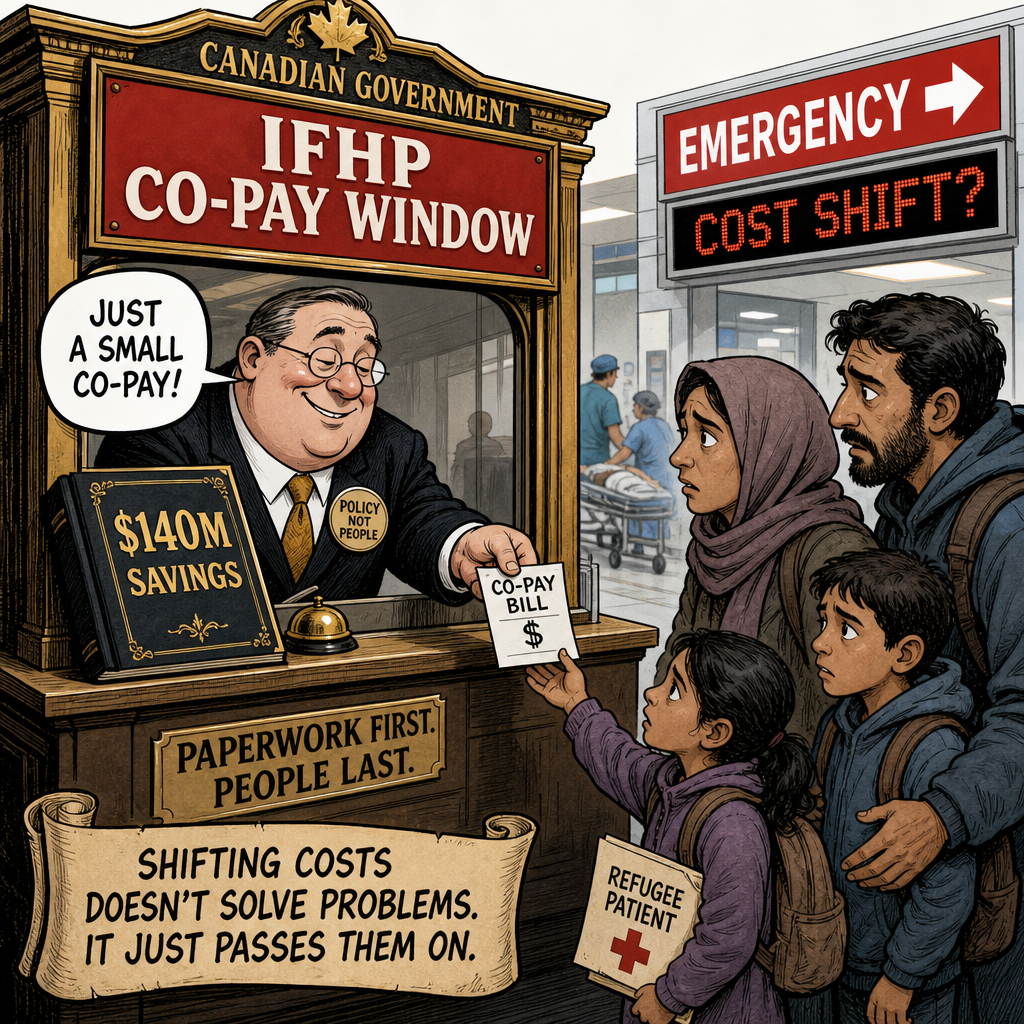
Ottawa’s new refugee health co-payments are being sold as savings. The accountable question is who is really paying the bill.
Immigration, Refugees and Citizenship Canada says co-payments under the Interim Federal Health Program began on May 1, 2026 for supplemental benefits. The basic coverage exemptions matter: doctor visits, hospital care and ambulances are not subject to the new charges. But the affected list is not minor. IRCC’s own page includes prescription medications, urgent dental care, vision care, mental-health counselling, occupational and physiotherapy, assistive devices, home and long-term care, and medical supplies and equipment.
The new patient charges are explicit: $4 for each eligible prescription filled or refilled, and 30 per cent of the IFHP-covered cost for other eligible supplemental benefits. That is not an administrative tweak for people living comfortably. It is a point-of-care bill placed in front of people who are often already navigating poverty, language barriers, trauma and an unfamiliar health system.
The Canadian Press reported that the government expects about $140 million in savings in 2026-27 from the co-pay model, with roughly $93 million tied to dental care. That number may look tidy on Ottawa’s spreadsheet. It looks very different if the result is skipped medication, delayed dental treatment, postponed counselling, or a problem that becomes more expensive when it reaches a hospital emergency room.
Doctors raised exactly that concern when the requirements took effect. CityNews, carrying Canadian Press reporting, quoted physicians warning of denial or delay of care, including patients skipping medication and later requiring more expensive treatment. That is not a sentimental objection. It is a basic cost-accounting warning: a federal “saving” can become a provincial hospital cost if Ottawa moves the charge to the wrong doorway.
The deeper failure is Liberal immigration management. The Parliamentary Budget Officer reported that IFHP costs grew from $211 million in 2020-21 to $896 million in 2024-25, and projected costs would reach almost $1.0 billion in 2025-26 and more than $1.5 billion by 2029-30 before the new co-pay model was reflected. When costs surge, government has a duty to show the full model: what drove the increase, what controls failed, what fraud or eligibility checks exist, what provinces will absorb, and whether co-pays actually reduce costs after delayed-care effects are counted.
Instead, Canadians get a policy that claims savings by shifting charges to vulnerable patients while leaving the public with too little modelling on downstream consequences. Conservatives should be clear: this is not about blaming refugees for using health care. It is about blaming Ottawa for building an expensive system, losing control of the cost curve, and then presenting a patient invoice as fiscal discipline.
If the Liberal government believes this saves money without worsening care, publish the evidence. Show the assumptions, hospital-offset analysis, collection costs, denied-care tracking, provincial impact estimates and safeguards for people who cannot pay.
Until then, the $140-million figure is not accountability. It is a receipt Ottawa is trying to hand to someone else.
- IRCC: Interim Federal Health Program co-payments
- IRCC: Changes to the Interim Federal Health Program
- CityNews / The Canadian Press: Doctors worry about refugees as payment requirements take effect
- iPolitics / The Canadian Press: Government expects $140M in savings with refugee health-care co-pay
- Parliamentary Budget Officer: Projecting the Cost of the Interim Federal Health Program
This article argues for transparent immigration and health-spending accountability while explicitly focusing responsibility on federal policy design, not on refugees or claimants seeking care.