The Committee Control Test: A Majority Built After the Election Should Not Hide Scrutiny
The issue is not whether majority governments normally control committees. The issue is what Carney’s Liberals do with that control when ethics, spending and legislation are on the table.
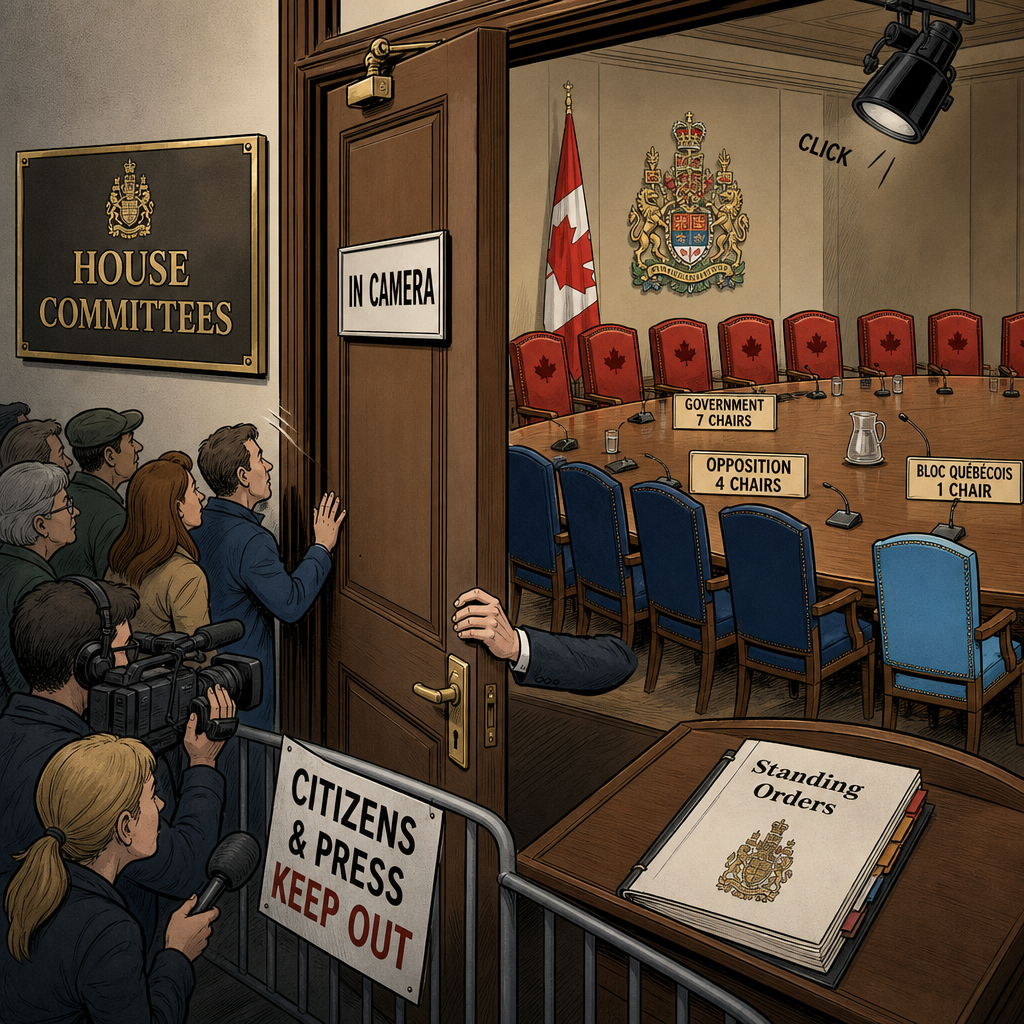
Canadians should pay attention to what happened to House committees after Mark Carney’s Liberals crossed the majority threshold. The Canadian Press reported in April that Government House Leader Steven MacKinnon would move to change the Commons standing orders so the government would have the most votes on committees. Before that change, the minority-Parliament arrangement generally gave committees four Liberals, four Conservatives and one Bloc Québécois MP.
The new math is not disputed. The April 27 House of Commons Journals record the motion changing most standing committees to 12 members: seven Liberals, four Conservatives and one Bloc member. Several oversight committees — including Access to Information, Privacy and Ethics, Government Operations and Estimates, Public Accounts, and Status of Women — were set at 10 members, with five Liberals, four Conservatives and one Bloc member.
That matters because committees are where governments are examined line by line. Bills are studied there. Witnesses are called there. Spending questions are put on the record there. Ethics files can be tested there. If committee control becomes a way to limit the public record, then parliamentary accountability becomes a slogan instead of a safeguard.
Global News, citing The Canadian Press, reported that after new Liberal MPs joined the health and ethics committees, Liberal members used their majorities to move debates into closed-door sessions within minutes. Conservative MPs said that pushed the media and public out and prevented members from speaking publicly about what happened afterward. MacKinnon responded that committees are “masters of their own agenda” and said no one was shutting down debate.
That response is too thin. A committee may be master of its agenda, but Canadians are the ones paying for the government being scrutinized. When the health committee is discussing questions around a reported $300-million electronic-prescription program, or when the ethics committee is dealing with the conduct of public officials, default secrecy is not a democratic virtue.
The Conservative case is straightforward: a majority assembled through byelections and floor crossings should not be used to weaken oversight that voters did not directly hand to the Liberals in the general election. The Liberal answer is that majority governments traditionally hold committee majorities. Both statements can be true. The accountability test is what happens next.
If Carney wants to claim competence and seriousness, his government should prove it in public. Keep substantive committee debates open by default. Publish reasons when meetings go in camera. Protect opposition-led scrutiny on spending and ethics. Let witnesses speak on the record. Let Canadians see the votes.
Bottom line: committee control is power. Power used to pass legislation can be defended. Power used to move scrutiny behind closed doors deserves resistance.
- Canadian Press via CityNews, April 21, 2026: Liberals move to take control of House committees
- Canadian Press via CityNews, April 22, 2026: MacKinnon rejects Conservative call on committee control
- House of Commons Journals, April 27, 2026: Government Business No. 9 committee-composition motion
- Global News / Canadian Press, April 29, 2026: Tories say Liberals using committee majorities to stop public debate
This article distinguishes reported opposition allegations from official House records and government responses. It does not assert what occurred in closed sessions beyond what was publicly reported.