$1.1 Billion Question: Why Are Temporary Residents Receiving So Much Canada Child Benefit?
The issue is not whether children should eat. The issue is whether Liberal immigration and benefits policy has turned “temporary” status into a permanent taxpayer cost without honest capacity planning, verification or public consent.
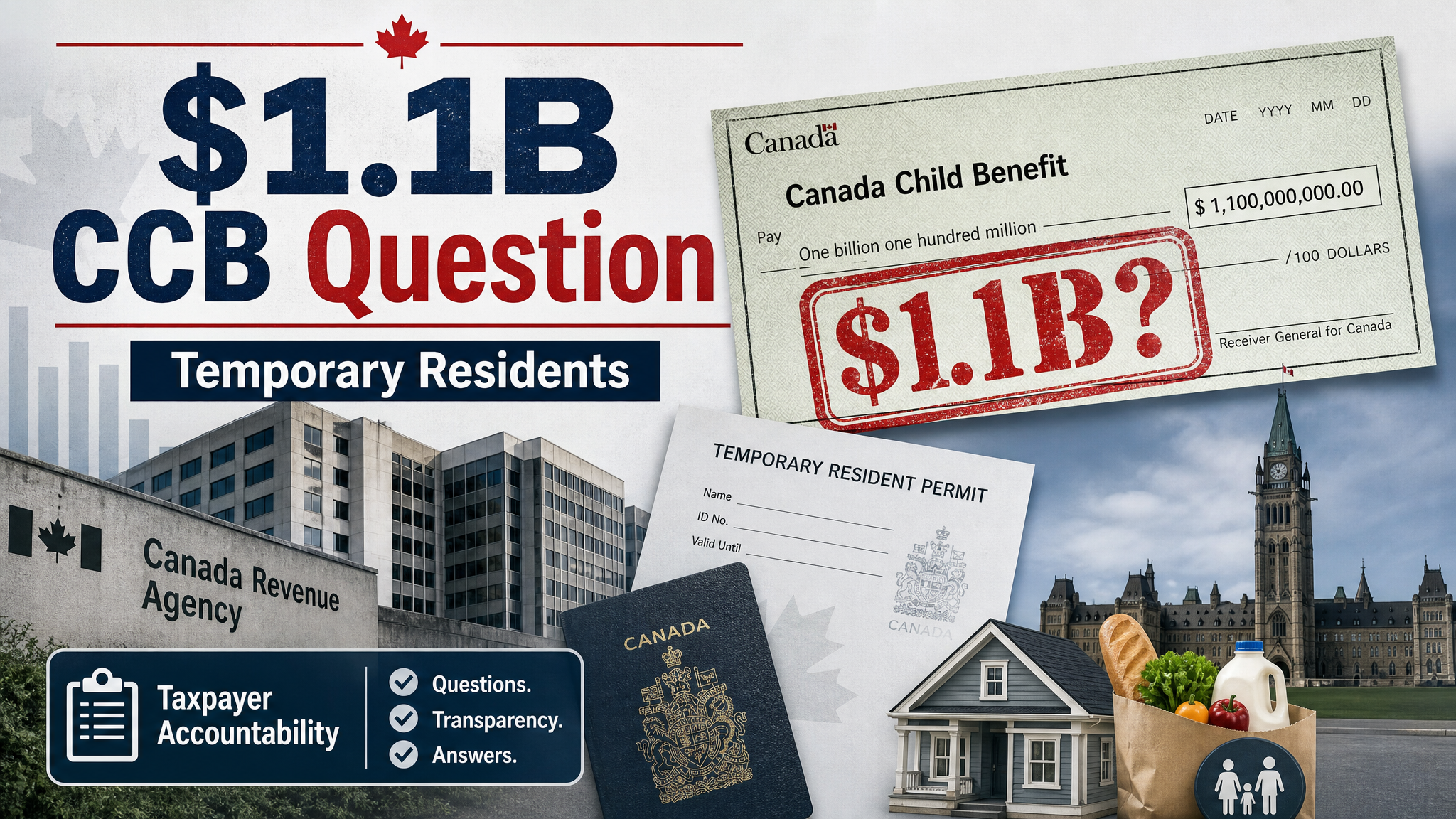
A Facebook reel turned a dry House of Commons response into a viral question: why did temporary residents receive more than a billion dollars in Canada Child Benefit payments in 2025?
The online phrasing can get ugly fast. This article will not use it. Children are not the problem. Families are not the problem. Newcomers following the rules are not the problem. The problem is a federal system that expanded temporary immigration, stretched housing and services, and then quietly attached a growing taxpayer benefit bill to a category the public was told was temporary.
According to Juno News, a written response tabled in the House of Commons and based on Canada Revenue Agency data showed more than $1.1 billion in Canada Child Benefit payments to temporary residents in 2025, including temporary foreign workers and international students. Juno reported the five-year total from 2021 to 2025 was $2,955,041,000, with annual payments nearly tripling from just under $389 million in 2021.
That is not a small accounting footnote. It is a policy signal. Temporary status has become a major part of Canada’s fiscal, housing and social-service system.
The Canada Child Benefit is one of Ottawa’s largest family programs. CRA’s published benefit tables show maximum annual amounts of up to $7,997 per child under six and $6,748 per child aged six to seventeen, depending on family income and eligibility.
Temporary residents are not automatically excluded. CRA eligibility rules say a parent may qualify if they meet the program’s residence and status requirements. Federal guidance has long recognized that a temporary resident who has lived in Canada for the required period and has valid status may be eligible.
That may be legal. But legality does not end the debate. If temporary immigration expands dramatically, then legal eligibility can create costs Parliament never forced ministers to explain clearly.
The real question is not “should children be punished?” It is: why did Ottawa build a temporary-resident system large enough to produce a billion-dollar child-benefit bill?
In March 2025, the Taxpayers’ Ombudsperson released a review of how CRA administers the Canada Child Benefit for temporary residents. The office made eleven recommendations after finding service and administration problems around temporary-resident status, documentation and communication.
That review matters because the public needs more than a dollar figure. It needs confidence that CRA can verify eligibility in a system where permits expire, renewals are delayed, status changes, families move, and federal databases do not always speak cleanly to one another.
If a person is eligible, say so. If they are not, stop payment quickly. If status is unclear, verify before taxpayers are asked to keep paying. That is not cruelty. That is basic program integrity.
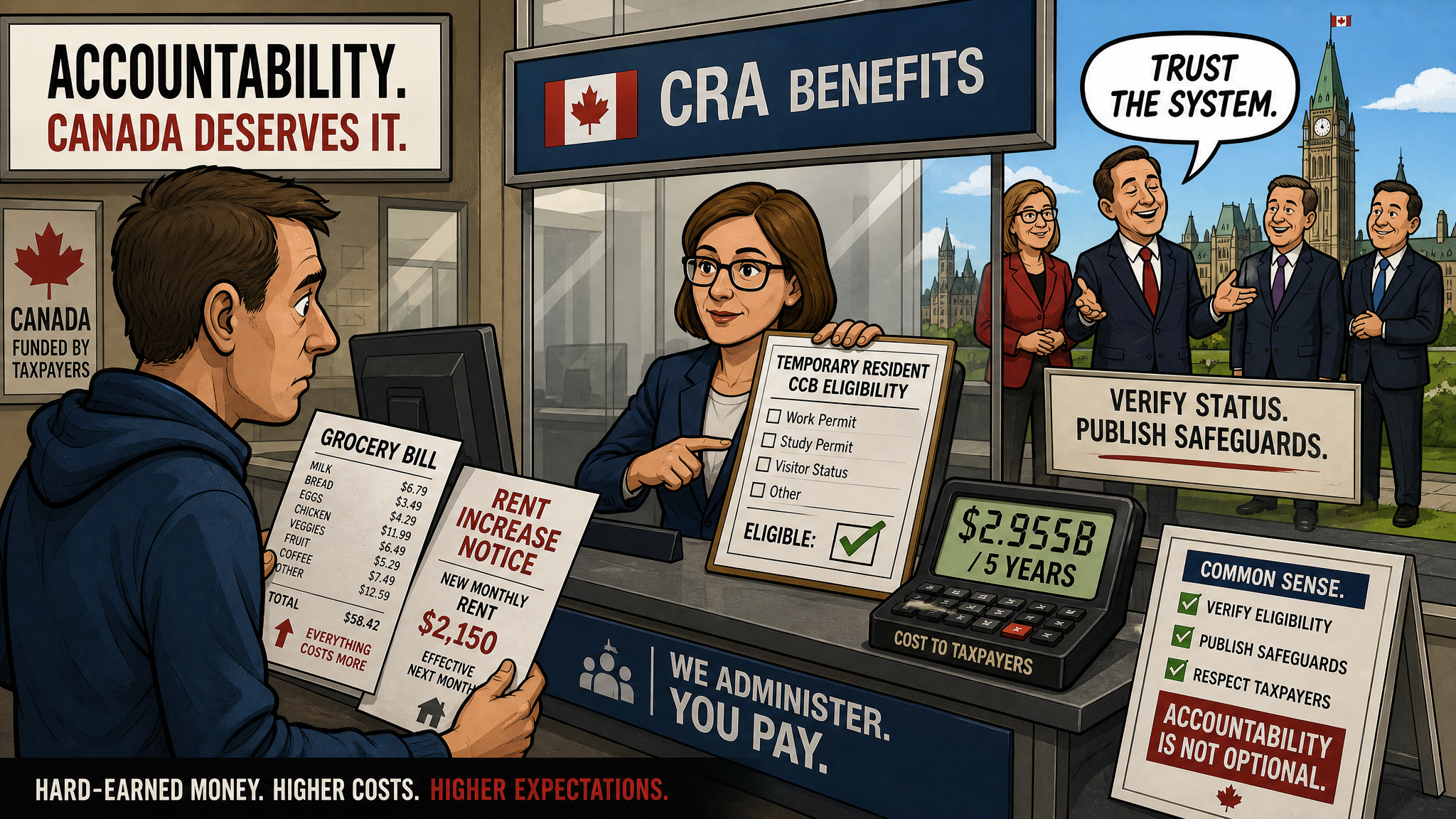
The larger failure belongs to Liberal immigration planning. Canada did not merely admit permanent residents. It massively expanded the population of temporary foreign workers, international students and other non-permanent residents, then tried to manage the consequences after housing, healthcare, schools and public services were already under strain.
That is how a “temporary” category becomes structural. People live here, work here, rent homes, use services, enroll children, need doctors and qualify for benefits. Many are doing exactly what the rules allow. The political failure is that Ottawa wrote rules and set intake levels without honestly presenting the full public cost.
Canadians deserve a benefits impact statement attached to every immigration levels plan. If ministers can project admissions, they can project housing demand, healthcare pressure, school capacity and benefit eligibility. The fiscal table should include Canada Child Benefit exposure for temporary residents, broken down by category, province, status type, duration in Canada and year-over-year growth.
Before Ottawa asks taxpayers to accept another immigration reset, Parliament should demand answers:
- How many temporary residents received the Canada Child Benefit in each year from 2021 to 2025?
- How many were temporary foreign workers, international students, visitors, refugee claimants or other permit holders?
- How many had been in Canada longer than two, three, five or ten years while still counted as temporary?
- How many payments were later found ineligible, recovered or written off?
- How quickly does CRA stop payments when temporary status expires?
- How does CRA verify status with IRCC, and how often are files manually reviewed?
- What is the projected CCB cost for temporary residents in 2026, 2027 and 2028?
- Did cabinet receive a benefits-cost estimate when approving temporary-resident growth?
These are not anti-immigrant questions. They are pro-accountability questions. A country that cannot honestly price its policies cannot honestly defend them.
The Liberals want to sell compassion while avoiding capacity math. That does not work anymore. Canadians are facing rent pressure, food inflation, doctor shortages, school crowding and heavy federal debt. When they learn that temporary residents received more than a billion dollars in child benefits in one year, they are entitled to ask how the system got there.
There may be cases where the benefit is defensible. A legally present worker with children, income below the threshold and valid status may meet the rules Parliament created. But that only moves the accountability one level up: who created the scale, who approved the cost, who monitored verification, and why did taxpayers have to learn about it through a written question rather than a plain-language fiscal table?
Carney’s government should not hide behind outrage or compassion slogans. It should publish the numbers, defend the rules, fix verification gaps and explain whether “temporary” still means temporary.
Bottom line: if Ottawa’s temporary-resident system now carries billion-dollar family-benefit costs, Canadians deserve the receipts before the next immigration plan is sold.
- Juno News, using House of Commons/CRA data: “$1B in child benefits for foreign workers, international students last year”.
- Canada Revenue Agency: Canada Child Benefit amounts.
- Canada Revenue Agency: CCB eligibility / who can apply.
- Taxpayers’ Ombudsperson: review of CCB administration for temporary residents.
- Facebook reel lead reviewed May 21, 2026: Matt Tremblay reel.
This article criticizes federal policy design, fiscal transparency and verification. It does not argue children should be left without support or blame families who follow existing rules.