Carney’s China Reset Just Hit the Taiwan Sovereignty Test
Beijing warned Canadian MPs and warships away from Taiwan. Carney’s China reset needs public red lines, not diplomatic fog.
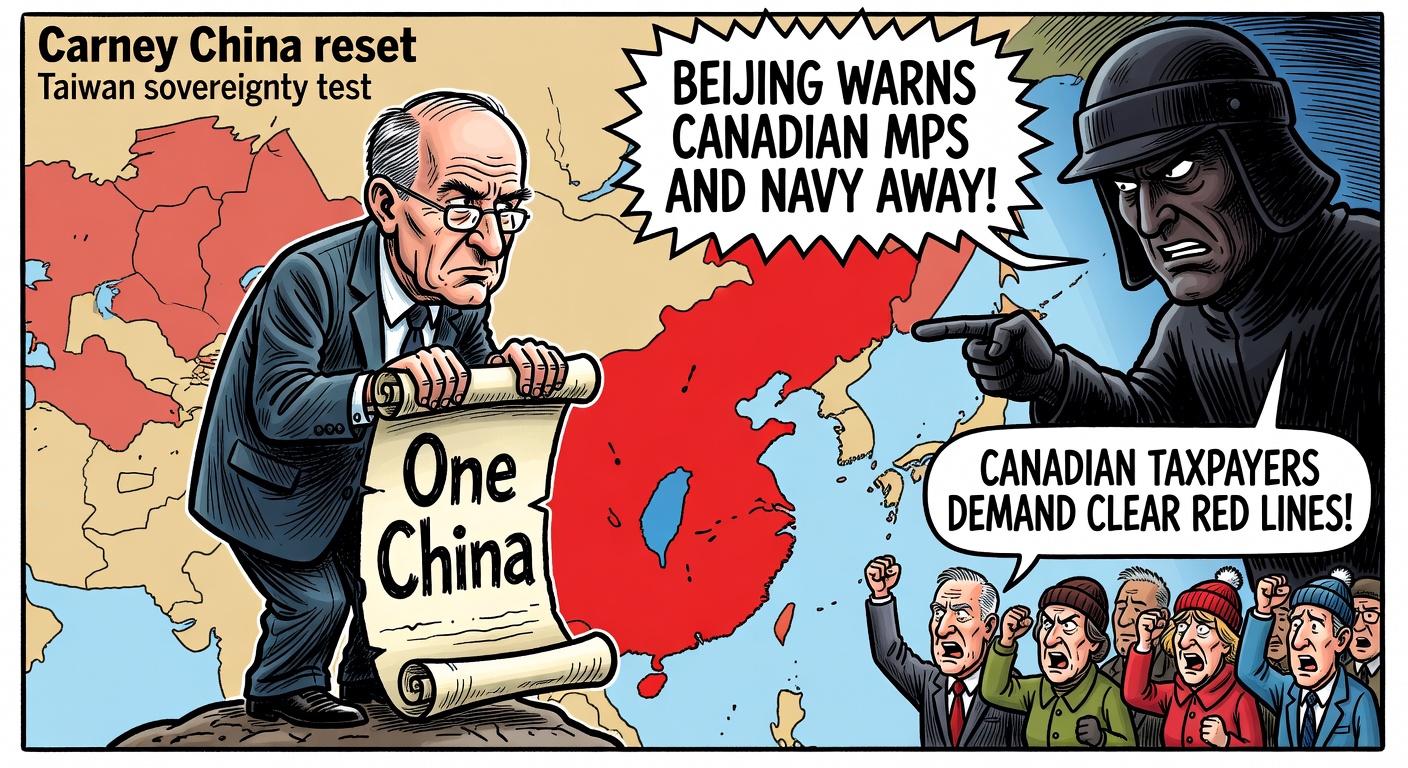
Mark Carney sold his January Beijing trip as hard-headed pragmatism: diversify trade, unlock canola relief, attract investment and build a new strategic partnership with the People’s Republic of China. The test of that partnership arrived faster than Ottawa expected. Beijing is now warning Canadian parliamentarians and Canadian warships away from Taiwan.
The issue is not whether Canada should be reckless. It should not. Canada has maintained a One China Policy since 1970, and Global Affairs says that policy still allows unofficial but valuable economic, cultural and people-to-people ties with Taiwan. Serious foreign policy requires careful language. But careful language is not the same thing as letting Beijing write Canada’s travel rules.
Canadian Press reported that Conservative foreign affairs critic Michael Chong travelled to Taiwan this week to meet Taiwanese officials and assert Canadian sovereignty after China’s ambassador warned MPs against visiting the island. China’s embassy responded by saying the visit crossed a “red line” and urged Canada not to interfere in what Beijing calls internal Chinese affairs.
iPolitics then reported that Foreign Affairs Minister Anita Anand defended Canada’s relationship with Taiwan while repeatedly returning to the One China Policy framework. Chong’s answer was clearer: Canada is sovereign and independent, and Canadian MPs do not take direction from a foreign government about where they travel or where Canadian Navy ships transit in international waters.
That is the conservative accountability point. Carney can pursue trade with China, but he cannot buy lower tension by leaving Canadians guessing about where Canada’s red lines are. A strategic partnership with an authoritarian state should make Ottawa more transparent, not less. Parliament deserves to know whether the government will keep supporting parliamentary visits to Taiwan, whether Canadian naval transits through international waters remain on the table, and whether economic retaliation will change those decisions.
The official January joint statement matters because it shows how much Carney put into this reset. Canada and China reaffirmed Canada’s One China Policy and committed to a new strategic partnership covering trade, energy, finance, public security, culture and multilateral cooperation. The same statement listed a policing memorandum of understanding between the RCMP and China’s Ministry of Public Security. That is not a minor diplomatic photo-op. It is a major repositioning of Canadian policy toward Beijing.
Which is why Taiwan is a useful stress test. Taiwan is a democracy facing pressure from the Chinese Communist Party. Canadian parliamentarians have visited before. Canada’s own policy leaves room for unofficial ties. If Beijing can convert Carney’s reset into a veto over MPs’ travel or naval movements, the partnership is not pragmatic; it is leverage.
Ottawa should publish the rules now: Canada’s One China Policy is not Beijing’s One China Principle; MPs may engage Taiwan without foreign permission; Canadian ships may transit international waters consistent with international law; and any trade threat tied to Taiwan will be disclosed to Parliament. Carney asked Canadians to trust his China reset. Fine. Then show the red lines before Beijing draws them for us.
Trade pragmatism cannot become sovereignty ambiguity. If Beijing is warning Canadian MPs and ships away from Taiwan, Ottawa owes Canadians clear red lines.
- Prime Minister of Canada — Carney announces Canada-China strategic partnership
- Prime Minister of Canada — Joint statement of the Canada-China Leaders’ Meeting
- Global Affairs Canada — Canada-Taiwan relations
- Canadian Press / CityNews — Chinese embassy denounces MP Chong’s Taiwan visit
- iPolitics — Anand reiterates One China Policy amid Chong’s Taiwan visit