Brookfield’s Public-Money Footprint Makes Carney’s Firewall Test More Urgent
Northern Perspective’s latest video points to the right accountability question: when Brookfield-linked energy-transition projects and funds draw public development finance, what firewall protects Canadian taxpayers from conflicts?
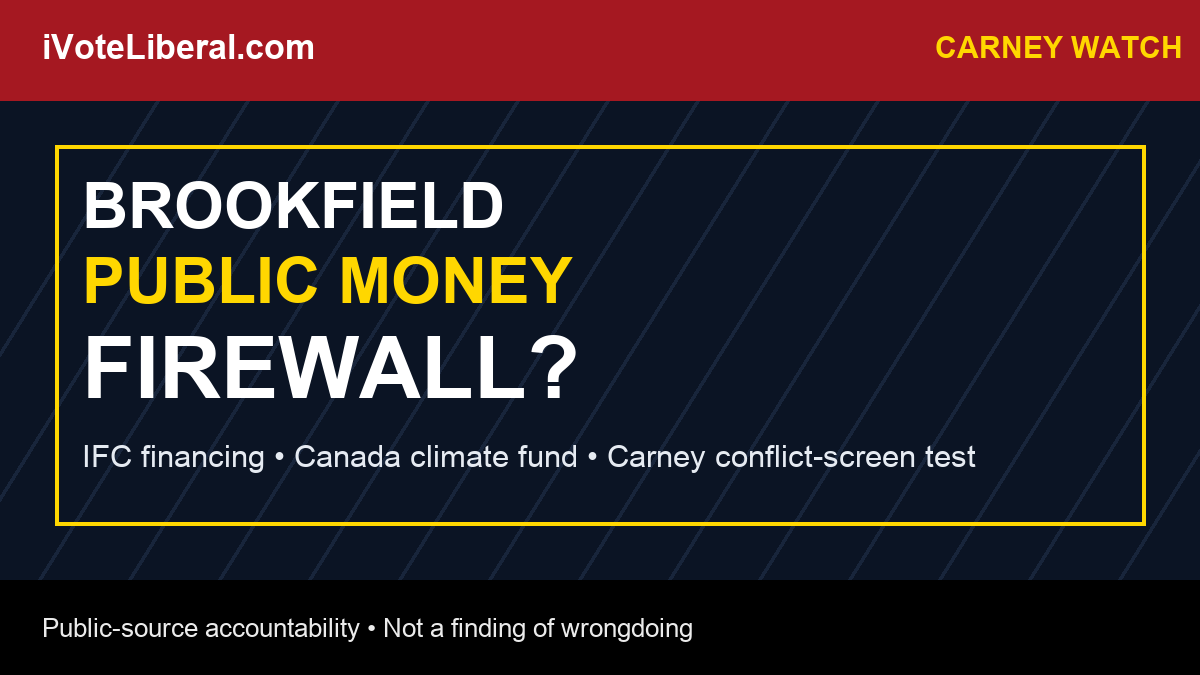
A new Northern Perspective video argues that public money and development-finance programs are intersecting with Brookfield-linked energy-transition projects. The safe conclusion is not that Mark Carney personally approved any particular financing. The safe conclusion is sharper: Brookfield’s public-finance footprint makes Carney’s conflict firewall test impossible to ignore.
Start with what the primary documents show. Global Affairs Canada lists a $250-million maximum contribution to the Blended Climate Finance Program, a partnership between Canada and the International Finance Corporation. The stated purpose is concessional financing to encourage private-sector investment in climate mitigation and adaptation projects in developing countries.
Separately, IFC announced in June 2024 that it committed $105 million to part-finance a roughly 550 MWp solar power project in Bikaner, India, being developed by Brookfield. IFC also announced in November 2025 that it would invest $100 million in Brookfield’s Catalytic Transition Fund LP, with an additional envelope of up to $75 million for co-investments alongside the fund.
Those facts matter because Brookfield itself appointed Carney in 2020 as Vice Chair and Head of ESG and Impact Fund Investing, saying he would help develop ESG-focused funds and build on Brookfield’s renewable-energy and sustainability strengths. That was before Carney became prime minister, but the issue follows him into office because the same broad sectors — climate finance, energy transition, infrastructure, public-private capital and carbon policy — remain live federal policy files.
This article does not claim Canadian taxpayer dollars from the Global Affairs program directly funded the named Brookfield projects. The documents show Canada funds an IFC blended climate-finance program; IFC separately financed or invested in Brookfield-linked projects/funds. That is enough to raise a public-accountability question, but not enough to allege a direct Canadian-to-Brookfield payment without more records.
Why the firewall question is bigger than one project
Carney’s defenders can say these are normal development-finance transactions. That may be true. But normal is not the same as transparent. If the prime minister’s former employer is active in the exact sectors where Ottawa, IFC, public pension capital, climate-finance vehicles and sovereign-style funds operate, Canadians deserve rules they can see.
The rule should be simple: any federal file touching Brookfield-linked entities, Brookfield-adjacent funds, climate-finance partnerships, carbon markets, transition funds, infrastructure vehicles or development-finance channels should have a published conflict-screen record. Canadians should know who attended meetings, who recused, what entities were screened, and whether taxpayer-backed capital touched a Brookfield-linked project directly or indirectly.
That is not anti-investment. It is pro-trust. Public money can support development finance. Private capital can build projects. But when political leadership has recent senior ties to a global asset manager, the public deserves more than “trust us.”
- A public Carney/Brookfield recusal log, including meetings and files screened out.
- A list of federal programs, agencies or Crown-linked vehicles with exposure to Brookfield entities or Brookfield-managed funds.
- Clear separation between direct federal spending, IFC/World Bank finance, pension-fund investment and private Brookfield capital.
- Independent review before any Canada Strong Fund, climate-finance or infrastructure vehicle invests in sectors where Brookfield is a major player.
The point is not to prove a scandal from a YouTube video. The point is to follow the documents and demand the firewall before the next cheque, guarantee, fund commitment or “public-private partnership” moves.
Carney built his public brand on competence and clean finance. Good. Then he should welcome a clean line between the Prime Minister’s Office and Brookfield’s global money machine.
- Northern Perspective video: New Evidence Connects Mark Carney To Massive Brookfield Funding From Canadian Taxpayers And MORE
- Global Affairs Canada project profile: Blended Climate Finance Program
- IFC, June 17, 2024: IFC to finance Brookfield’s Bikaner solar power project
- IFC, Nov. 17, 2025: IFC invests in Brookfield’s Catalytic Transition Fund
- Brookfield, Aug. 26, 2020: Mark Carney appointed Vice Chair and Head of ESG and Impact Fund Investing
This is political commentary based on public documents. It is not a finding of illegality or personal misconduct. The accountability ask is disclosure, recusal records and a visible firewall.