The China Police Pact Canada Refuses to Show You
Carney’s Ottawa renewed police cooperation with Beijing while Canada’s own security record warns about foreign interference, transnational repression and cyber threats. The verified facts are serious enough — and the unanswered questions are the story.
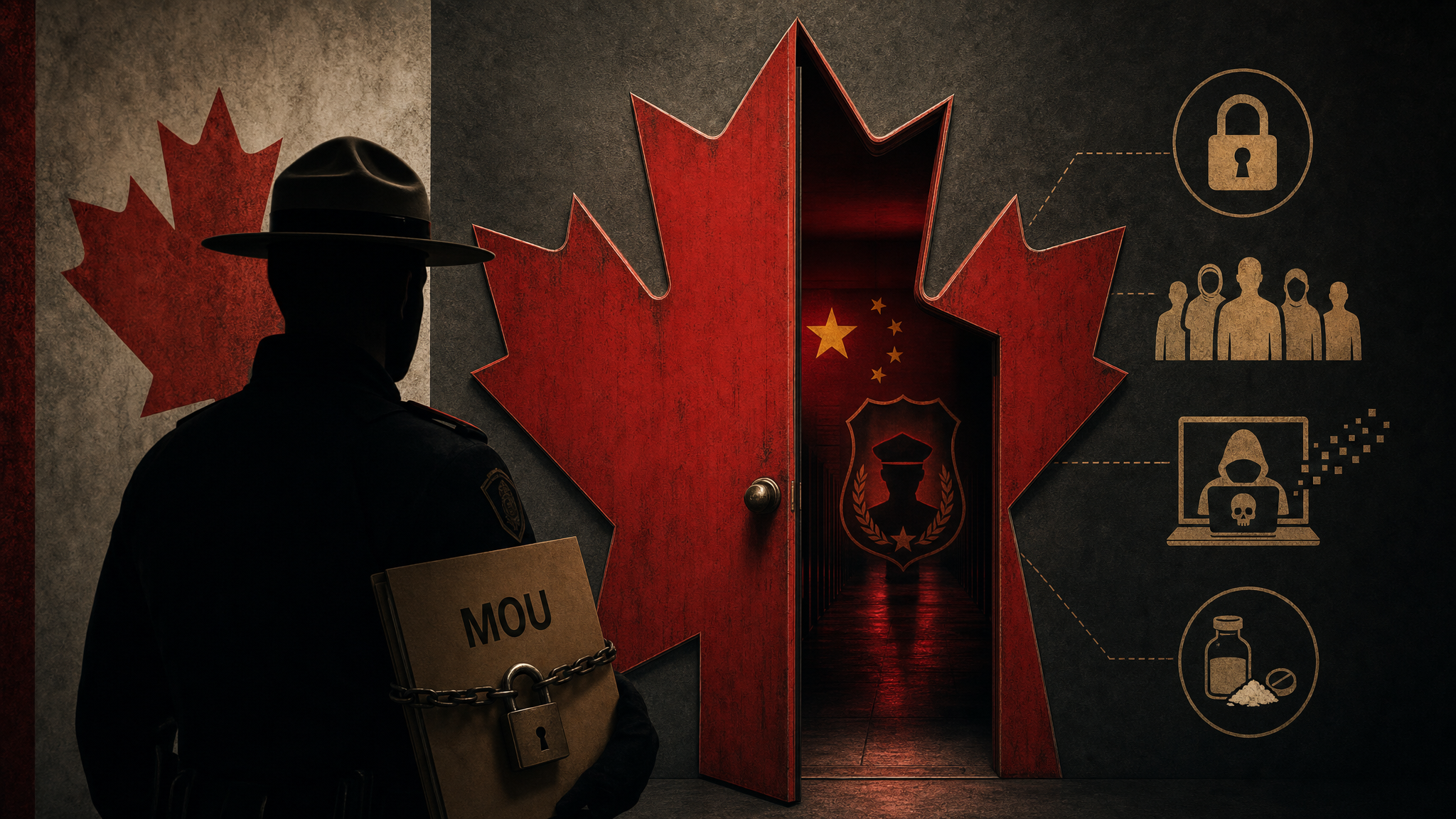
There are political stories that look loud online but collapse under evidence. This is not one of them.
The Facebook posts are messy. Some captions jump too quickly from an unreleased policing agreement to claims about “hidden tech” and malicious surveillance. Those claims require proof. But strip away the online fog and a much more serious, fully documentable story remains: Mark Carney’s government renewed police cooperation with Beijing while refusing to show Canadians the agreement, even as Canada’s own national-security record says the People’s Republic of China remains a foreign-interference, cyber and transnational-repression threat.
This is not a debate about whether Canada should ever cooperate internationally on crime. Of course it should. Fentanyl, money laundering, cybercrime, human trafficking and organized crime do not respect borders. The question is whether a Canadian government can safely maintain a non-public policing arrangement with the security ministry of an authoritarian state — and whether Canadians, Parliament and affected diaspora communities are being asked to trust another Liberal black box.
The most important sentence in this story is not a slogan. It is the accountability question now sitting in plain sight:
Why does the RCMP need China’s permission to tell Canadians what is in a Canadian policing agreement?
The Canada-China police cooperation issue is not imaginary. The Prime Minister’s Office announced in January 2026 that Prime Minister Mark Carney met Chinese Premier Li Qiang in Beijing and that Canada and China agreed to launch what the statement called a “new strategic partnership.” The same joint statement listed renewed cooperation in multiple areas, including a memorandum of understanding involving the RCMP and China’s Ministry of Public Security.
That matters because the Ministry of Public Security is not simply a foreign police partner comparable to a democratic ally’s national police service. It is a core security organ of the Chinese party-state. Cooperation with it may be defensible in narrow criminal cases — but only if the limits, safeguards and oversight are explicit and independently reviewable.
Public Safety Canada’s public position, as reported by The Canadian Press, is that the MOU covers information exchange, investigative assistance, technical expertise and training, and coordination between law-enforcement agencies. The same reporting says the government insists all cooperation must follow Canadian law. That sounds reassuring until one asks the basic follow-up: what exactly can be shared, with whom, for what purposes, under what approval process, and with what human-rights exclusions?
Those answers are not available because the text has not been released.
At a Senate committee appearance, RCMP Senior Deputy Commissioner Bryan Larkin was pressed on why the details could not be discussed openly. According to the official Senate record, Larkin said the agreement contains a clause that does not allow public disclosure unless permission is given by the other party. In practice, that means the Canadian public cannot see the full policing agreement unless the Chinese side agrees.
That is the heart of the scandal. Not “there must be secret spy tech.” Not “every police exchange is corrupt.” The scandal is more basic and more dangerous: a Canadian policing arrangement with China’s security ministry appears to be shielded from Canadians by a confidentiality rule that gives Beijing leverage over disclosure.
Conservative public-safety critic Frank Caputo has demanded the agreement be released. NDP MP Jenny Kwan has also raised concerns, asking whether safeguards exist to protect dissidents, journalists, human-rights defenders and diaspora communities from information being misused. That cross-partisan concern is important. It shows this is not merely an opposition-war-room attack. It is a national-security question that cuts across party lines.
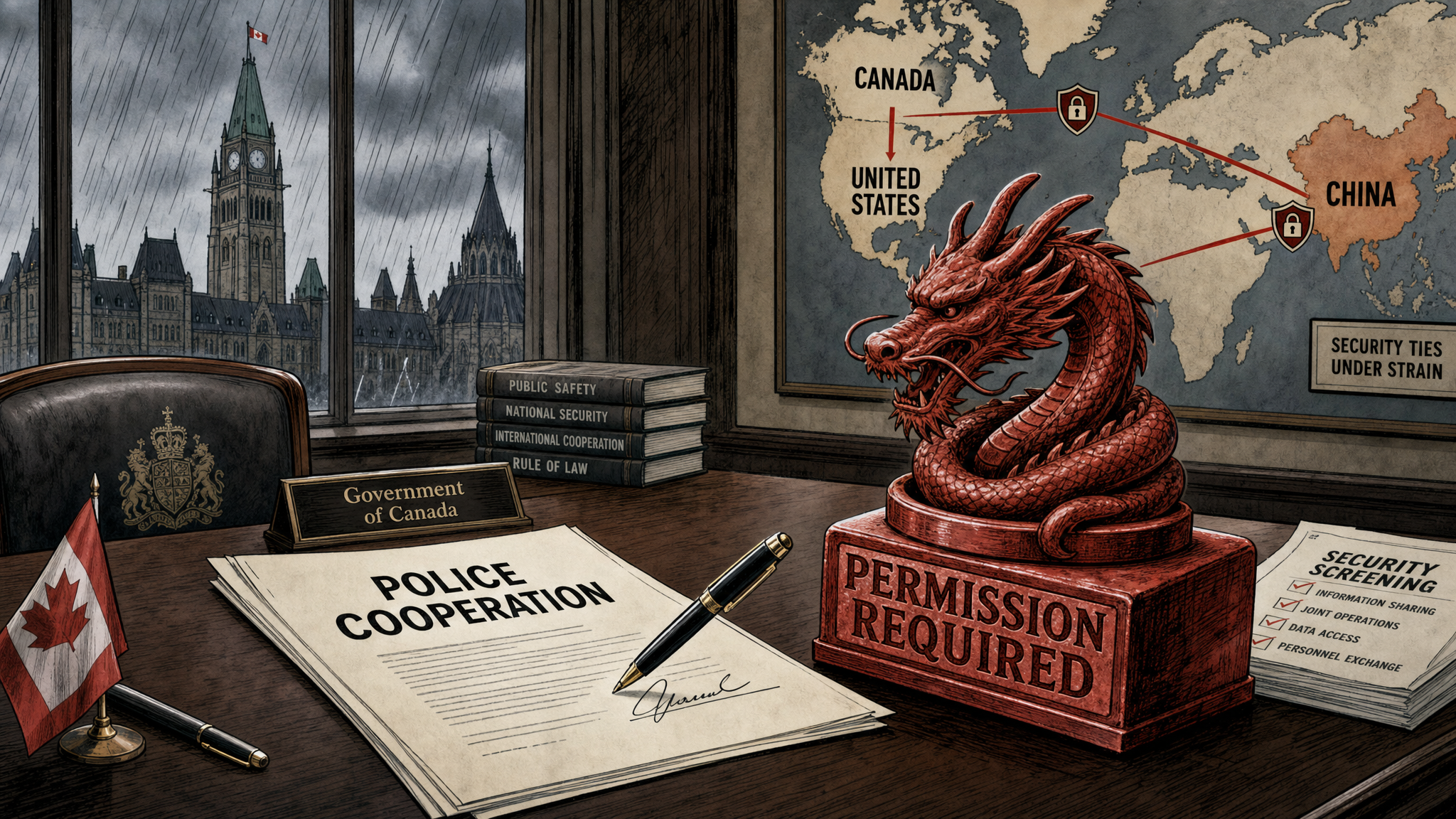
Canada has large communities with direct experience of Beijing’s pressure campaigns: Hong Kongers, Uyghurs, Tibetans, Taiwanese Canadians, Falun Gong practitioners, Chinese democracy activists, journalists, students and dissidents. These Canadians and residents do not hear “police cooperation with Beijing” as a neutral phrase. They hear it against years of warnings about transnational repression, intimidation, surveillance and pressure on families abroad.
The federal foreign-interference inquiry heard extensive evidence about interference threats from foreign states, including the PRC. CSIS has repeatedly warned that hostile foreign actors target Canadian institutions and communities. Global Affairs Canada briefing material in 2026 warned Parliament that China has continued to engage in foreign interference and transnational repression activities, while also presenting cyber and intelligence threats.
That is why this MOU has to be viewed through a stricter lens than ordinary law-enforcement cooperation. If the agreement permits information exchange, what prevents information about a Canadian resident, activist, witness, businessperson, student or family member from becoming useful to a foreign security apparatus? If the agreement includes technical training or operational coordination, what safeguards prevent Canadian resources from helping a hostile state refine methods that can later be used against diaspora communities?
The government may have good answers. If so, publish them.
While Ottawa asks Canadians to trust a hidden policing MOU with Beijing, Washington has treated Chinese transnational-policing activity as a direct threat to sovereignty. The U.S. Department of Justice prosecuted the operation of an undeclared Chinese government police station in New York. In 2024, a defendant pleaded guilty to acting as an illegal agent of the PRC in connection with that operation.
That case does not prove anything about the Canadian MOU by itself. But it proves something crucial about the security environment: democratic countries are not dealing with a normal foreign police partner. They are dealing with a state that Western law-enforcement and intelligence agencies have accused of reaching into diaspora communities abroad.
Washington’s national-security posture toward China is also hardening across defence, supply chains, technology and intelligence. The U.S. Department of Defense continues to identify the PRC as the pacing challenge for American defence planning. U.S. agencies have warned about PRC cyber operations targeting critical infrastructure. The strategic direction is clear: the United States is narrowing trust, hardening systems and protecting defence-industrial capacity from Chinese state leverage.
Canada is a Five Eyes intelligence partner and a NORAD defence partner. Our allies do not judge us only by speeches about sovereignty. They judge us by whether our systems can protect shared intelligence, critical infrastructure, police channels, defence procurement and diaspora communities from foreign-state compromise.
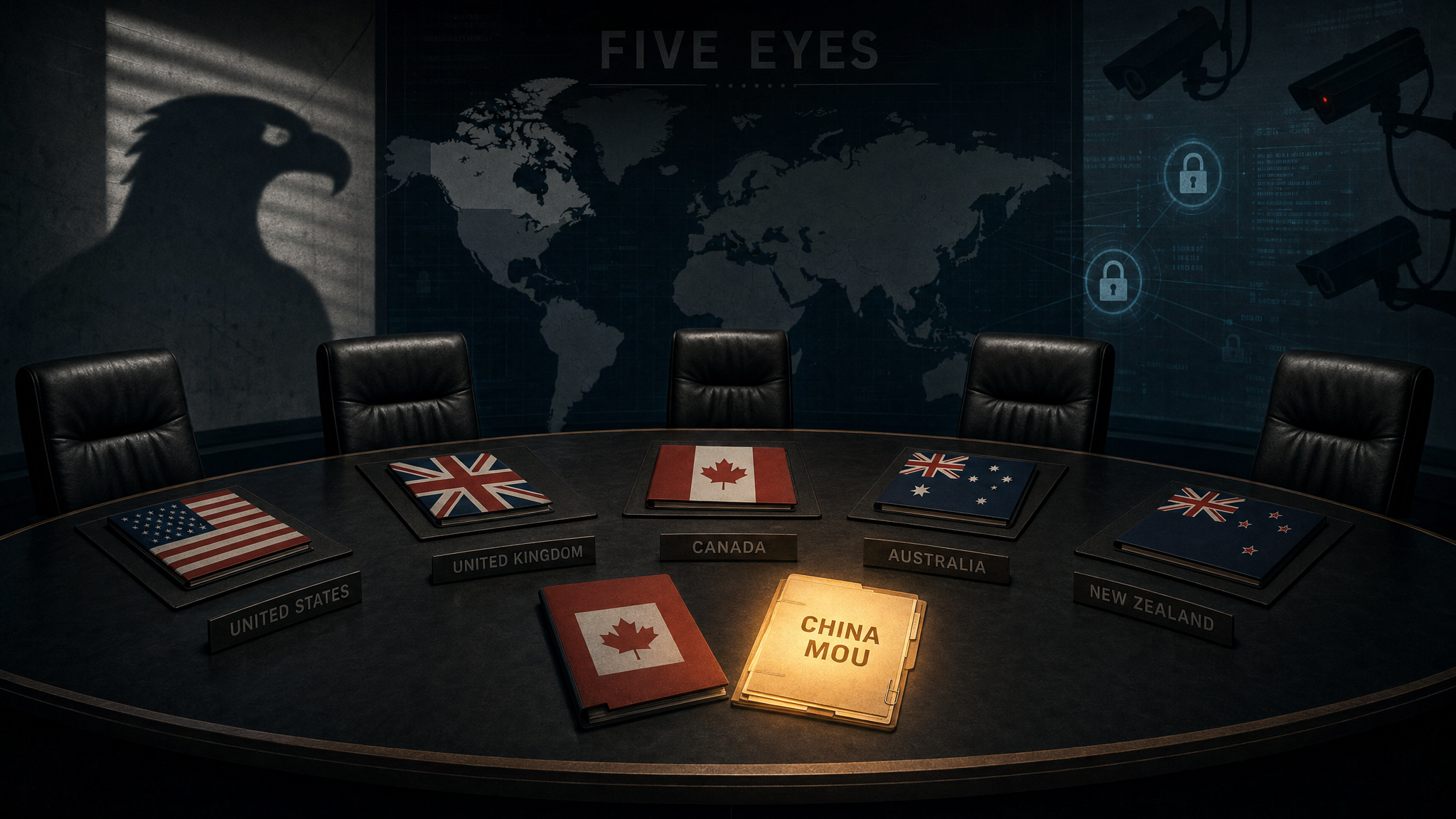
A serious investigation should not pretend to know what the hidden text says. It should identify the open doors the public cannot evaluate because the text is hidden. Here are the doors Ottawa has left open:
- The information-sharing door: Can personal information, travel history, financial intelligence, immigration-related data, criminal-intelligence leads or witness information be shared? Are Canadian citizens, permanent residents, refugees and asylum claimants treated differently?
- The political-offence door: Does the MOU explicitly exclude cases tied to speech, protest, national-security laws in Hong Kong, religious practice, democratic activism, labour organizing or criticism of the Chinese Communist Party?
- The diaspora-protection door: Are Hong Kong, Uyghur, Tibetan, Taiwanese, Falun Gong and dissident communities specifically protected from information exchange that could expose them or their families?
- The technical-assistance door: What does “technical expertise” mean? Does it include cyber tools, surveillance methods, forensic training, digital evidence, cryptocurrency tracing, AI tools or communications data?
- The fentanyl and organized-crime door: If cooperation is justified by narcotics, money laundering or organized crime, what prevents Beijing from using the same channel to request information on political enemies under the cover of criminal allegations?
- The oversight door: Who approves exchanges? Are they logged? Can NSIRA, Parliament, the Privacy Commissioner or courts review them? How often are requests denied?
- The disclosure door: Why should a confidentiality clause prevent Canadians from seeing the safeguards in a Canadian agreement affecting Canadian rights?
None of these questions requires conspiracy thinking. They are the minimum due-diligence questions any serious democracy should ask before trusting a police channel with an authoritarian security service.
Carney sells himself as the adult in the room: global financier, risk manager, steady hand. But risk management is not a biography. It is a practice. On China, the practice looks dangerously familiar: announce a strategic reset, ask for trust, release summaries, withhold the text, and tell Canadians the real details are too sensitive.
That does not meet the moment. Canada is already under pressure from foreign interference findings, diaspora-safety fears, cyber threats, defence-readiness doubts and strained alliance trust. A government that wants a “new strategic partnership” with Beijing has to explain where cooperation ends and national-security compromise begins.
The Liberals often accuse critics of being simplistic on China. Fine. Then answer the sophisticated questions. Publish the MOU. Publish the exclusions. Publish the oversight mechanism. Publish the number of requests received, granted and denied. Publish the human-rights test. Publish whether any Canadian data has already moved through the channel. Publish whether any request touched activists, journalists, religious minorities, Hong Kong national-security cases, Taiwan-related files or political speech.
If the answers are clean, transparency will help the government. If the answers are not clean, secrecy is exactly the problem.
The standard should be simple: Canada can cooperate with foreign police on genuine crime. Canada must not create a doorway for foreign political policing, diaspora intimidation, cyber leverage or alliance-risk exposure.
Before this agreement is allowed to operate behind closed doors, Parliament should demand a full public accountability package:
- The full RCMP–Ministry of Public Security MOU, with only narrow operational redactions justified line by line.
- A public legal opinion explaining how the agreement complies with the Charter, privacy law, refugee protection obligations and Canada’s human-rights commitments.
- A written exclusion for political offences, national-security-law prosecutions, speech, protest, religion, journalism and diaspora activism.
- A ban on sharing information that could endanger Canadians, residents, refugees, asylum claimants or their families abroad.
- Independent review by NSIRA, the Privacy Commissioner and a parliamentary committee with security clearance.
- Annual public reporting on request volume, subject matter, approvals, refusals, safeguards triggered and complaints.
- A suspension clause allowing Canada to halt cooperation immediately if Beijing engages in intimidation, illegal policing, cyber activity or bad-faith requests connected to Canada.
That is not anti-Chinese. It is pro-Canadian. Chinese Canadians and diaspora communities are among the people most exposed when Ottawa gets China wrong. Protecting them requires transparency, not secrecy dressed up as sophistication.
The bigger story is not that a Facebook video went viral. The bigger story is that Canada’s government may be trying to reopen doors with Beijing at the exact moment our allies are locking theirs, hardening theirs and checking who has the keys.
Carney says he understands risk. This is the test.
Canadians do not need wild claims to be worried. The verified facts are enough: a hidden policing agreement, a confidentiality barrier, a PRC security ministry, documented foreign-interference concerns, diaspora-safety fears and a Five Eyes alliance environment where trust has to be earned. Release the MOU.
- Prime Minister of Canada — Canada-China leaders’ joint statement, January 16, 2026: PMO statement
- Senate of Canada — National Finance Committee evidence on the RCMP-China MOU disclosure issue: Senate evidence
- The Canadian Press / InfoNews — “Public deserves answers on Canada-China policing agreement,” May 2026: CP report
- Conservative Party — demand to release the RCMP-PRC policing agreement: Caputo statement
- Global Affairs Canada — 2026 parliamentary briefing material on China, foreign interference, cyber and transnational repression: GAC briefing
- Public Inquiry into Foreign Interference — final report, January 2025: Final report PDF
- CSIS — annual public report and foreign-interference threat reporting: CSIS report
- U.S. Department of Justice — illegal PRC police station case in New York: DOJ release
- U.S. Department of Defense — China as the pacing challenge in U.S. defence planning: DoD report