Ethics Committee to Carney: Blind Trusts Are Not Enough
When a prime minister manages trillion-dollar policy decisions, Canadians need more than “trust me” and a blind trust label.
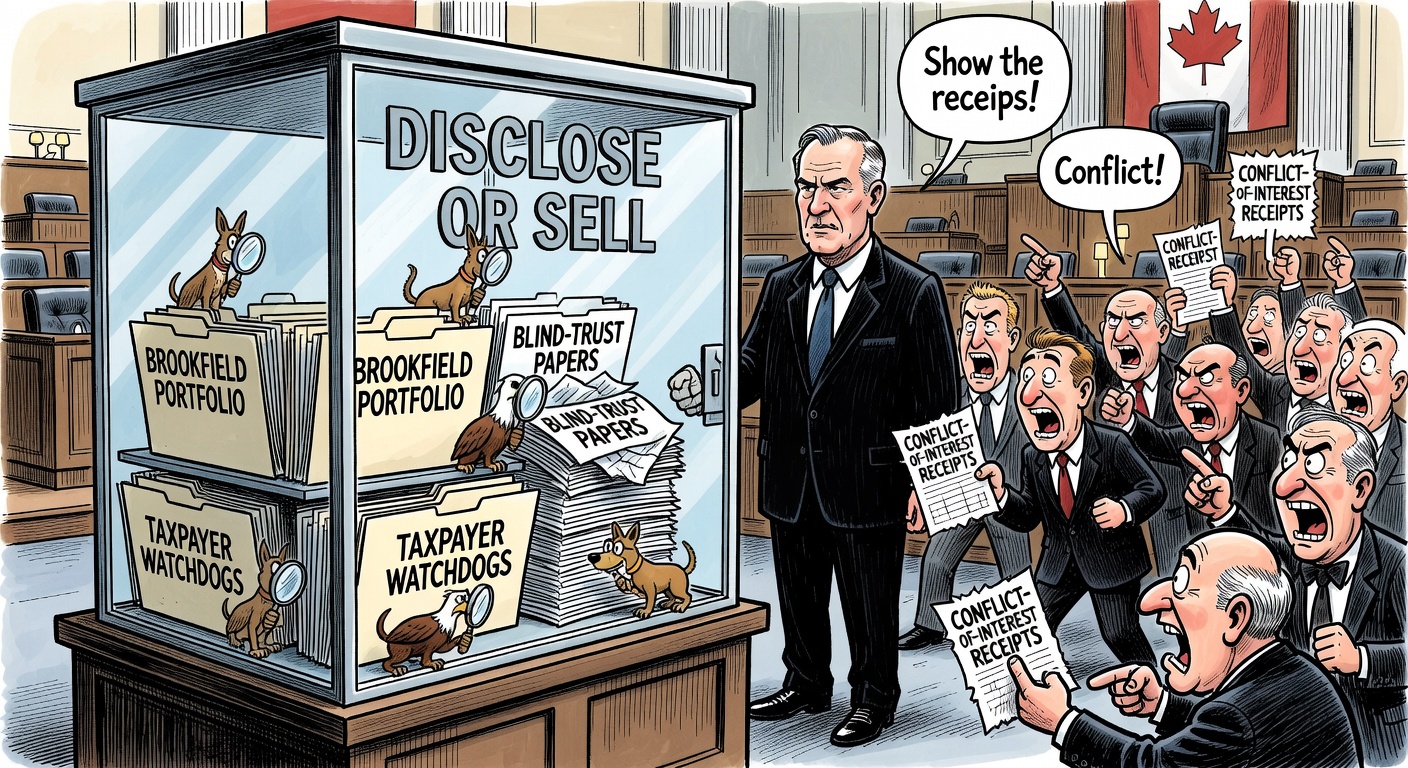
The House of Commons ethics committee has put the Carney conflict question in writing: for a prime minister, a blind trust is not enough.
In its Review of the Conflict of Interest Act, the committee recommends amending the law so that the prime minister, as a reporting public office holder, is fully divested from controlled assets through sale, because placement in a blind trust does not constitute true divestment. That is not a partisan slogan. It is a parliamentary ethics recommendation, and it lands directly on the central weakness in Mark Carney’s political brand.
Carney entered office after a career moving through Goldman Sachs, central banking, Brookfield and global climate-finance networks. None of that is illegal. Some of it is impressive. But it also means his government is now making decisions on infrastructure, electricity, industrial policy, carbon markets, public assets and investment funds while Canadians are asked to accept that conflict screens are working behind the curtain.
That is not good enough. A blind trust may hide the day-to-day management of assets, but it does not erase the public’s reasonable question: what industries, funds, counterparties or former associates could benefit from federal decisions?
The committee also pushed for stronger conflict-screen administration, including written logs, non-partisan public servants administering screens, and public disclosure of screens. That is exactly the minimum standard this government should meet before billions move through new capital programs.
The conservative accountability test is simple. Carney should publish the categories of assets placed in trust, the full list of recusals and screens, the public servants responsible for administering them, the dates when screened matters arose, and the policy areas covered. If there are legitimate privacy or market-sensitivity concerns, disclose categories and procedures. But do not ask Canadians to treat a black box as a firewall.
This matters because Ottawa is no longer just writing cheques. The Carney government is talking about public-private capital, strategic assets, energy corridors, electricity expansion and industrial funds. Those are precisely the files where private financial interests can intersect with public power.
The standard should be higher because the office is higher. Ministers can be replaced, departments can be audited, and programs can be cancelled. But a prime minister sets the whole direction of government, including which industries receive national attention and which projects become priorities.
The bottom line: if Carney wants to govern as the grown-up technocrat, he should meet the grown-up ethics standard. Sell what should be sold. Disclose what can be disclosed. Log every screen. Canadians should not have to wait for the next scandal to learn whether the firewall actually existed.