The Viral Allan Adam Post: What Checks Out, What Needs Proof
A forwarded post is blasting Chief Allan Adam over Alberta’s blocked separation petition. The insults are not the story. The public-record questions are.
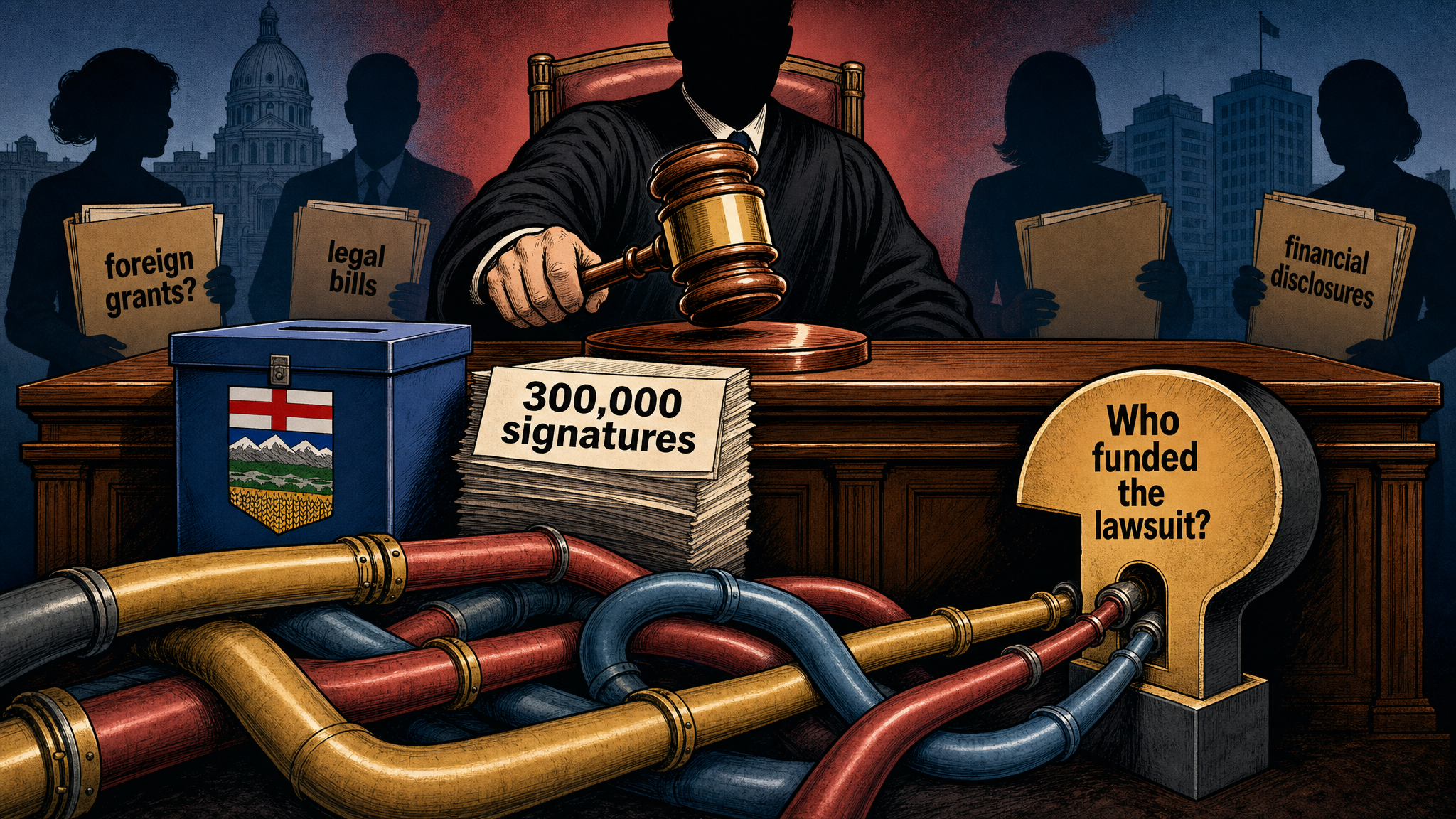
A viral post about Athabasca Chipewyan First Nation Chief Allan Adam is moving through social media with heavy language: “corrupt,” “traitor,” “foreign interference,” “scam.” That wording may feel satisfying to people angry about Alberta’s separation petition being stopped, but it is not the strongest version of the case.
The stronger version is simple: when litigation can stop more than 300,000 Alberta signatures from reaching a democratic vote, the public deserves clear disclosure of who paid, what interests were involved, and what the official financial record actually says.
What checks out
First, the court ruling is real. An Alberta judge quashed the separatist petition, finding the petition should not have been issued because Alberta failed to consult First Nations and because separation would affect treaty rights. Global News reported that the case was brought by lawyers for Athabasca Chipewyan First Nation and the Blackfoot Confederacy against Alberta, the Chief Electoral Officer and petition organizer Mitch Sylvestre.
Second, ACFN is not a tiny, broke organization. Its latest posted audited consolidated statements, for the year ended March 31, 2025, show $61.48 million in revenue, $50.17 million in expenditures, a $13.88 million annual surplus, $193.09 million in accumulated surplus and $167.89 million in net financial assets. The same statements list $21.84 million in industry contributions and $9.68 million from Indigenous Services Canada.
Third, the 33-person claim is misleading but not invented. Federal First Nation Profiles list ACFN’s registered population in the 1,500-plus range, with 20 registered males and 13 registered females “on own reserve.” That does not mean only 33 people are members. It means the accurate question is why a First Nation with a small on-reserve population and significant financial capacity was able to help stop a province-wide petition before voters ever saw a ballot.
Fourth, the Tides-linked record exists — but it must be stated carefully. Public charity filings available through ProPublica/IRS records have been reported as showing Tides Foundation support connected to 850450 Alberta Ltd. for climate/tar-sands activity. ACFN’s own consolidated statements list 850450 Alberta Ltd. as part of the First Nation’s consolidated reporting entity. That is a fair public-interest fact pattern.
What needs proof
The viral post says money was wired “directly to Chief Allan Adam’s bank account.” We are not repeating that as fact. The public record reviewed so far supports questions about an ACFN-linked entity and anti-oilsands advocacy, not proof that Adam personally received a bribe or that the 2026 court case was foreign-funded.
The post also treats the 2020 RCMP incident as closed and fully exonerating the police. That is not the cleanest summary either. Charges against Adam were dropped in 2020, RCMP publicly defended the arrest as within guidelines, and APTN reported in September 2024 that the ASIRT investigation was still open. That episode is not necessary to the referendum-funding question, and dragging it in weakens the argument.
The National Post / Teck Frontier allegations also need careful handling. There is a long public record of ACFN fighting oilsands projects while also negotiating benefit agreements with industry. That may look contradictory. It does not automatically prove “opposition was for sale.” The defensible accountability point is narrower: Canadians deserve to know when environmental objections, industry contributions, benefit agreements and political litigation overlap.
The question CBC should have asked
If Chief Adam appeared on national media to celebrate the ruling as a win for democracy, the obvious follow-up should have been:
- Who paid the legal bills for the court application?
- Were outside charities, foundations, legal funds or activist groups involved?
- Were any foreign-funded entities involved directly or indirectly?
- Why are recent chief-and-council remuneration schedules still not posted on the federal transparency portal for 2021–22 through 2024–25?
- What exact consultation standard must Alberta meet before citizens can vote on a province-wide question?
Those questions are not anti-Indigenous. They are not anti-treaty. They are not pro-separation. They are basic democratic-accountability questions.
The Carney problem
This matters far beyond one Alberta petition. Mark Carney says Canada can build big projects, energy corridors and national infrastructure. But the same legal and funding opacity that stopped this petition can also stop pipelines, mines, power lines, roads and ports.
If Ottawa, the courts and the funded activist ecosystem can create a process where nobody knows the rules until after the project is dead, then Carney’s “build Canada” promise is just another slogan. Canada needs treaty respect and democratic clarity — not vague consultation rules, undisclosed legal financing and media interviews that skip the money trail.
Bottom line: do not share the sloppy version. Share the sourced version. The issue is not name-calling. The issue is disclosure. Who paid? Who benefits? What records are missing? And why were hundreds of thousands of Alberta signatures stopped before voters ever reached the ballot box?
Sources reviewed include Global News / Canadian Press reporting on the Alberta ruling; Indigenous Services Canada First Nation Profiles and ACFN financial disclosure records; ACFN’s March 31, 2025 audited consolidated financial statements; ProPublica’s Tides Foundation Form 990 archive; Washington Examiner reporting that summarized the older Tides allegation while relying on Toronto Sun commentary; APTN reporting on the 2020 RCMP/ASIRT file; and ACFN public statements on Alberta secession litigation. This article does not allege bribery, personal payment to Chief Adam, or foreign funding of the 2026 litigation. The unresolved issue is transparency.
Global News / CP court report · ISC ACFN financial disclosures · ACFN 2024–25 audited statements · ISC registered population · ProPublica Tides Foundation filings · Washington Examiner summary of Tides allegation · APTN on RCMP/ASIRT file.