Carney’s Pesticide Rewrite Gives Cabinet a Science Override
If Ottawa can invoke “economic security” to override pesticide-risk decisions, Canadians need the evidence, definitions and safeguards before Parliament votes.
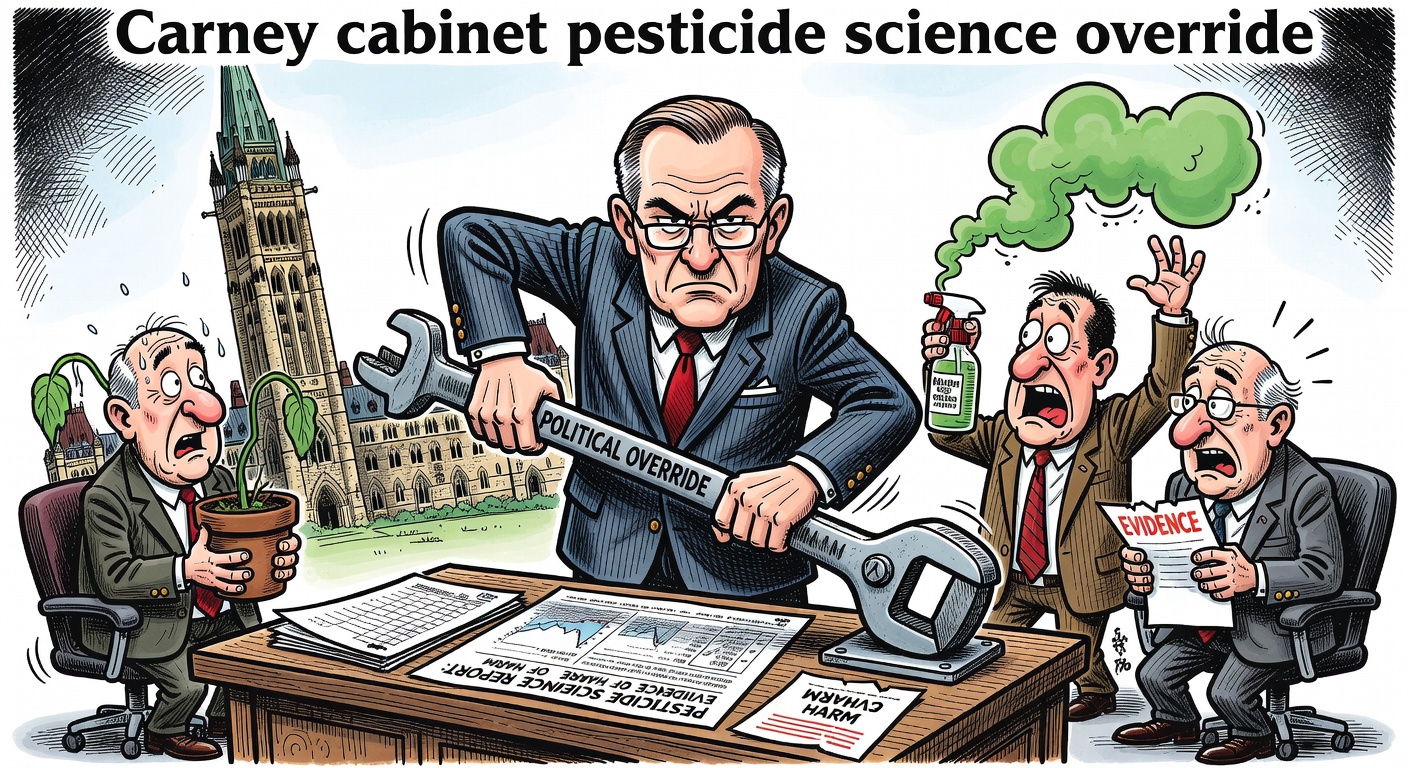
The Carney government’s pesticide-law overhaul deserves a simple conservative test: who is accountable when political convenience outranks the safety review?
Toronto Star columnist Althia Raj reported Saturday that Ottawa is bringing sweeping changes to the Pest Control Products Act through two omnibus financial bills, warning that the changes could make it harder for government to ensure air, water and food are protected from dangerous toxins. National Newswatch’s index of the column summarizes the same core concern: the provisions are buried in budget legislation and would overhaul the pesticide law.
Ecojustice, an environmental law organization, says Bill C-30 would empower Cabinet to issue emergency, economic-security or food-security orders that override science-based decisions by the Minister of Health and permit use of a pesticide despite a finding that environmental risks are unacceptable. It also says the bill would require the minister to consider national economic security, regional economic security or national food security when making pesticide decisions, while leaving those terms undefined.
That is the accountability problem. “Economic security” can be a real public interest. Farmers need workable tools. Food supply chains matter. Canada should not regulate by activist slogan. But if the law lets Cabinet override an unacceptable-risk finding, the burden should be on ministers to show the evidence in public, define the emergency, name the affected product, disclose the risk tradeoff and set an expiry date.
Health Canada’s own May 2026 ministerial briefing materials point in the same policy direction. They describe work to better integrate economic considerations, reduce red tape and move the Pest Management Regulatory Agency away from a mandatory 15-year cyclical re-evaluation model toward a risk-based post-market approach. Those phrases may sound bureaucratic, but they matter. A mandatory re-check creates a public backstop. A discretionary risk-based system depends much more heavily on the judgment, resources and transparency of the regulator.
The Liberal response will be to say this is modernization. Maybe some parts are. But modernization is not a blank cheque for Cabinet power, especially when the changes are attached to omnibus fiscal bills instead of a stand-alone health and environment debate. Canadians should not have to read budget implementation legislation to discover who gets the final word on pesticide risk.
Conservatives should keep the critique factual and defensible. This is not an argument to ban every pesticide or ignore food security. It is an argument for parliamentary scrutiny, plain-language definitions, public reasons, independent science and mandatory reporting whenever ministers override health or environmental risk findings.
If Carney wants to put the economy into pesticide approvals, he should say exactly how far that principle goes. The food Canadians eat, the water they drink and the farms that feed the country all deserve better than a quiet science override hidden in an omnibus bill.
Toronto Star / Althia Raj: Mark Carney’s pesticide policy could put the economy ahead of your health; National Newswatch: Althia Raj article index and preview; Ecojustice: major overhaul of pesticide law in omnibus legislation; Health Canada: May 2026 ministerial briefing book; OpenParliament: Bill C-30 debates and text index.