Carney’s Weak Spot: Hope Without Household Proof
The Elevate Report is right about one thing: anti-Liberal anger alone is not enough. Carney is vulnerable when his “hope” language meets household bills and hard policy proof.
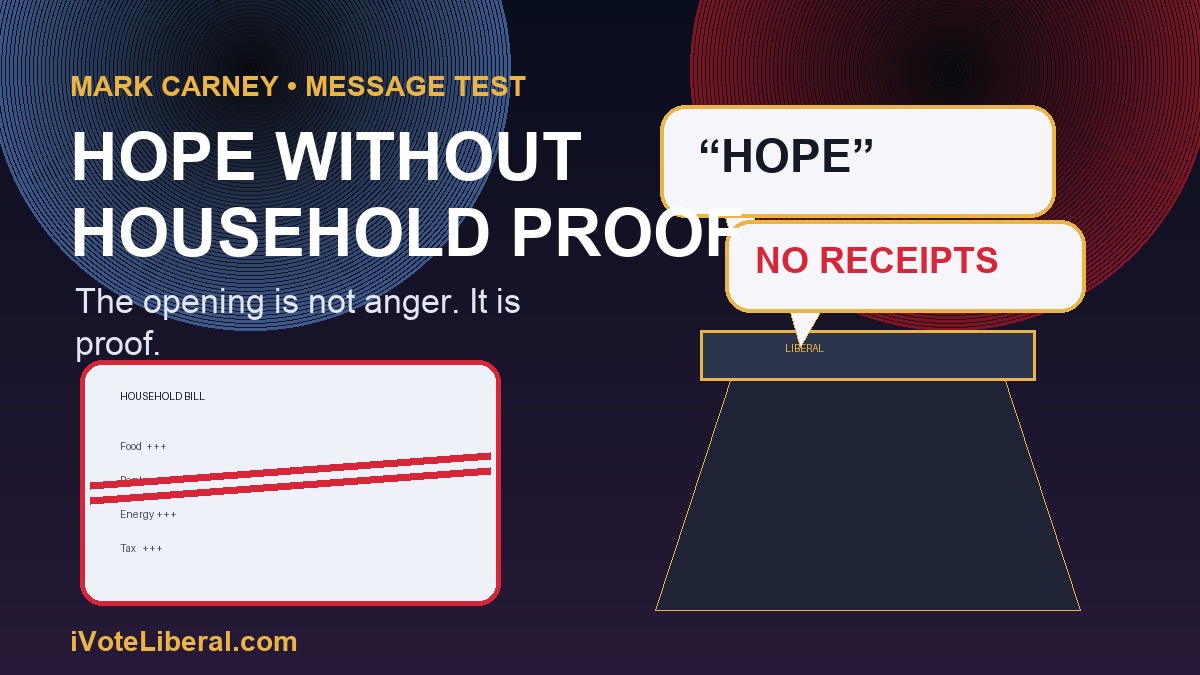
The Elevate Report’s latest video, This Could Be the END for Mark Carney, makes a useful strategic point for anyone trying to hold the Liberals to account: voters do not move just because an opposition party says “no.” They move when criticism is paired with a hopeful, practical alternative that touches daily life.
That matters because Carney’s own political brand leans heavily on seriousness, competence and future-facing language. In recent speeches he has used lines like “hope is not a strategy” and “hope is not a plan” to present himself as the adult in the room. The weakness is obvious: if hope is not enough, then neither are Carney’s slogans. He has to show receipts.
And right now, the receipts are where the opening is.
Carney is talking about energy deals while a pipeline agreement is tied to industrial carbon pricing. He is talking about infrastructure while opening the door to selling public assets like airports and ports. He is talking about a clean electricity buildout while Canada faces a multi-decade grid expansion challenge. He is talking about security while Bill C-22 raises serious privacy and encryption questions.
The mistake would be to answer all of that with generic “just another Liberal” messaging. That line may satisfy people who already agree, but it does not explain to a young renter, a parent buying groceries, a small business owner, or a worker in Atlantic Canada how life gets better.
The stronger message is simple: Carney’s promise is not the standard. Household proof is the standard.
If Ottawa says a pipeline is coming, show the permits, dates, route certainty and carbon-price cost. If Ottawa says asset sales are responsible finance, publish the valuation, buyer rules, foreign-control limits and user-fee protections. If Ottawa says Bill C-22 is not an encryption backdoor, write that protection directly into the law. If Ottawa says a doubled electricity grid will lower costs, show the bill by province and by household.
That is where the opposition can turn frustration into persuasion. Not just “Carney is bad.” Rather: “Here is what Carney promised, here is what it will cost, here is what he has not proven, and here is the better path.”
The Elevate Report’s bigger point is that politics needs a positive destination. Fair. But the positive destination cannot be vibes. It has to be measurable relief: lower bills, safer streets, protected privacy, faster projects, credible budgets and a government that cannot hide big costs behind polished speeches.
Carney’s vulnerability is not that he sounds serious. It is that seriousness without proof becomes theatre. The answer is not more shouting. It is a receipt-by-receipt campaign that forces the Liberals to defend the gap between their language and Canadians’ lives.
The Elevate Report: This Could Be the END for Mark Carney; Liaison Strategies: Federal Tracker shows Liberal lead but Carney approval slide; CityNews / Canadian Press: Carney-Smith energy announcement and industrial carbon pricing; AP: Carney electricity grid strategy; Public Safety Canada / Justice Canada references used in our Bill C-22 coverage.