Carney’s Pipeline Bargain Comes With a Carbon-Price Invoice
Carney’s pipeline reset with Alberta is tied to industrial carbon pricing. Canadians should ask whether this is real project certainty or another carbon-price bargain with no permit attached.
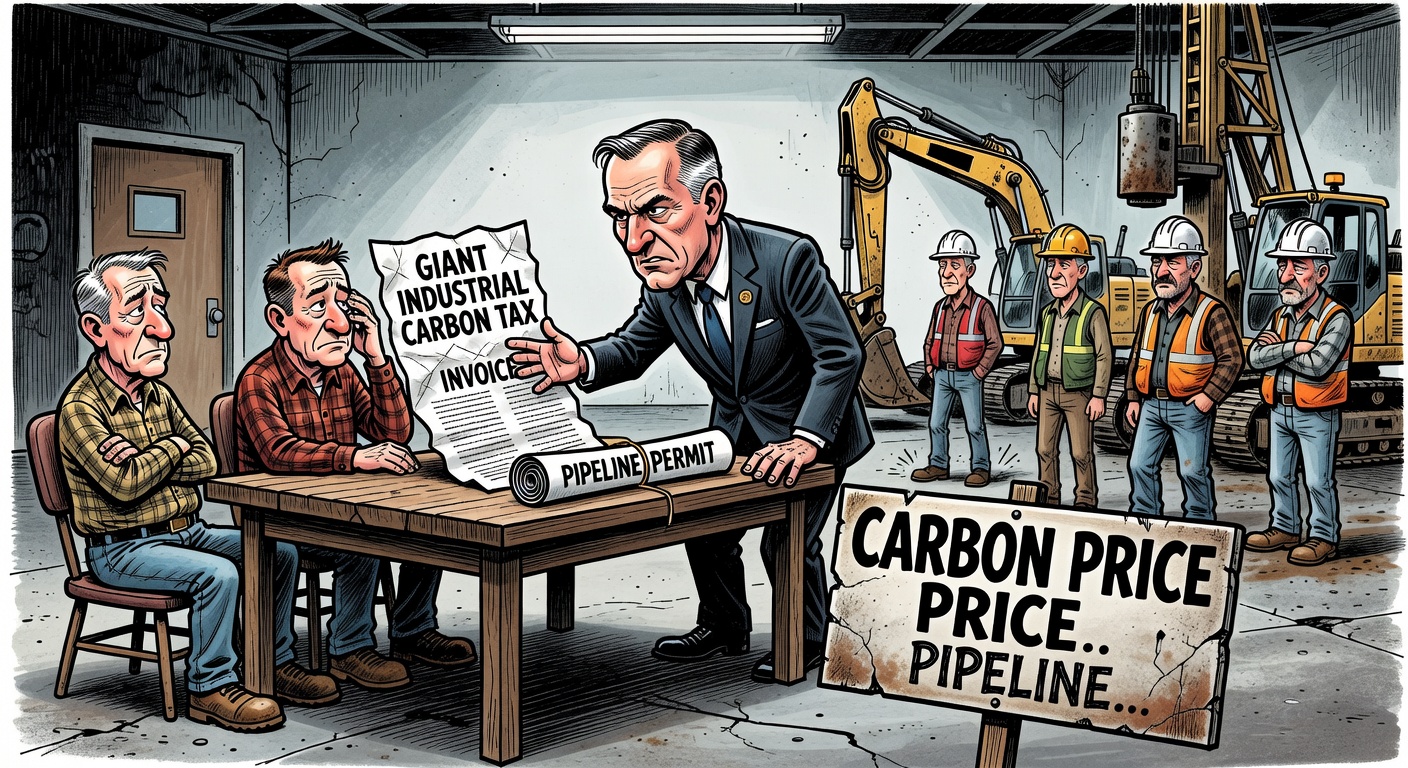
Mark Carney wants Western Canada to believe Ottawa has changed. The test is whether he delivers a pipeline — or merely sells Alberta a carbon-price invoice with a press conference attached.
Canadian Press reporting says Carney and Alberta Premier Danielle Smith are in Calgary to announce the next step in their energy pact. The announcement is expected to include an implementation agreement on industrial carbon pricing and to advance a potential pipeline to the West Coast. A source cited in the reporting said the industrial carbon emissions price could reach $130 per tonne by 2040.
Reuters reporting, carried by MarketScreener and energy outlets, described the deal as a new Alberta industrial carbon-pricing framework, with the price rising from the current $95 per tonne and eventually escalating after 2036. National Post reporting summarized the bargain bluntly: Alberta unfreezes its industrial carbon tax in exchange for Ottawa moving on a new oil pipeline and relaxing other federal climate rules.
That is the political trade. But Canadians should separate three things: a tax trajectory, a memorandum of understanding, and an actual built pipeline. They are not the same.
Western workers do not need another symbolic “reset.” They need permits, timelines, financing, Indigenous equity options, tanker-ban clarity, environmental-review certainty, and a route that survives court challenge. Investors need to know whether Ottawa is serious enough to remove the barriers that helped make Canada uncompetitive in the first place.
The industrial carbon price is the tell. Carney eliminated the consumer carbon tax because it became politically toxic, but the Liberal climate machine did not disappear. It moved deeper into industrial pricing, regulation, clean electricity rules, emissions caps, tax credits and government-controlled investment vehicles. The cost is less visible at the gas pump, but it still moves through the economy — into power bills, project economics, and the competitiveness of Canadian industry.
If Ottawa is truly abandoning the old Trudeau approach, it should say so plainly. If it is only trading one carbon framework for another while calling it “nation-building,” Canadians deserve to know that too.
The public also deserves a fairness test. If Alberta receives a special federal deal, what happens to Saskatchewan, British Columbia, Ontario and Atlantic Canada? Canadian Press noted that equal treatment across jurisdictions matters under federal carbon-pricing law. One province’s bargain can quickly become every province’s precedent.
There is a pro-growth version of this story: Ottawa and Alberta finally agree to build, Indigenous partners gain equity, a West Coast route opens Asian markets, and Canada stops landlocking its own resources. Conservatives should welcome real movement if it produces real steel in the ground.
But the accountability version is just as important: no more Liberal announcements where the tax is certain and the pipeline is hypothetical.
Carney should publish the full agreement, the carbon-price schedule, the pipeline decision path, the regulatory exemptions, the expected project timeline, and the conditions that could still kill the project. If Ottawa wants credit for building, it should accept scrutiny before collecting another dollar through industrial carbon pricing.
Canada needs pipelines. It does not need another Liberal invoice dressed up as courage.
Canadian Press / CityNews: Carney, Smith confirm energy announcement coming Friday; Reuters via MarketScreener: Industrial carbon pricing deal details; National Post feed: Pipeline pact and industrial carbon tax plan; Reddit discussion: Public reaction to pipeline/carbon-pricing reports.