Four Justice Bills Were Defeated. Canadians Deserve the Vote Record.
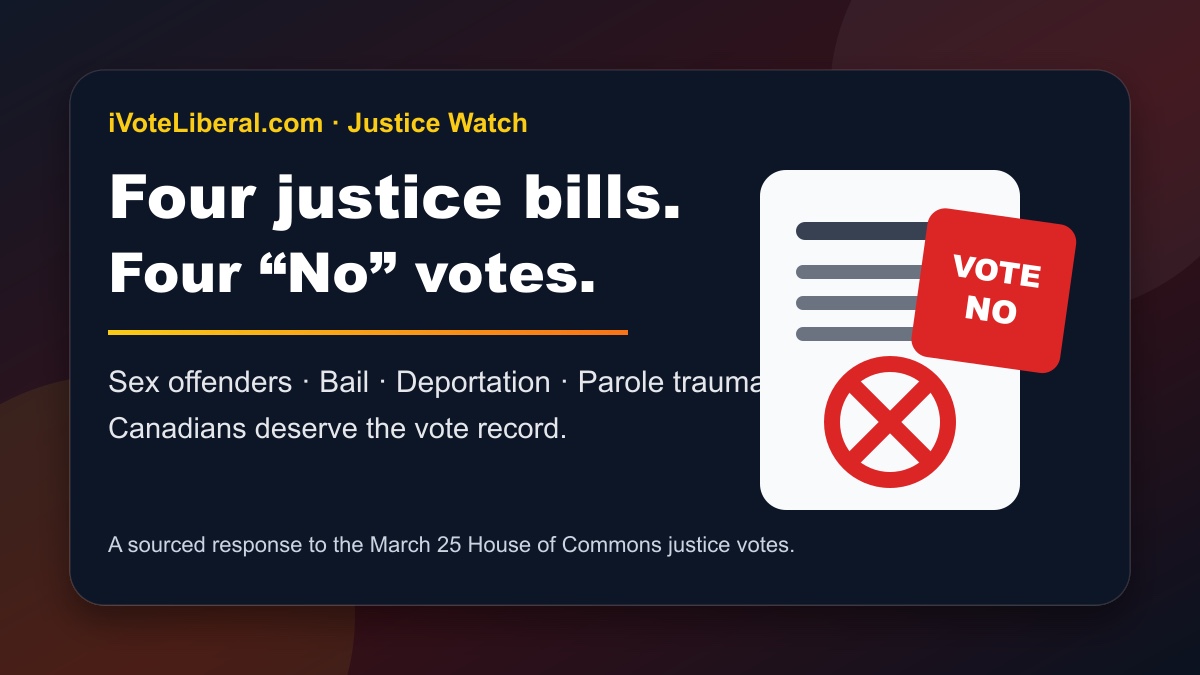
A viral TikTok from Protect Your Cubs is blunt and angry. The official House vote record is just as serious: four justice-focused bills were defeated, one after another.
Canadians hear a lot of speeches about public safety. They hear the government say it cares about victims, families, women, children, newcomers, communities and the rule of law. But speeches are not the record. Votes are the record.
On March 25, 2026, the House of Commons voted on a series of Conservative justice measures. The bills dealt with consecutive sentencing for sexual predators, deportation consequences for serious non-citizen offenders, parole hearing trauma for murder victims’ families, and bail reform for repeat violent offenders.
All four were defeated.
That should not disappear into parliamentary fog. If MPs believe these proposals were flawed, they should explain the flaws plainly. If they had better amendments, they should put them forward. But Canadians should not be asked to accept another round of soft-on-crime slogans while the vote record says something very different.
1. Bill C-246: consecutive sentences for sexual offences
Bill C-246 proposed Criminal Code amendments dealing with sentencing for sexual offences. In plain English, the goal was to make sure multiple offences against victims could be recognized with consecutive sentencing rather than blended into a single punishment that families see as too lenient.
The official House record shows the bill was defeated at second reading. The result: 157 yeas, 169 nays, 10 paired.
For victims and parents, this is the one that cuts deepest. If a predator commits multiple offences, each offence should matter. Each victim should matter. Each crime should be recognized by the justice system as more than a line item in a negotiated outcome.
2. Bill C-220: serious crimes and immigration status
Bill C-220 dealt with sentencing and non-citizens convicted of serious crimes. Its political message was simple: Canada should not bend sentencing outcomes in ways that let serious offenders avoid immigration consequences because of how a sentence is structured.
The official House record shows the bill was defeated at second reading. The result: 158 yeas, 171 nays, 10 paired.
Canadians are generous. They welcome people who come here to build, work, study, raise families and respect the country. But generosity is not weakness. If someone who is not a citizen commits a serious crime, the public is entitled to expect consequences that protect Canadians first.
3. Bill C-243: parole hearings and murder victims’ families
Bill C-243 addressed parole review timing for people convicted of first or second degree murder. The argument behind the bill is that families of murder victims should not be forced back into traumatic parole proceedings year after year without stronger protection from repeated emotional harm.
The official House record shows the bill was defeated at second reading. The result: 136 yeas, 192 nays, 10 paired.
This is not abstract policy. For families of murder victims, a parole hearing is not paperwork. It is a reopening of the worst day of their lives. If Parliament will not change the law, MPs owe those families a better answer than procedural language.
4. Bill C-242: “Jail Not Bail”
Bill C-242, branded by supporters as “Jail Not Bail,” proposed changes aimed at repeat violent offenders and bail rules. Canadians have seen too many stories of violent accused people released, re-arrested, released again, and then linked to another victim.
The official House record shows the bill was defeated at second reading. The result: 136 yeas, 193 nays, 10 paired.
The public-safety question is not complicated: when someone has shown a pattern of serious violence, why should the system’s default concern be the offender’s convenience rather than the community’s safety?
The bigger problem
Not every private member’s bill is perfect. Some are drafted too broadly. Some raise constitutional questions. Some need committee work. That is what Parliament is for.
But voting down one justice bill after another sends a message. It tells Canadians that the people who run the system are more worried about legal theory than lived reality. It tells victims’ families that their trauma will be acknowledged in speeches, then parked when the vote bell rings. It tells parents that the justice system still has not learned the difference between compassion and weakness.
Prime Minister Mark Carney’s Liberals cannot claim to be restoring order while refusing to move on basic justice reforms. If the answer is always no, Canadians deserve to know what the government’s actual plan is — not another press conference, not another task force, not another “whole-of-government” slogan.
Four bills. Four defeats. Four reasons for Canadians to check the vote record themselves.
Because public safety is not measured by what politicians say after a tragedy. It is measured by what they vote for before the next one.
Protect Your Cubs public TikTok, March 25, 2026; House of Commons recorded divisions, March 25, 2026: Vote No. 88 on Bill C-246; Vote No. 89 on Bill C-220; Vote No. 90 on Bill C-243; Vote No. 91 on Bill C-242; LEGISinfo bill pages for C-246, C-220, C-243 and C-242.