Parliament Should Not Rubber-Stamp Carney’s $230.4B Spending Ask
The PBO says Ottawa is asking Parliament to approve $230.4 billion in voted spending. Before MPs say yes, Canadians deserve line-by-line transparency on central votes and defence-security buckets.
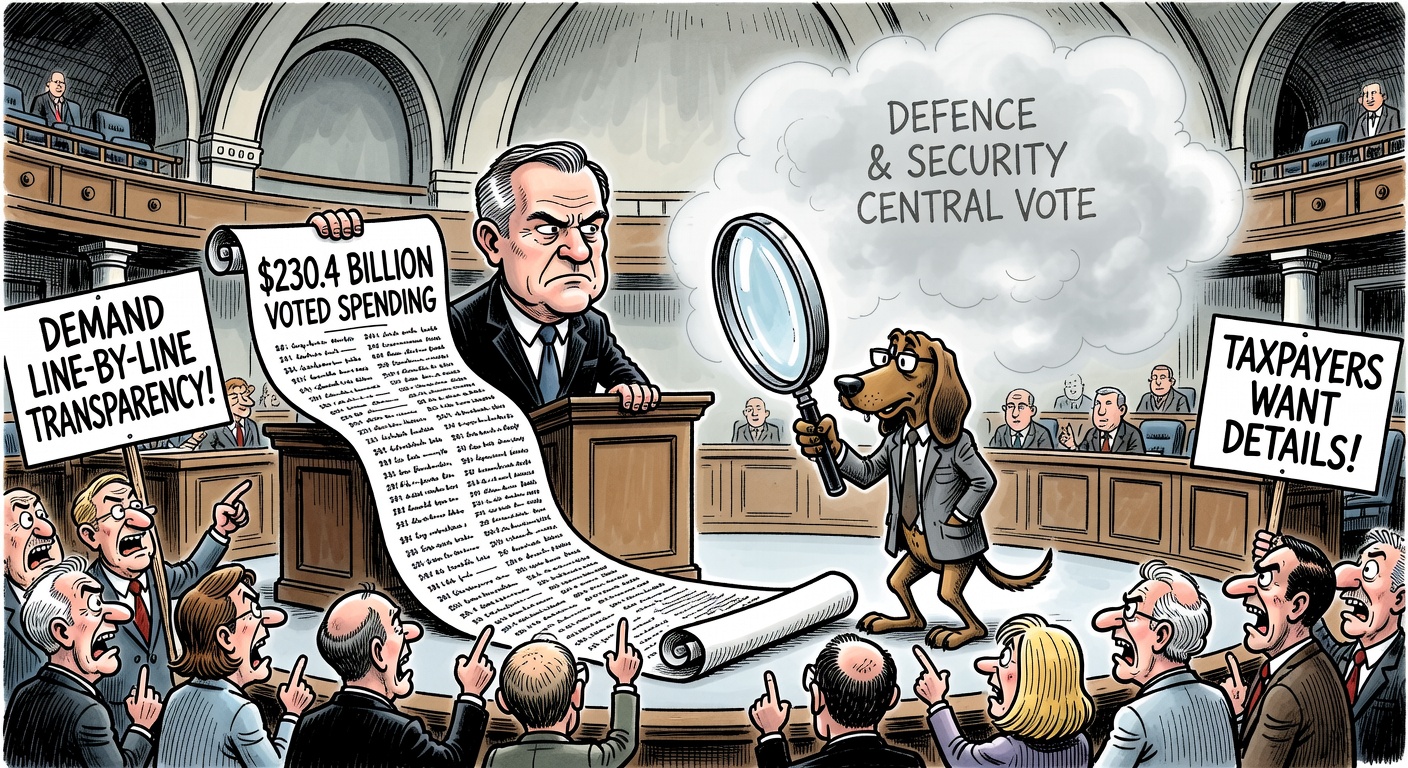
The Parliamentary Budget Officer has put a hard number on Ottawa’s next spending ask: the 2026-27 Main Estimates support an appropriation bill seeking Parliament’s approval for $230.4 billion in voted budgetary authorities.
That is exactly why this story matters. A government can call spending “investment,” “security,” or “Canada Strong,” but Parliament’s job is not to approve branding. Parliament’s job is to examine the ask, test the details, and decide whether taxpayers are getting value for money.
The PBO’s May 7 analysis says the Main Estimates also report $272.4 billion in statutory expenditures that already flow under other laws. In plain English, MPs are being asked to approve the voted portion while hundreds of billions more are moving through the fiscal machine automatically. That makes the visible vote even more important, not less.
The biggest accountability flag is buried in the machinery of “central votes” — money administered through the Treasury Board before departments receive it. The PBO identifies major central-vote increases, including defence and security funding, contingencies, and the refocusing-government-spending fund. Defence and security can be legitimate priorities. Conservatives should support a serious military rebuild. But serious national security does not require vague buckets that make it harder for Parliament to see who receives the money, on what timeline, and under which measurable deliverables.
The same report notes that public debt charges are rising too, reaching $53.7 billion, up $4.7 billion compared with all 2025-26 Estimates to date. That is the cost of a decade of treating debt like a political inconvenience instead of a real bill. Interest is now one of Ottawa’s biggest programs, and it buys Canadians nothing new.
There is also a timing problem. Because this is an election year, the PBO notes there is no fixed budget date under the Standing Orders. That means MPs are being asked to study spending plans while the larger budget picture is less predictable than usual. The answer is not to rubber-stamp faster; it is to demand clearer documentation before the vote.
The Carney government should publish a line-by-line table for every central vote above $100 million, identify the department expected to receive each transfer, disclose whether the money is operating or capital spending, and commit to quarterly public reporting. If the government wants trust, it can start with receipts.
Conservative accountability does not mean opposing every dollar. It means refusing to let billions disappear into soft labels and central pools. Parliament should not approve a $230.4 billion ask until Canadians can see the plan.
Parliamentary Budget Officer: news release on the 2026-27 Main Estimates; Parliamentary Budget Officer: full report, The Government’s Expenditure Plan and the Main Estimates for 2026-27.