Release the RCMP-China Police Pact Before Asking Canadians to Trust It
If Ottawa says China is a national-security risk, why is a police-cooperation pact with Beijing’s security ministry still hidden from the people most exposed to intimidation?
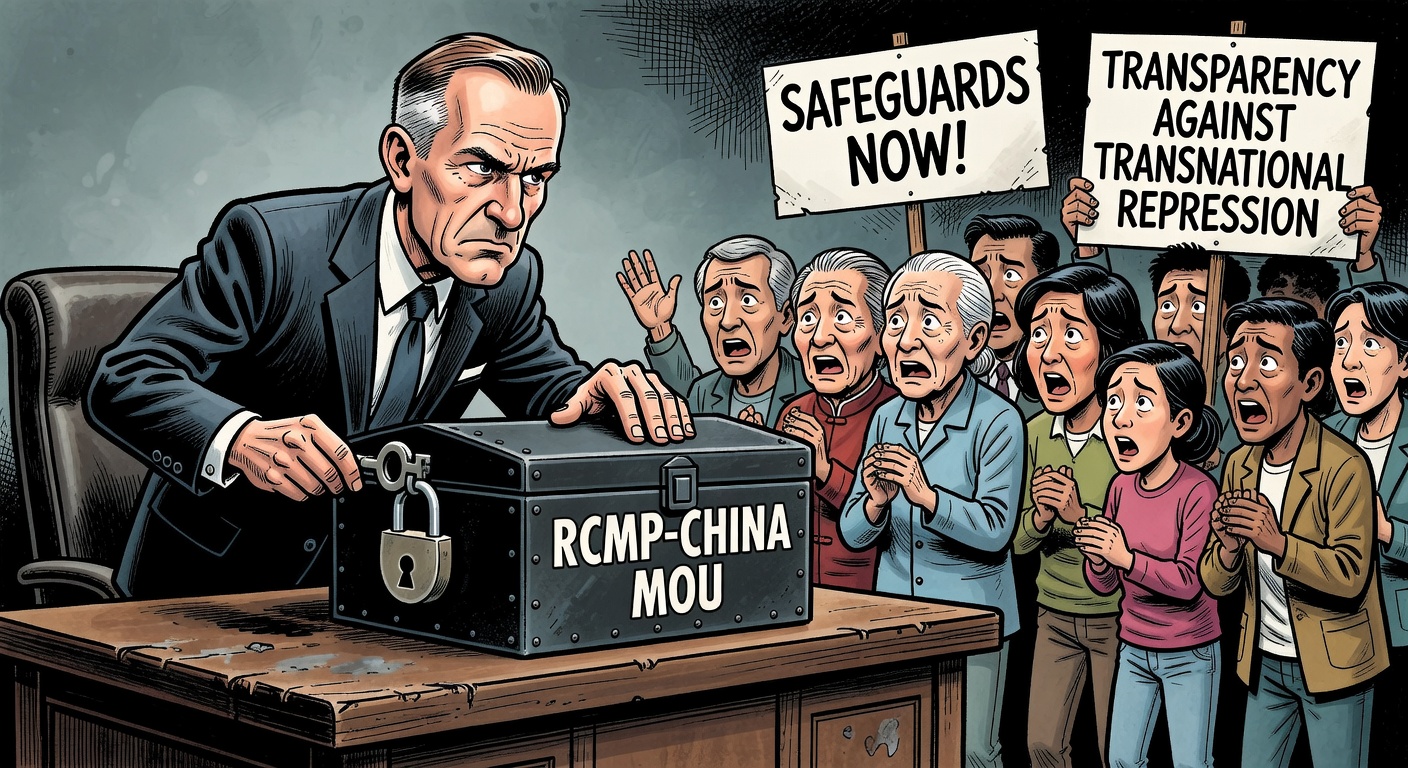
The Carney government has a simple China problem: it keeps asking Canadians to trust secret arrangements while the public record keeps warning that Beijing uses state power far beyond its borders.
The latest flashpoint is the RCMP memorandum of understanding with China’s Ministry of Public Security. The Bureau reported May 11 that national-security voices at the Canada Strong and Free conference questioned the government’s direction on China, including the police-cooperation MOU. The concern is not abstract. China’s Ministry of Public Security is not a neutral police service operating inside a liberal democracy. It is part of an authoritarian state that Canadian security agencies and diaspora communities have repeatedly linked to foreign interference, intimidation and transnational repression.
That is why the unanswered questions matter. On February 12, Hong Kong Watch and nine other diaspora organizations publicly warned that the MOU’s lack of transparency had created fear and uncertainty among Hong Kong communities in Canada. Their request was not radical. They asked Ottawa to release the full text, explain the scope, identify safeguards and show that any crime-fighting cooperation would not expose Canadians or residents to surveillance, intimidation or political targeting.
That should be the minimum standard in a free country. Police cooperation with a foreign government is sensitive even when the partner is a trusted ally. With Beijing, the bar has to be higher. Canadians of Hong Kong, Uyghur, Tibetan, Taiwanese, Falun Gong and mainland Chinese dissident backgrounds have real reasons to ask whether information-sharing, liaison work or joint investigative channels could be misused.
The government may have answers. Perhaps the MOU is narrow. Perhaps it excludes political offences, human-rights cases, diaspora monitoring and any exchange that could put people in danger. Perhaps RCMP officers have written instructions and audit trails. If so, publish the text and the safeguards. If not, suspend the arrangement until Parliament and affected communities can see what was signed in their name.
This is where conservative accountability should be clear. Public safety does require international cooperation against fraud, trafficking, fentanyl, cybercrime and organized crime. But national security also requires sovereignty, transparency and a government willing to say no when cooperation creates leverage for hostile states.
Carney cannot campaign as the sober manager of risk while leaving diaspora Canadians to wonder what Ottawa has promised China’s police ministry. The demand is modest: release the MOU, publish the safeguards, and let Parliament test whether this agreement protects Canadians — or merely asks them to trust another Liberal black box.
The Bureau: Op-ed on Carney, China policy and the RCMP–MPS MOU; Hong Kong Watch: diaspora groups raise concerns; Diaspora coalition statement: statement on RCMP-China Ministry of Public Security MOU.