Carney Says Deeper U.S.-Mexico Integration Is on the Table — Which Sectors?
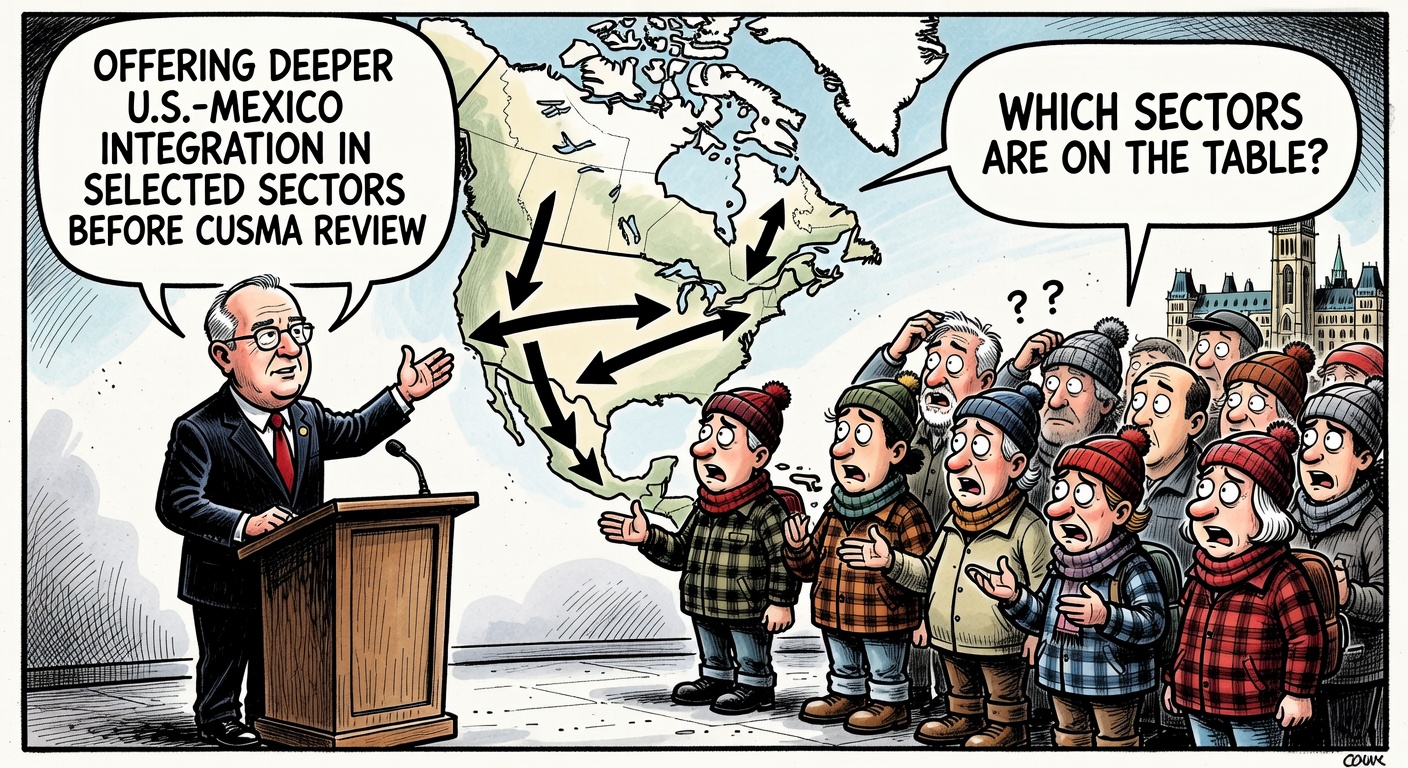
The Prime Minister campaigned as the man who would stand up to Washington. Now he says Canada is open to deeper continental integration in selected sectors — without saying which sectors, what terms, or what Canadians would be asked to give up.
There is nothing automatically wrong with trade. Canada is a trading nation, and any serious government has to deal with the fact that our economy is deeply linked with the United States and Mexico. The question is not whether Ottawa should talk to its neighbours. The question is whether Canadians are being told what is actually being offered in their name.
At a political conference in Toronto on Saturday, Bloomberg Law reported that Prime Minister Mark Carney said Canada remains open to “deeper integration” with the United States and Mexico, including “Fortress North America” options in selected sectors. Bloomberg also reported the part Canadians should notice: Carney did not identify which industries he had in mind, while adding that “those offers are on the table.”
That is a major statement to make before the scheduled 2026 review of CUSMA, the Canada-United States-Mexico trade agreement. Investing.com, citing Bloomberg, framed the remarks around that six-year review and reported that Carney paired the integration offer with a fallback: if that route is not possible, Canada would invest heavily in new markets and products. In other words, Ottawa is describing a two-track strategy — continental integration if Washington and Mexico agree, diversification if they do not.
Fine. But a slogan like “Fortress North America” is not a policy. It could mean tighter supply chains for autos, steel, critical minerals, energy, defence procurement, digital infrastructure, agriculture or all of the above. It could mean sensible co-operation against hostile foreign supply chains. It could also mean giving foreign governments more leverage over Canadian industrial policy while the public learns the details after the deal is already politically locked in.
That is where conservative accountability matters. Carney has spent months arguing that Canada must reduce the vulnerabilities created by overreliance on the U.S. At the same time, he is now telling a progressive summit that deeper U.S.-Mexico integration remains available in selected sectors. Those ideas are not impossible to reconcile, but they do require transparency. Which sectors are on the table? What protections exist for Canadian workers, resources and regulatory sovereignty? Who has been consulted — provinces, unions, affected businesses, Indigenous communities, Parliament — before the offers were made?
Supporters will say this is pragmatic statecraft. Maybe. But pragmatism without disclosure becomes blank-cheque government. If the Prime Minister wants a continental bargain, he should table the objectives before negotiations harden: sector list, red lines, expected concessions, and the measure of success.
Canadians were promised strength, sovereignty and diversification. They should not have to decode a summit sound bite to find out what parts of the economy are already “on the table.”
Global News video: Carney says “Canada remains open to deeper integration” with U.S. (May 9, 2026); Bloomberg Law: Carney Signals Openness to Deeper Trade Ties With US and Mexico (May 9, 2026); Investing.com: Canada open to deeper U.S.-Mexico trade ties in strategic sectors (May 10, 2026); Atlantic Council: Using the USMCA review to strengthen regional integration (April 20, 2026).