Democracy Watch Says Carney's Ethics Screen Leaves Canadians in the Dark
Northern Perspective's latest Carney Watch video focuses on Democracy Watch's warning that Canada's ethics rules still leave enormous loopholes around prime ministers, ministers, insiders and so-called blind trusts.
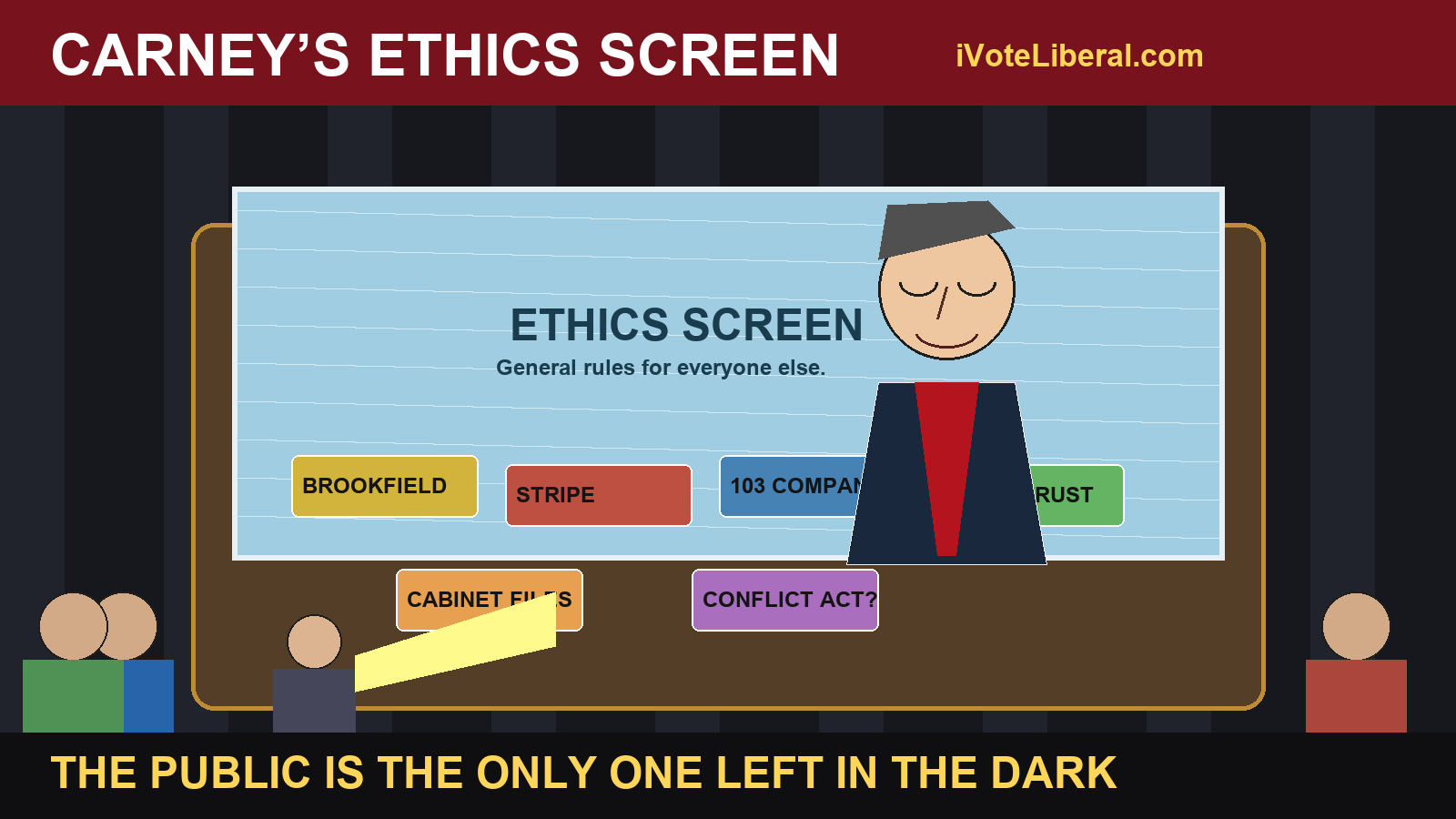
Mark Carney's conflict-of-interest problem has never been just one company or one investment. It is the bigger question of whether Canada's ethics system is strong enough to handle a prime minister who came into office from the centre of global finance.
A new Northern Perspective video, “Mark Carney Broke The Law, Violated Conflict Of Interest Act According To Democracy Watch,” points viewers to Democracy Watch's April submission to the House Ethics Committee. The advocacy group says Carney has millions in financial conflicts involving Brookfield and argues that part of his “ethics screen” is being enforced in a way that leaves the public without meaningful transparency.
National Post previously reported that Carney agreed to an extensive conflict screen covering Brookfield, Stripe and more than 100 other companies owned or controlled by them. The screen reportedly means Carney cannot be involved in official matters or decision-making processes that would further his own interests or the interests of those companies.
That sounds reassuring until Canadians ask the obvious democratic question: who gets to see when the screen is triggered, what files are affected, and whether the prime minister is actually kept out?
- Carney's financial background is unusually complex for a sitting prime minister.
- The conflict screen touches Brookfield, Stripe and a large network of related companies.
- Democracy Watch says federal ethics-law loopholes allow too much secrecy and too little enforcement.
- Canadians are being asked to trust a process they cannot fully inspect.
To be clear: Democracy Watch is making allegations and legal arguments. The Ethics Commissioner and courts are the authorities that decide formal violations. But the political issue does not depend on a courtroom finding. The political issue is transparency.
Carney's brand is competence. His defenders say his financial background makes him uniquely qualified to run the country. Fine. Then his conflicts should be handled with a level of public disclosure that matches the scale of his network. If the prime minister is screened off from files affecting over 100 companies, Canadians should not have to guess how often that happens or whether major public decisions are being shaped around those conflicts.
The deeper problem is that Ottawa's ethics regime was built for an older political world. It was not designed for a prime minister whose career moved through central banking, global finance, asset management, climate finance and private-sector networks that overlap with federal policy.
That is why Democracy Watch's submission matters. It argues that the current system contains major loopholes — including around blind trusts, screens, enforcement and secret profit from decisions — that leave Canadians relying on trust instead of proof.
The Liberal message is: the screen is enough. The accountability answer is: show Canadians what is behind the screen.
- Northern Perspective — “Mark Carney Broke The Law, Violated Conflict Of Interest Act According To Democracy Watch,” May 7, 2026
- Democracy Watch — April 16, 2026 submission on Conflict of Interest Act loopholes
- National Post — Carney ethics screen covering Brookfield, Stripe and related companies
- Office of the Conflict of Interest and Ethics Commissioner — public registry declaration