The Liberals Promised a Free Flood-Risk Tool for Homebuyers by December 31. They Missed It.
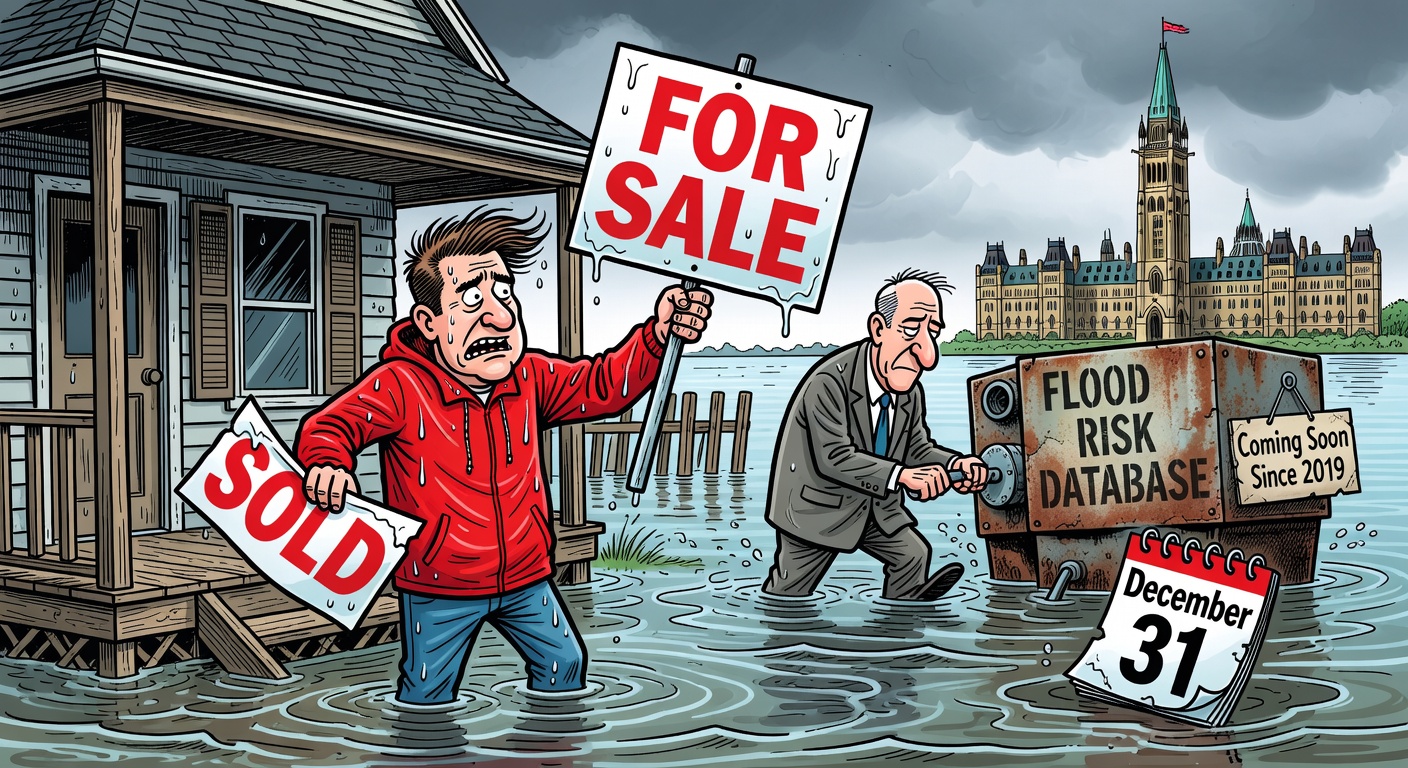
The Department of Public Safety promised Canadians a free, keyword-searchable flood-risk database — so prospective homebuyers could check whether the property they were about to spend $800,000 on was likely to end up underwater. The deadline was December 31, 2025. The Commissioner of Environment and Sustainable Development confirmed yesterday: it's late. The government will not say when it will be ready. "That would be very helpful," the Commissioner observed, dryly.
What Was Promised
The federal government has been promising a national flood risk portal since the late 2010s. The current iteration is a keyword-searchable, publicly accessible database that Canadians could use — for free — to check the flood risk of any address in the country before buying a home. The Department of Public Safety set a hard deadline of December 31 for launch.
The use case is exactly the kind of basic government service Canadians should be able to expect. You are about to make the largest purchase of your life. Your insurer wants to know if the basement is in a 100-year flood plain. Your bank wants to know if the property is uninsurable. You — the buyer — should be able to find the same information your insurer can find. That is what this database was supposed to provide.
What Was Delivered
Nothing. Yesterday the Commissioner of Environment and Sustainable Development confirmed to Parliament that the database is late. There is no firm new launch date. The Department of Public Safety acknowledged the delay. The Commissioner's understated response, captured by Blacklock's Reporter: "That would be very helpful."
The Commissioner's office is one of the few independent watchdogs Canadians have on federal environmental and disaster-preparedness commitments. When the Commissioner publicly notes that something promised by year-end isn't there, that is the federal government being officially called out by its own auditor.
Why This Matters More Than the Headline Suggests
Flood damage is now Canada's costliest weather risk. Insurance Bureau of Canada data has consistently shown flood claims rising year over year. Major Canadian floods — the Calgary floods of 2013, the Ottawa-Gatineau floods of 2017 and 2019, the British Columbia atmospheric river floods of 2021 — caused billions of dollars in damage. Some of the worst-affected homes had been built on land that was already known to be flood-prone, but that information was not in the hands of the people who bought them.
A national flood-risk database isn't a luxury. It is one of the most basic informational tools a federal government can provide its citizens. It costs comparatively little to build and maintain. And when 23-year-olds are being asked to take on $800,000 mortgages because the average Canadian home now costs that much, the very least the government can do is tell them whether the property is going to sit underwater every spring.
A Pattern of Missed Deadlines
This is not a one-off. The Carney and Trudeau governments have built a track record of announcing programs with dramatic flair, missing their deadlines, and quietly hoping no one notices:
- Buy Canadian Policy: Announced as Carney's signature procurement reform; the policy's actual definition of "Canadian" is so broad that companies 100% foreign-owned still qualify (Blacklock's, May 4).
- Bill C-5 nation-building projects: Carney promised major nation-building projects under his bill; one year in, zero have been started.
- $60 billion in operational savings: Promised over five years. The Parliamentary Budget Officer this week confirmed there is no evidence of how it will be achieved.
- The 800 fraudulent foreign students: Identified by federal audit weeks ago. The Immigration Minister now says she does not know what became of them.
- The flood-risk database: Deadline December 31, 2025. Result: missed.
This is what a government in administrative drift looks like. Big announcements. Dramatic press conferences. Soaring rhetoric about "Canada Strong" — paid for, in part, by ad campaigns that violated Treasury Board rules. And then, when it comes time to actually deliver something — a database, a project list, a balance sheet — the deadline slides, the details vanish, and the only thing that arrives on time is the next round of self-congratulatory branding.
The Cost of Incompetence
Flood damage in Canada now exceeds $1 billion per year in insured losses on average, and considerably more in uninsured losses. Every year that passes without a national flood-risk database is another year of Canadians making the largest purchase of their lives without the government information that could protect them. The financial cost of building the database is a rounding error compared to the human and economic cost of the floods themselves.
Yet here we are: the Commissioner of Environment publicly noting, in May, that a December 31 deadline has come and gone with no replacement date.
"That would be very helpful," the Commissioner said. He was being polite. The unvarnished version is simpler: the Liberal government cannot run the basic plumbing of a federal department. It can announce. It can rebrand. It can spend $54 million on an ArriveCAN app. What it cannot consistently do is finish the things it has already started.
And every Canadian buying a house this spring is paying the price.
Blacklock's Reporter: "Nt'l Flood Program Runs Late" (May 5, 2026), citing the Commissioner of Environment and Sustainable Development; Department of Public Safety statements on the missed December 31 deadline. Related: "Buy Canadian — Not Canadian" (May 4, 2026); National Post: "Budget watchdog says key details missing in Liberal government's fiscal plans".