"I Choose Not To": The Liberals Are Hiding the Report Behind Their New Police Surveillance Bill
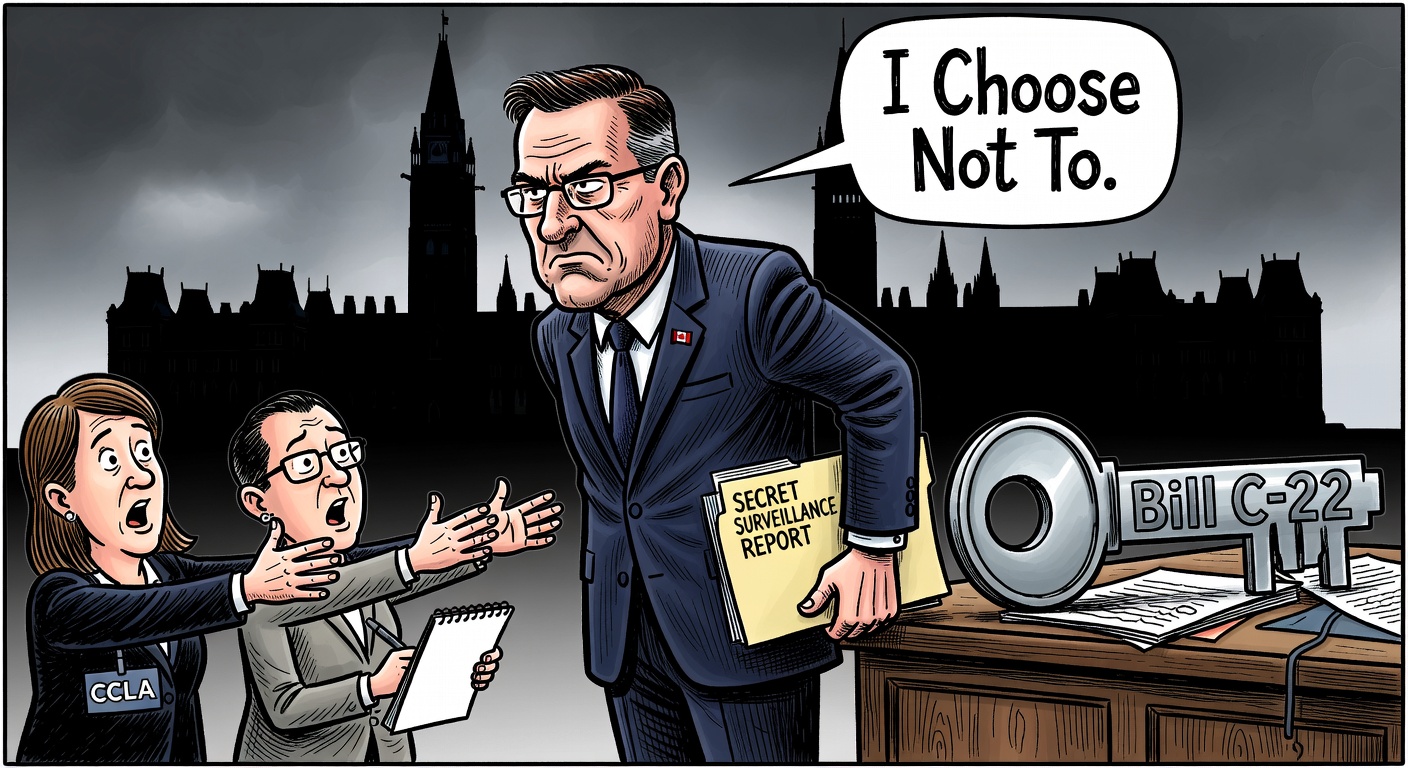
Public Safety Minister Gary Anandasangaree is refusing to release the unclassified Rankin Report — the document that guided his government's rewrite of Bill C-22, a sweeping new police surveillance law. Civil liberties advocates say there is "no legitimate reason" to keep it secret. The minister's direct response to why he won't release it: "I choose not to."
What Is Bill C-22 — And Why Does It Matter?
Bill C-22 is the Carney Liberal government's second attempt at what's called "lawful access reform" — expanding police and intelligence agencies' powers to intercept private digital communications. The ability to access Canadians' private information and monitor their communications is one of the most intrusive powers a government can hold. Getting it right matters enormously for the civil liberties of every Canadian.
The first attempt — Bill C-2, tabled right after last year's election — was widely criticized from across the political spectrum as "overly broad and invasive." The government was forced to start over. This time, they hired former NDP MP and B.C. cabinet minister Murray Rankin to lead private consultations with government officials, civil society, national security specialists, and advocacy groups throughout the summer and fall.
Rankin completed his report and submitted it to the minister earlier this year. The minister praised it as "highly influential" in shaping Bill C-22. He has now introduced the bill to Parliament. Committee study of Bill C-22 begins Tuesday, May 5.
And the minister is refusing to release the report that shaped it.
"I Choose Not To" — The Minister's Own Words
National Post made repeated requests to Anandasangaree's office for a copy of Rankin's unclassified report. His spokesperson Simon Lafortune said journalists would need to file an access-to-information request — a process that typically takes months — so that "necessary redactions" could be applied.
When pressed directly in a brief interview, the minister offered a different justification: because Rankin is a lawyer who submitted the report to the minister, he considered it a "privileged document." He also claimed nothing in it was "earth shattering."
National Post then asked the obvious question: if it's not earth shattering, why not waive the privilege and release it?
The minister's response: "I choose not to."
Three words. No legal obligation cited. No national security justification. No claim of classified content. Simply: I choose not to.
Civil Liberties Advocates: "No Legitimate Reason"
Tamir Israel of the Canadian Civil Liberties Association (CCLA) did not mince words. "There is no legitimate reason to keep it secret," he said. "The only reason to delay its publication is to further avoid meaningful scrutiny of Bill C-22."
That scrutiny would be meaningful precisely because this is the government's second attempt at this legislation after the first was rejected for being too invasive. Bill C-22 is being rushed into committee study beginning today. Parliamentarians, civil society groups, privacy advocates, and ordinary Canadians have had no opportunity to evaluate whether the legislation reflects the consultation process — because the document that guided that process is being withheld.
Leah West, a national security law specialist who actually participated in Rankin's consultation process, said she received a copy of the report when it was completed and finds no reason it shouldn't be public. "I do think that Bill C-22 does reflect the recommendations and the stakeholder process. So I'm very puzzled as to why they wouldn't share it," she said.
West added: "I think the lesson from the first go around was the need for consultation, the need to be clear about the reasons behind the legislation and specific measures. And in general, since the press conference announcing C-22, I haven't seen those lessons implemented."
This Is a Pattern, Not an Exception
The Liberals' refusal to release the Rankin Report is not an isolated incident. It is the latest in a long pattern of the Carney and Trudeau governments refusing to provide transparency on legislation that directly affects Canadians' civil liberties:
- Bill C-2 (first lawful access attempt) — criticized for being drafted without adequate public consultation
- Bill C-63 (Online Harms Act under Trudeau) — contained sweeping internet censorship powers, passed without full public debate
- The Emergencies Act invocation in 2022 — still under legal challenge, with the Chief Justice just this week refusing to recuse himself from the appeal
- Secret in-camera health committee hearings on a $300 million PrescribeIT contract
Each time, the government claims the secrecy is routine or necessary. Each time, advocates who have actually seen the documents say there is no good reason for the secrecy. And each time, Canadians are left unable to evaluate the legislation that governs their own digital lives.
Why You Should Care About Lawful Access
"Lawful access" is a bureaucratic term for something that touches everyone who uses a phone, a computer, or the internet. It is the legal framework under which police and intelligence agencies can compel service providers to hand over your private data, intercept your communications, or monitor your online activity. Getting this framework wrong doesn't just affect criminals — it affects every Canadian.
Canada's digital privacy law has not kept pace with modern technology. There are legitimate reasons to update it. But "trust us" is not a legitimate argument when the legislation has already been rejected once for being too broad, when civil liberties advocates are warning about specific provisions, and when the government won't even release the unclassified roadmap it used to write the bill.
Committee hearings start today. The minister's report is still locked in a drawer. And when asked why, he said: "I choose not to."
That is not transparency. That is exactly the kind of Liberal governance Canadians were promised was over.
National Post: "Liberals refuse to disclose report on police search powers consultation as bill heads to committee" (May 5, 2026); Canadian Civil Liberties Association statement; statement by national security law specialist Leah West.