Carney's First Major Appointment: A Governor General His Critics Already Don't Trust
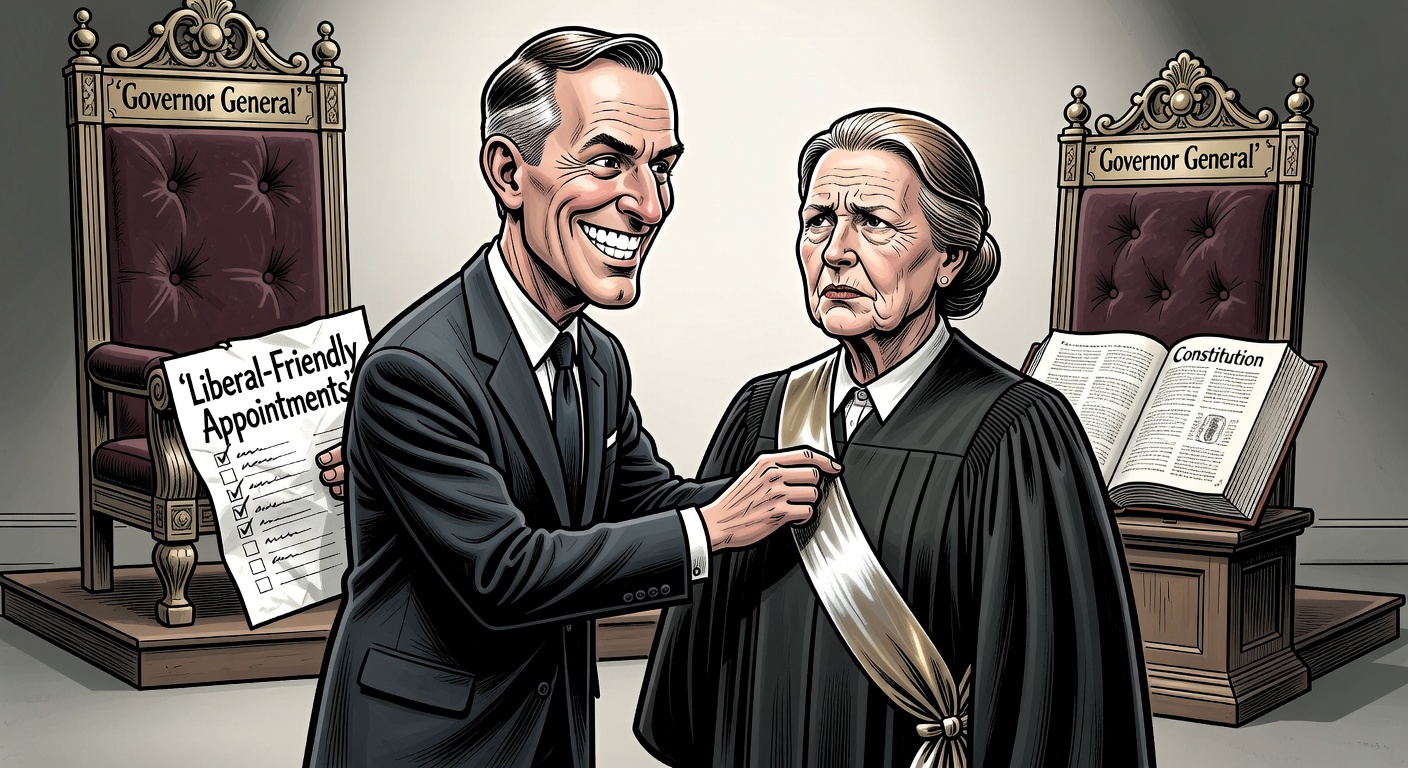
Mark Carney has chosen Louise Arbour — a former Supreme Court justice turned UN official with a long, politically charged record — as Canada's next Governor General. Arbour was approved by King Charles after Carney submitted his recommendation. She occupies one of Canada's most constitutionally sensitive positions. Critics are already asking whether the appointment was about merit — or about installing a like-minded ally in the vice-regal role.
Who Is Louise Arbour?
On paper, Louise Arbour is a formidable legal figure. She served on the Supreme Court of Canada from 1999 to 2004. She then spent four years as the United Nations High Commissioner for Human Rights (2004–2008). She later led a high-profile external review of sexual misconduct in the Canadian Armed Forces and the Department of National Defence in 2021, a process that was welcomed by the Liberal government.
But Arbour's record is not without controversy — particularly among conservatives and those skeptical of the UN's selective application of human rights principles. During her tenure at the UN, she was criticized by some former Liberal cabinet ministers and legal observers for positions they viewed as ideologically driven. A piece in Law Times in 2007, written by a colleague, called her a "colleague we have failed" — referring to professional disputes that followed her UN career.
She has also expressed strong public views on issues — from the role of the Crown to separatism — that will inevitably intersect with her constitutional duties as Governor General. When asked Tuesday whether she would build bridges with critics, Arbour said she wouldn't deal with anyone in "cheerleading mode" and would "reach out to anyone who wishes to engage with me." It was a confidence that struck some observers as politically assured — not the studied neutrality one might expect from Canada's vice-regal representative.
The Patronage Pattern
The Governor General is not elected. She is appointed by the Prime Minister and approved by the King. There is no parliamentary vote. No public consultation. The Prime Minister picks someone — and they become the constitutional backstop between a government and its obligations to Parliament and the Crown.
This matters more than people realize. The Governor General has the theoretical power to refuse royal assent to legislation. She presides over cabinet swearing-in ceremonies. She reads the Speech from the Throne. In a constitutional crisis — of the kind that doesn't seem impossible in a Canada where two provinces are openly discussing separatism referendums — the Governor General's judgment and perceived neutrality become critically important.
Carney acknowledged as much when he invoked Alberta and Quebec's independence movements at Tuesday's press conference. Arbour responded that she hoped to spark dialogue "in a spirit of respect and moving the country forward, in an ambitious, united way." That's a perfectly reasonable thing to say. It is also, notably, an echo of Carney's own political messaging about "building Canada."
When the vice-regal representative and the Prime Minister appear to share a political worldview — and when the PM personally selected the GG — the independence of that office becomes a legitimate question.
"The Crown Is a Continuous Thread"
Carney's framing of the announcement was notably constitutional in tone. "The Crown is a continuous thread through our constitutional life," he said. It was a well-turned phrase. But it glosses over a more uncomfortable reality: the Prime Minister controls who fills that Crown-representative role in Canada, entirely at his discretion.
Under Justin Trudeau, Governor General Julie Payette was appointed without adequate vetting and resigned in disgrace after a toxic workplace report. Her replacement, Mary Simon, faced widespread controversy for being unable to speak French — a requirement that has been considered foundational to the role for decades. Carney himself told Radio-Canada he was "absolutely" committed to a bilingual appointee, and Arbour does speak both languages.
But meeting the language requirement is a floor, not a ceiling. The question worth asking is whether the appointment process involved the kind of independent, arms-length vetting that would make Canadians confident the pick was about service to the country — or whether, like so many Liberal appointments before it, it was about who the Prime Minister trusted to hold power on his behalf.
A Pattern of Stacking the Deck
This appointment doesn't stand alone. Carney has already been reported to be discussing appointing his own principal secretary to the Senate. He secured a manufactured parliamentary majority through floor-crossings. He inherited a Senate already packed with 58 Trudeau-era appointees presenting themselves as "independents." And now he has appointed the constitutional officer who would be the final check on any parliamentary manoeuvre.
One can argue Arbour is qualified. One can argue the appointment is appropriate. But the pattern — Prime Minister after Prime Minister, Liberal after Liberal, stacking every constitutional and quasi-constitutional institution with allies — is now so well established that it no longer surprises anyone.
It should.
The Bottom Line
Canadians did not elect Louise Arbour. They didn't vote on this appointment. They didn't get to weigh in. Mark Carney submitted her name to King Charles, who approved it. She will now preside over Canada's constitutional machinery — reading the government's own speech, swearing in the government's own ministers, and serving at the pleasure of the government's own political tradition.
Whether or not Arbour proves to be an excellent Governor General, the process by which she was chosen tells Canadians exactly how much say they have in shaping the constitutional architecture of their own country.
None.
Reporting based on: National Post — "Carney announces former Supreme Court justice Louise Arbour as new governor general," May 5, 2026. Western Standard — "Carney names former Supreme Court justice Louise Arbour as Governor General," May 5, 2026.