The Record Behind the Robe: Carney's New Governor General Praised Castro and Beijing — And Has a Long Record of Singling Out Israel
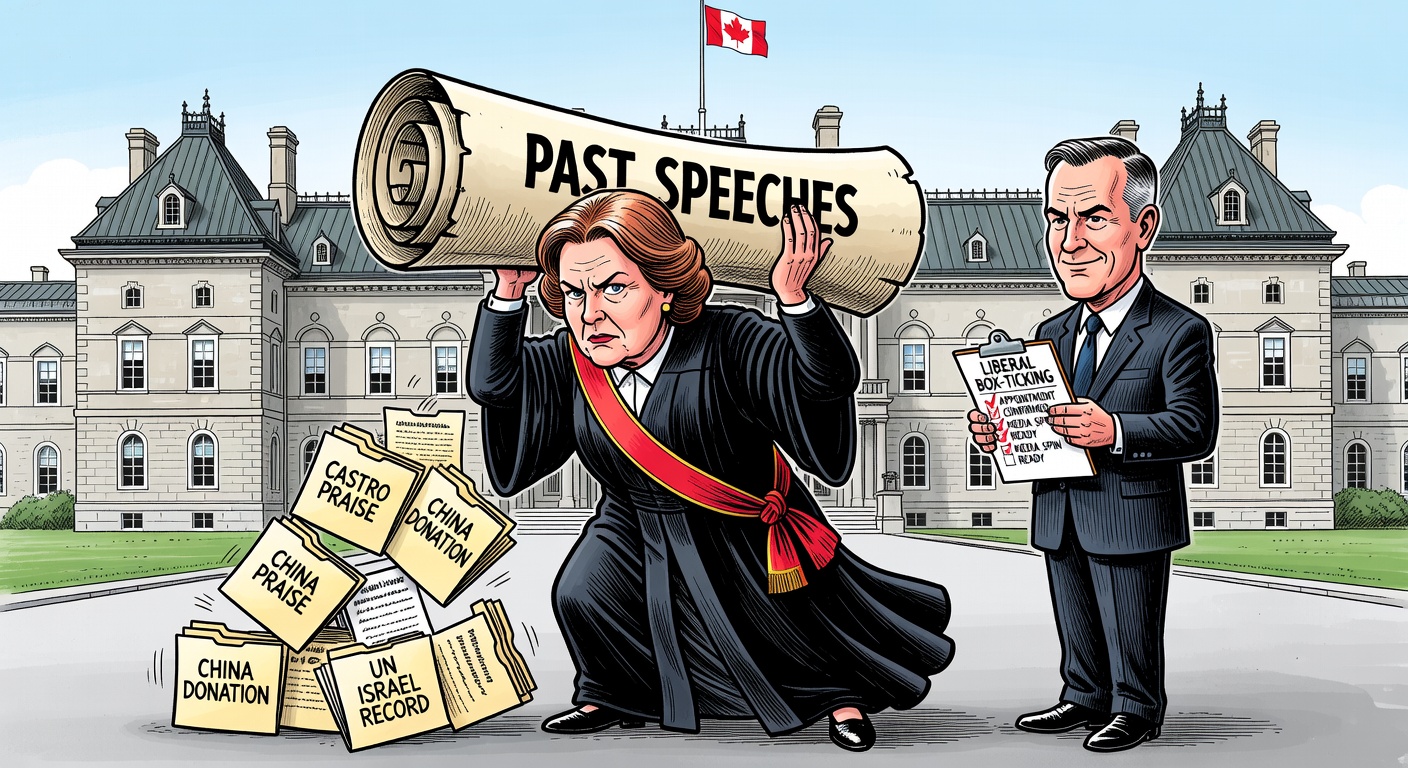
Yesterday we covered the patronage problem with the Arbour appointment. Today the record itself is in the news. National Post columnist Chris Selley laid out the documented controversies — and they are extensive: praising Fidel Castro's regime, complimenting China's "commitment" to human rights weeks after Beijing donated to her UN office, and a record of singling out Israel for criticism that other UN actors avoided. The job of Governor General is supposed to be non-partisan. Carney just appointed one of the most ideologically opinionated public figures in the country.
This story was also flagged by Canadian commentator Jasmin Laine, who connected the Arbour appointment to a broader pattern in Mark Carney's choices: institutional insiders, global-governance resumes, and controversial records that deserve public scrutiny before they are normalized.
What a Governor General Is Supposed to Be
The Governor General is the King's representative in Canada. The role is constitutional, ceremonial, and — by long-standing convention — non-partisan. The GG dissolves Parliament, swears in new governments, grants royal assent to legislation, and stands above the political fray. They are not supposed to have a public record of taking sides on contested global political questions. That is the entire point of the office.
The reason Canadians have constitutional monarchy and not an elected presidency is precisely so that there is one figure in the system who is not seen as advancing a political agenda. Whatever you think of any individual GG's personal views, those views are supposed to fade into the background once they take the office.
Louise Arbour brings a 40-year public record into Rideau Hall. That record will not fade quietly.
The Castro Praise
According to UN Watch, the NGO that monitors the United Nations, Arbour — while serving as UN High Commissioner for Human Rights — publicly praised Fidel Castro's communist regime in Cuba for its "unprecedented positive engagement with the UN human rights system." This was not a casual remark. UN Watch documented it as part of her substantive engagement with the Cuban government.
Cuba is a one-party communist state that has imprisoned dissidents, journalists and pro-democracy activists for decades. Praising Cuba's "engagement" with human rights mechanisms — at a time when ordinary Cubans were jailed for political speech — is a choice. It is the kind of choice a UN diplomat might make. It is not the kind of choice a Canadian Governor General is supposed to be on record having made.
The China Donation and the China Praise
The most uncomfortable item on the record concerns the People's Republic of China. As reported in China Daily in January 2008, Arbour publicly praised Beijing for its "commitment to the spirit of the Universal Declaration of Human Rights" — shortly after the Chinese government donated funds to her UN office.
This was not 1972. By 2008 the world had documented decades of Chinese repression of dissidents, the persecution of Falun Gong practitioners, the surveillance state in Tibet, and the early stages of what would become the Uyghur internment system in Xinjiang. Praising China's "commitment to the spirit" of universal human rights — after accepting a Chinese government donation — is exactly the kind of public statement that reasonable Canadians remember.
It is also the kind of statement Carney's government does not need on the record at the moment. This is a government whose Foreign Minister, Anita Anand, just unveiled a "new foreign policy" of cooperation with Beijing in the same week CSIS reported that Chinese intelligence agencies are actively cultivating relationships with Canadian politicians. The juxtaposition is awkward at best.
The Israel Record
Selley's column also notes Arbour's well-documented record of issuing condemnations of Israel that, in tone and frequency, exceeded her criticism of regimes that openly call for Israel's destruction. UN Watch and other monitoring bodies have catalogued her statements over the course of her tenure as UN High Commissioner.
The 2006 Lebanon war is central to the controversy. Hezbollah crossed the Israeli border and kidnapped Israeli soldiers, triggering a 34-day conflict. During that period, Arbour focused heavily on Israel's military response and warned that civilian casualties could raise war-crimes questions. Critics argued she created a false moral equivalence between a terrorist group deliberately targeting civilians and a state responding militarily after its soldiers were abducted.
Reasonable people can disagree about Middle East policy. The point is that a person who came into office with a contested public record on one of the most divisive geopolitical questions in the world cannot then be neutral when, as GG, she may need to grant royal assent to or read into law legislation that touches on Canada's foreign policy, the Israeli–Palestinian question, antisemitism, or international institutions. Her past statements will be cited. The office will be politicized whether she wants it to be or not.
"They Did It Again"
Selley's column for the National Post is titled, plainly: "How can the Liberals possibly be this awful at picking governors general?" His verdict: "They did it again. It's absolutely extraordinary. The Liberals have appointed another opinionated Type A personality from the most central realms of Central Canada."
The pattern matters. Mary Simon's appointment was a disaster — multi-million-dollar French lessons that did not produce French; an inability to address Canadians in both official languages; criticism of her bilingualism that Liberal cabinet ministers tried to handwave away by saying she "spoke an Indigenous language, which I think is fair game." Before Simon, Julie Payette resigned in disgrace amid a workplace harassment scandal that had been raised before her appointment was finalized.
And before Payette, Michaëlle Jean, whose past sympathy for Quebec separatism and family connections to FLQ figures became a national controversy after the appointment was made.
Three consecutive Liberal-appointed governors general, three consecutive controversies. This is not bad luck. As Selley puts it: "The Liberals know how to tick boxes better than almost anything else. It's so much easier than following through on anything. And yet, they keep buggering this office up."
What Carney Needed — And Didn't Pick
Selley argues the obvious box-ticking exercise should have produced a francophone GG from outside Central Canada — there is, as he wryly notes, "the rest of the country" west of Ontario. Instead the Carney government picked a 79-year-old retired judge from Montreal with a documented international human-rights record on three of the most contested geopolitical questions of the past 25 years.
This is what governing-by-resume looks like. It is also what a government that is more concerned with optics than with the actual function of an institution looks like. The Crown is supposed to be the part of our system that does not pick sides. The Carney Liberals have, for the third time in a row, handed the Crown to someone who has spent a career picking them.
Laine's broader point is worth taking seriously: Carney's appointments are not random. Whether the issue is immigration, global institutions, China, or Israel, he keeps reaching into the same world — elite institutions, international governance networks, and people whose records align more comfortably with global managerial politics than with ordinary democratic accountability. That is the story Canadians should watch.
National Post: Chris Selley, "How can the Liberals possibly be this awful at picking governors general?" (May 5, 2026); Jasmin Laine: "Trump Just Did What Carney Said Was Impossible | CBC: 'What Is He Doing?'" (May 5, 2026); Western Standard: "Carney's new Governor General backed mass immigration in the past, dismissed critics as 'misguided'" (May 5, 2026); UN Watch documentation of statements regarding Cuba; China Daily coverage (January 2008) of UN High Commissioner statements following Chinese government donation.