Carney Wasted an Entire Year on the Alberta Pipeline. Alberta Is Still Waiting.
Mark Carney has been Prime Minister for over a year. He signed a Memorandum of Understanding with Alberta last November on a pipeline to Asian markets. And this week, asked directly whether he supports building it, his answer was: "more probable than possible." Poilievre put it simply — Carney wasted an entire year and still hasn't made up his mind.
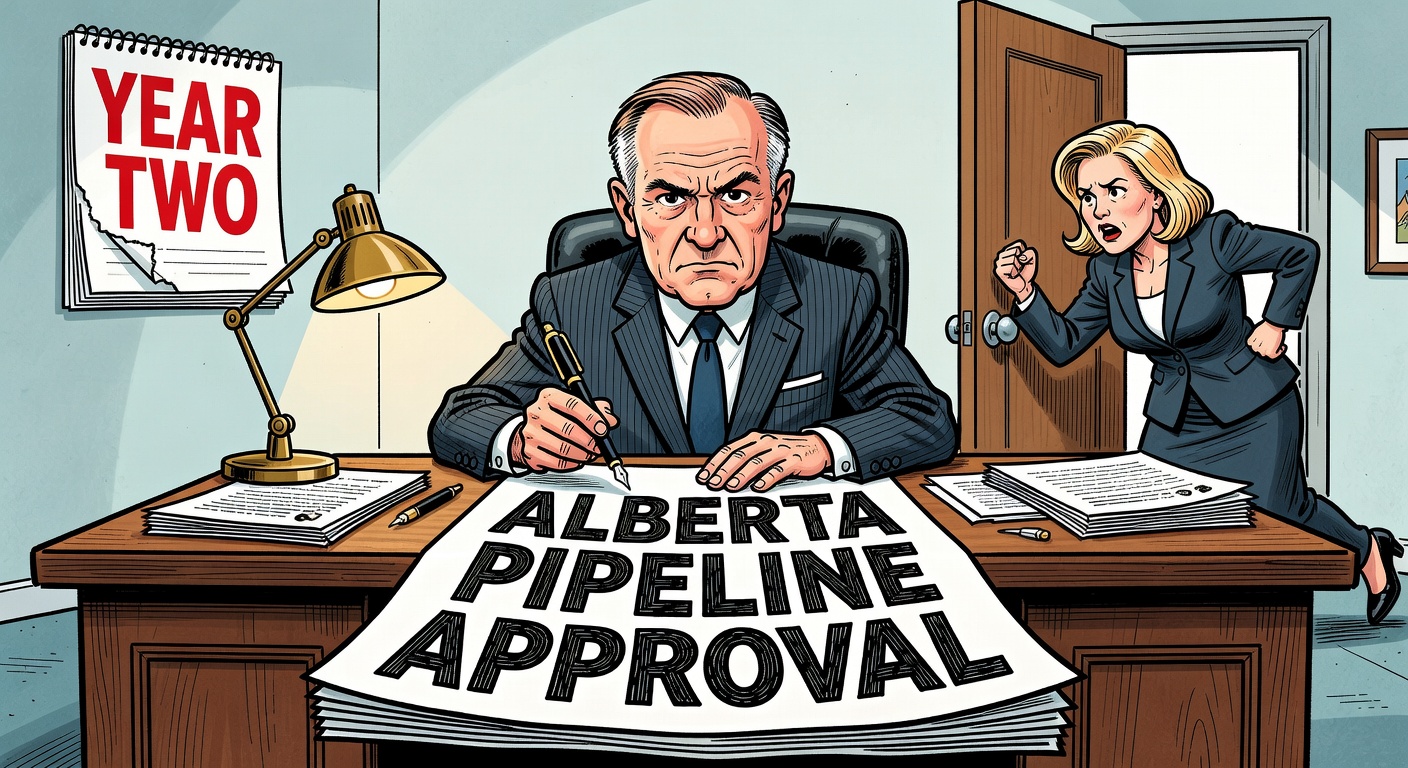
"More Probable Than Possible" — Translation: Still No
When Canadian Press asked Prime Minister Mark Carney directly whether he supports building a new pipeline out of Alberta, he offered perhaps the most carefully crafted non-answer in recent political memory: "more probable than possible."
That's not a commitment. That's not a plan. That's not even a timeline. "More probable than possible" is what a politician says when they're unwilling to say yes and politically afraid to say no. It is the linguistic equivalent of a blank cheque with no date on it.
After a full year as Prime Minister — and after signing a formal Memorandum of Understanding with Alberta last November specifically on pipeline development — this is the best Carney can offer.
"He's been prime minister for a year and he still hasn't even made up his mind whether he supports a pipeline," Conservative Leader Pierre Poilievre said at a news conference in Toronto on Sunday. "He's wasted an entire year."
That is an accurate description of the situation.
What the MOU Actually Said
In November 2025, after months of tension between Ottawa and Edmonton, the Carney government and Alberta Premier Danielle Smith signed a Memorandum of Understanding that included significant commitments. Alberta agreed to act as a proponent for developing a pipeline to Asian markets, including opportunities for Indigenous co-ownership. Alberta also committed to push forward on a major carbon capture and storage project.
In return, Ottawa agreed to suspend the proposed federal oil and gas emissions cap and exempt Alberta from certain clean electricity regulations. These were real concessions by the federal government, significant enough that they were celebrated as a breakthrough at the time.
But the MOU did not include federal approval for the pipeline. It did not include a timeline. It included language about "making progress" — the same non-committal phrase Carney deployed again this week when he described the pipeline as "part of a bigger package. We're making progress."
Progress on what? After how long?
Why This Matters: Energy Security and National Wealth
Canada's energy sector is one of the most significant drivers of national wealth. Alberta's oil sands contain one of the largest proven petroleum reserves in the world. The problem has never been supply — it's been getting the product to international markets efficiently. Trans Mountain, the sole existing oil pipeline to the Pacific, took over a decade and $34 billion to complete. Canadian oil still trades at a significant discount to world prices because of infrastructure bottlenecks.
A new pipeline to Asian markets would change that equation. It would provide Alberta — and by extension all of Canada — with better access to growing energy demand in Japan, South Korea, and India. It would reduce dependence on US market access precisely when the Trump administration is demonstrating how quickly trade relations can deteriorate. It would generate royalties, jobs, and federal tax revenue for decades.
Trump himself, just recently, approved a pipeline project from Canada to the US border — a move Carney is busy commenting on while his own government's domestic pipeline decision sits unsigned on his desk.
"It doesn't need any government handouts. It just needs a permit to go ahead." — Pierre Poilievre, May 4, 2026
The Liberal Energy Record
This delay doesn't happen in a vacuum. It is the continuation of a decade-long Liberal pattern of hostility toward Western Canadian energy development. Under Justin Trudeau, the Liberals cancelled the Northern Gateway pipeline, imposed the tanker ban on BC's northern coast, passed Bill C-69 (the "no more pipelines act"), and allowed Energy East to die. Trans Mountain was eventually completed only because the federal government bought it — with billions of taxpayer dollars — after private investors concluded the regulatory environment was too unpredictable.
Mark Carney presented himself as different. He was a technocrat, a pragmatist, a man of the markets who understood capital and economic logic. He would make the hard calls, he said. He'd work with Alberta.
One year in, he signed an MOU. He suspended the emissions cap. He said a pipeline is "more probable than possible." He said it's "part of a bigger package." He said they're "making progress."
Alberta is still waiting.
Carney's Context: A Man Abroad While the West Waits
These latest comments came as Carney addressed a European summit in Armenia, where he also announced $270 million in military aid to Ukraine. The optics were striking: the Prime Minister was travelling internationally, committing hundreds of millions to foreign causes, while back home the nation's most consequential infrastructure decision remains unresolved.
The contrast isn't lost on Albertans. Their province contributes disproportionately to federal revenues. Their resource wealth has funded transfer payments to the rest of Canada for decades. And after years of Liberal governments treating their energy sector as an embarrassment to be managed rather than an asset to be developed, they were promised — in writing — that this government would be different.
"More probable than possible" is not different. It's just more carefully worded.
The Bottom Line
Building a pipeline doesn't require government money. It requires a permit, regulatory certainty, and a government that will get out of the way. Carney has had a year. He has an MOU. He has a willing provincial partner. He has rising global energy demand driven by geopolitical instability, including the Iran conflict he cited himself.
What he doesn't have is an answer.
That's the difference between governing and performing. Governing means making decisions with consequences. Performing means using words like "more probable than possible" and hoping nobody notices the year has passed.
Albertans noticed.
CBC News: "Poilievre argues Carney has 'wasted an entire year' on possible Alberta pipeline" (May 3, 2026); The Canadian Press interview with Prime Minister Carney on pipeline status.