Carney's "Buy Canadian" Includes the Bank of China
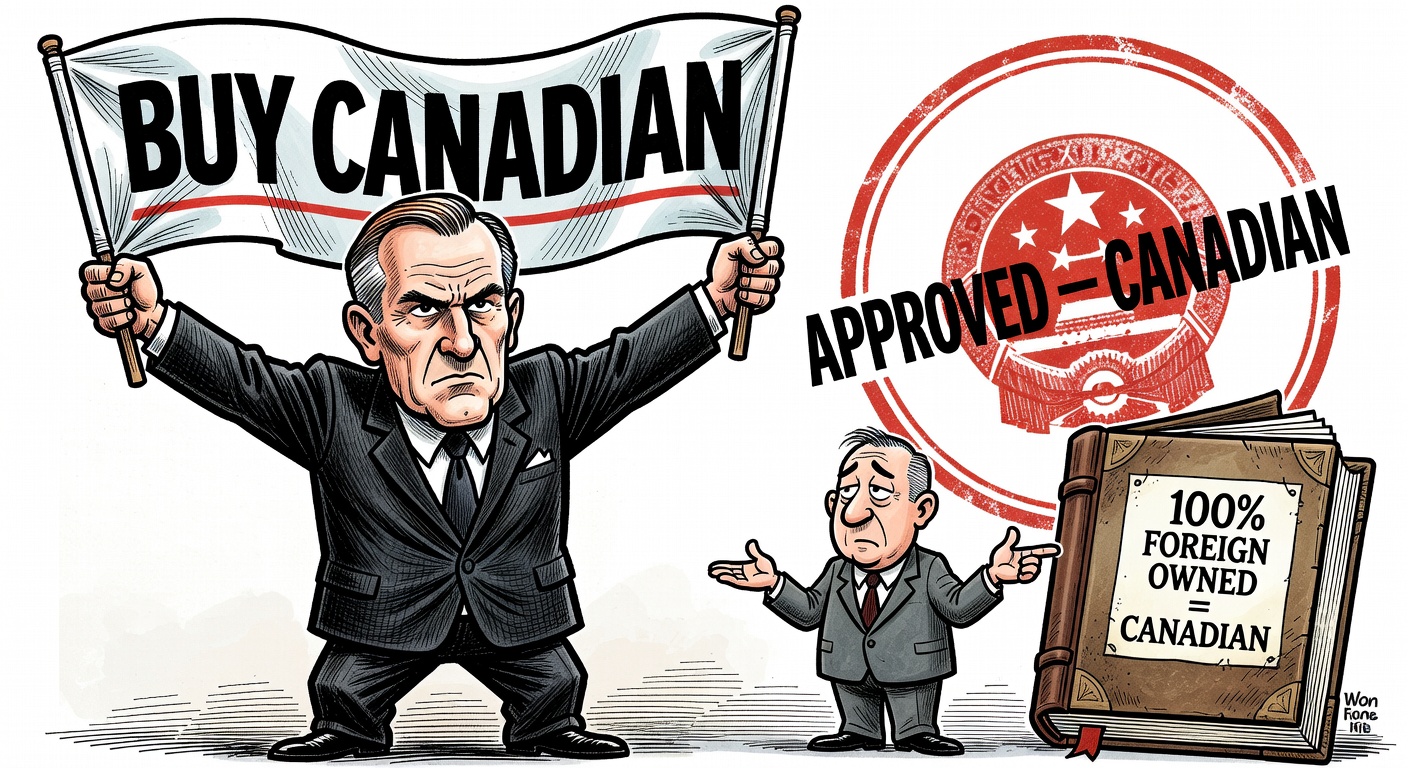
The Carney government's signature "Buy Canadian" policy — its anti-Trump economic patriotism pitch — defines "Canadian" so loosely that 100% foreign-owned corporations qualify. That includes companies like the Bank of China that operate Canadian storefronts. It isn't a Buy Canadian policy. It's a "Buy From Anyone With a Canadian Address" policy.
The Policy That Sounds Good and Means Nothing
When Donald Trump threatened Canada with tariffs earlier this year, Prime Minister Mark Carney responded with a wave of economic nationalism. "Buy Canadian" became the Liberal government's rallying cry — buy Canadian goods, support Canadian workers, protect Canadian industry. The government announced procurement policies to direct federal spending toward Canadian suppliers. Carney presented himself as the defender of Canadian jobs.
There's just one problem: the government's definition of "Canadian" is nearly meaningless.
According to documents obtained by Blacklock's Reporter, the Department of Public Works confirmed that companies which are 100 percent foreign-owned still qualify as "Canadian" under the Buy Canadian procurement policy, as long as they have a Canadian business registration or storefront presence. The definition is so broad that even the Bank of China — a state-owned institution of the People's Republic of China — would qualify as "Canadian" and be eligible for federal government contracts under the policy.
When pressed by Parliament on what exactly qualifies as "Canadian," a government official responded: "We need to go back to what the Prime Minister said."
That response alone tells you everything.
Nationalism as Theatre
The "Buy Canadian" campaign was one of the most politically effective moves the Carney Liberals made this spring. In a moment of genuine national anxiety about Canadian sovereignty and American tariff aggression, the Prime Minister offered a simple message: stand up for Canada, buy from Canadians, keep the money here.
Canadians responded. Consumer campaigns encouraging people to swap American products for domestic alternatives gained momentum. Canadian flags went up in grocery store windows. The optics were powerful.
But the policy underpinning the rhetoric was, it now turns out, a shell. A foreign-owned subsidiary registered in Ontario qualifies as "Canadian." A wholly-owned arm of a Chinese state enterprise with a Vancouver office qualifies as "Canadian." The government's own procurement officials don't have a clear answer on what the Prime Minister actually meant — so they said they'd "go back to" him to find out.
This is not a minor administrative oversight. This is the fundamental question the policy was built to answer: what counts as Canadian? The government doesn't know, or won't say.
The China Problem
The specific example of the Bank of China isn't hypothetical posturing — it's a documented illustration of how badly the policy is designed. The Bank of China is a state-owned commercial bank majority-owned by the Chinese government. It operates branches in Canada. Under the current Buy Canadian definition, it counts.
This matters especially given the parallel contradiction happening at the exact same time. While Carney was deploying "Buy Canadian" nationalism to appeal to voters worried about American economic aggression, his Foreign Minister Anita Anand was simultaneously announcing a "new foreign policy" emphasizing cooperation with Beijing. CSIS publicly confirmed this week that China remains one of the leading perpetrators of espionage and foreign interference in Canada, actively cultivating "relationships with unnamed politicians."
So the government is:
- Running a "Buy Canadian" campaign that would include Chinese state-owned enterprises
- Directing $270M to Ukraine (announced today in Armenia) while warming ties with China
- Asking Canadians to be economic patriots while defining "Canadian" as anyone with a postal code
What "Buy Canadian" Should Actually Mean
A genuine Buy Canadian procurement policy would prioritize companies that are majority Canadian-owned, employ primarily Canadian workers, pay Canadian taxes, and whose profits stay in Canada. That's what the phrase implies when Carney uses it on stage. It's what Canadians think they're hearing.
But a standard that rigorous would exclude many foreign-owned corporations that do business in Canada — corporations that happen to contribute politically, lobby aggressively, and benefit from federal contracts. So the government has instead chosen a definition so permissive it encompasses virtually everyone with a Canadian business number.
The result is a policy that's perfect for a press conference and useless as a procurement principle. Carney can point to "Buy Canadian" on the campaign trail. The Bank of China can collect federal contracts. And public officials can refer reporters back to what the Prime Minister said — because they genuinely don't know what he meant.
A Pattern of Hollow Promises
This is not an isolated case. It fits a clear pattern from the Carney government: announce a policy that sounds decisive and patriotic, leave the implementation vague enough to satisfy every stakeholder, and move on before reporters can dig into the details.
The $78.3-billion deficit was announced alongside pledges of "fiscal discipline." The $25-billion sovereign wealth fund was seeded with borrowed money. The "one negotiator" on Canada-U.S. trade excluded elected Conservative MPs representing millions of Canadians. The ethics committee recommendations to divest Brookfield investments were ignored. The in-camera committee hearings were justified as procedural necessity.
And now "Buy Canadian" doesn't actually mean Canadian.
The Carney government governs through optics. The substance — when you dig into it — consistently falls short of the headline. Canadians deserve to know that what they're being sold is frequently not what's being delivered.
Blacklock's Reporter: "'Buy Canadian' Not Canadian" — records from the Department of Public Works confirming foreign-owned companies qualify as "Canadian" under Carney's procurement policy. Blacklock's Reporter does not accept government subsidies.