Ottawa Texted Alberta About the 30x30 Land Lockup. That Was the Consultation.
On March 31, 2026, the Carney government unveiled a $3.8 billion plan to lock up 30% of Canada's land and waters by 2030 — affecting hundreds of millions of hectares of provincial Crown land. Alberta's Environment Minister learned about it the way you'd find out a neighbour moved a fence: a brief text message. No prior consultation. No meetings. No recognition that provinces — not Ottawa — own and manage their own land. Just a text and a press conference.
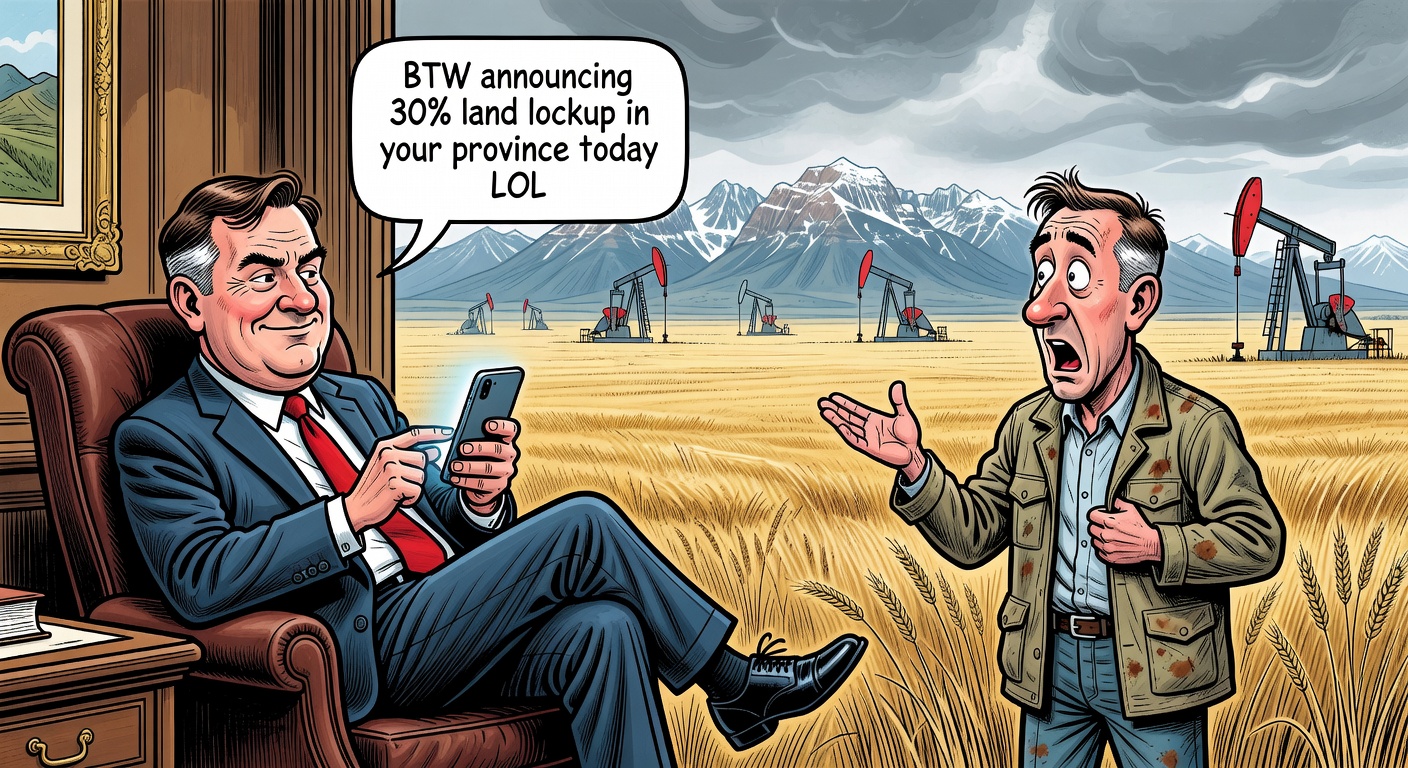
The Text That Started a Fight
Grant Hunter, Alberta's Minister of Environment and Protected Areas, took over the portfolio in January 2026. His first interaction with Ottawa's new Nature Strategy — announced by federal Environment Minister Julie Dabrusin on March 31 — came via his phone.
"We're excited about rolling out the 30x30 plan and look forward to your feedback." — Federal Minister Julie Dabrusin's entire "consultation" with Alberta
That was it. No meetings. No draft proposals. No recognition of the Alberta government's constitutional jurisdiction over land and resource management within its own borders. Ottawa announced a sweeping $3.8 billion land conservation plan affecting the country's most resource-rich province, and the province's minister found out by text.
Hunter's response was immediate and blunt. On April 7, he issued a public statement pointing out that Ottawa's plan fails to recognize what Alberta is already doing — and misrepresents the entire picture.
Alberta Already Exceeds the Spirit of 30x30
Here's what Ottawa's press releases won't tell you: Alberta already manages nearly 60% of its land — approximately 40 million hectares of Crown land — in a way that preserves and protects natural landscapes. Within that total:
- 16% is in formal parks and conservation areas
- 15% is in the Rockies and foothills — among the most pristine wilderness on Earth
- ~4% is in working landscapes such as low-impact cattle grazing leases
Alberta has been a genuine steward of its land — managed by people who actually live there. Farmers, ranchers, Indigenous communities, and resource workers who understand the land because it is their livelihood. Ottawa's rigid, Ottawa-designed metrics simply don't count this stewardship because it doesn't fit a federal bureaucrat's preferred definition of "protected."
"It's pretty stringent what they're putting forward," Hunter said, "for them not to recognize our farmers and ranchers, who have been stewards of the land — probably the best stewards you'll ever find."
What Ottawa's Plan Actually Does
Canada is currently at 14% formally protected land and waters under Ottawa's narrow definition. Hitting 30% by 2030 requires adding another 16% — roughly 1.6 million square kilometres. That land doesn't grow on trees. It has to come from somewhere. For Alberta, that means federal pressure to lock up Crown land that currently generates economic activity: energy exploration, mining, agriculture, tourism, forestry.
Hunter warned that Ottawa's one-size-fits-all approach risks "sterilizing Alberta's ability to respond to critical mineral demands, energy needs, or economic shocks." A Financial Times of London headline from this week put it bluntly: "Canada's Red Tape Is Worse Than Trump Tariffs." Ottawa's instinct, in every crisis, is to add more constraints — not fewer.
The Constitutional Reality Ottawa Keeps Ignoring
This is not a new fight. The pattern of federal overreach on land management has defined Ottawa-Alberta relations for decades. Former Environment Minister Steven Guilbeault spent years trying to throttle Alberta's oil and gas sector. Carney eventually moved Guilbeault aside — but replaced him with a Toronto Liberal who announced a sweeping provincial land policy via text message.
"It's not a mom and dad versus the children relationship," Hunter said. "It is an equal co-partnership."
Under Canada's Constitution, provinces own and manage their own Crown lands. Ottawa can set broad environmental targets. It cannot unilaterally dictate how provinces manage their territory. And yet the federal Nature Strategy was designed, announced, and funded without any meaningful consultation with the provinces most affected.
This is how Carney's government operates: centralize authority in Ottawa, announce national plans that override provincial jurisdiction, then offer provinces the opportunity to "provide feedback" after the fact. It is not federalism. It is federal supremacy dressed up as environmentalism.
Who Profits from the Lockup?
One question that deserves continued scrutiny: when land gets locked up in carbon conservation schemes, who benefits financially? Mark Carney built the architecture of voluntary carbon markets during his time as UN Special Envoy and while employed at Brookfield Asset Management — a firm managing over $1 trillion in assets with major positions in green energy and transition infrastructure.
Ottawa's $3.8 billion Nature Strategy generates carbon credits. Those carbon credits are managed and traded through financial mechanisms. Carney designed those mechanisms. The company he worked for profits from them. Albertans are being told their land must be locked up — and someone in a Toronto or New York financial tower will monetize the result.
- Alberta's Environment Minister received a text message as Ottawa's entire "consultation" on the 30x30 plan
- Alberta already manages ~60% of its land in ways that preserve natural landscapes — Ottawa refuses to recognize it
- The $3.8B Nature Strategy requires adding 1.6 million km² of "protected" land — most of it from resource-generating provinces
- Under Canada's Constitution, provinces own and manage their own Crown lands — Ottawa cannot unilaterally lock them up
- Carbon credits generated by locked-up land flow through financial markets Carney helped design — and Brookfield is positioned to profit
Source: National Post — "Mark Carney finds a brand new way to clash with Alberta" (May 3, 2026)