Carney's Senate Gambit: After Buying a Majority in the House, He Now Wants to Control the Senate Too
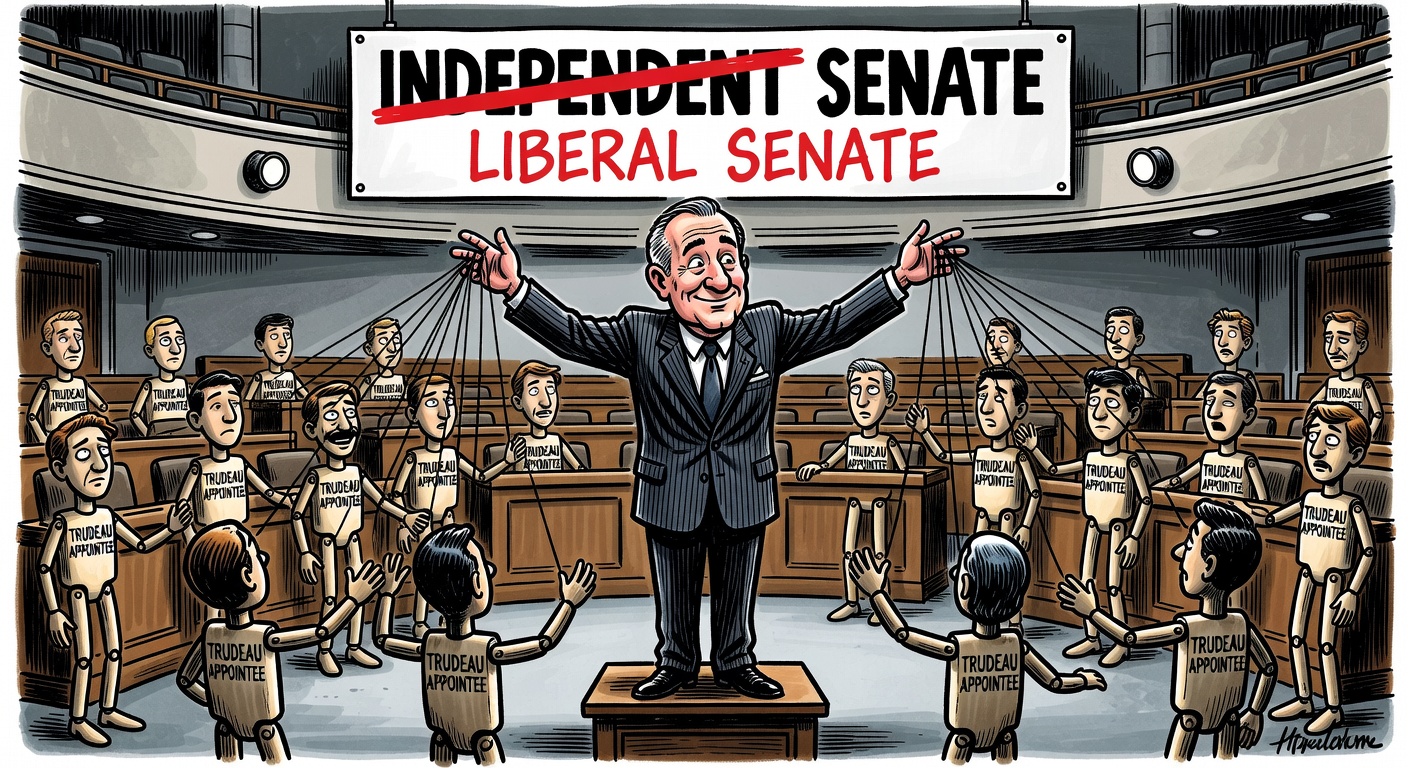
Mark Carney seized a parliamentary majority through three byelections and five floor-crossings — MPs who switched parties without asking voters. Now, according to the Globe and Mail, discussions are underway to appoint Carney's own principal secretary directly to the Senate, make him government leader there, and add him to Cabinet — all to "expedite legislation." The Senate he wants to control? It's already packed with 58 Trudeau appointees masquerading as "independents." So much for the world's greatest deliberative body.
How Carney Got His Majority
When Mark Carney won the April 2025 federal election, the Liberals fell short of a majority. They needed others to govern. What followed was a carefully managed series of political transactions. Three byelection victories — held in ridings hand-picked for Liberal competitiveness. Then five floor-crossings: MPs from other parties who crossed the aisle to sit as Liberals, without any of their voters being asked what they thought.
The result: a manufactured majority. Carney now controls the House of Commons without ever having won a majority mandate from Canadians. He governs with, as the Globe put it, "total legislative freedom" in the lower chamber.
But that's apparently not enough control.
The Senate Gambit
According to reporting by the Globe and Mail, discussions have taken place within the Carney government about appointing Tom Pitfield — Carney's own principal secretary — to the Senate, naming him government leader in the upper chamber, and placing him in cabinet. The stated goal: expedite Carney's legislative agenda through a Senate that, nominally, lacks a government caucus.
The government denied any such plan is being pursued. But the fact that it was reported — and not denied as absurd — says everything.
Pitfield is not a neutral figure. He is Carney's inner circle. Appointing your own chief of staff to the Senate to manage your legislation is not parliamentary procedure — it's institutional capture. It turns the Senate from a chamber of "sober second thought" into a rubber stamp run by the PM's own office.
The Fiction of Senate Independence
Here's what makes this especially absurd: the Senate Carney supposedly can't control is already, by any honest accounting, a Liberal institution.
When Justin Trudeau abolished the Senate Liberal caucus in 2014, he claimed he was creating an "independent" Senate. Twelve years later, the results are clear. The so-called Independent Senators Group has 41 members — every single one appointed by Justin Trudeau, except one appointed by former Liberal PM Jean Chrétien. The Progressive Senate Group's 17 members were also all appointed by Trudeau. The Canadian Senators Group has additional Trudeau-era appointees.
That's 58-plus senators appointed by the Liberal Party, now nominally "independent," who will vote to "expedite" Carney's agenda whether or not Pitfield is named government leader. The Globe's own editorial acknowledged: "The notion that the Senate might thwart Mr. Carney is laughable."
The only real brake on Liberal power in the Senate is the 12-member Conservative caucus — senators appointed mostly by Stephen Harper — and they will lose a member now that Senator Larry Smith has reached the mandatory retirement age of 75.
"Mr. Carney has taken control of the House of Commons thanks to three Liberal byelection victories that, along with five floor-crossings, elevated his party into a majority. Unfettered in Parliament's lower house, the Carney government's only possible obstacle to total legislative freedom will be a Senate that, in name anyway, doesn't have a properly obedient government caucus." — Globe and Mail editorial, April/May 2026
Why This Should Concern Every Canadian
Canada's Parliament is designed with checks and balances precisely because concentrated power is dangerous. The Senate is supposed to serve as a review body — slowing down legislation, catching errors, forcing second thoughts. It's an imperfect institution with many well-documented problems. But the answer to an imperfect Senate is not to pack it more tightly with government loyalists and appoint the PM's own secretary as its manager.
Consider the pace of what's happening. In the span of a few months, Carney has:
- Gained a House majority without winning one at the polls
- Announced a $25-billion sovereign wealth fund funded by borrowed money
- Moved key committee hearings in-camera to block public scrutiny
- Declared himself the sole voice in Canada-US trade negotiations
- Ignored parliamentary ethics committee recommendations to divest his investments
- Now discussed converting the Senate into a more efficient arm of his agenda
Each step, taken alone, might be defended as procedurally legitimate. Taken together, they describe a government systematically eliminating every friction point in its path.
Trudeau's Legacy, Carney's Inheritance
Trudeau built the fiction of Senate independence precisely to give the Liberals plausible deniability over the upper chamber. Senators could vote the Liberal line on every major bill while claiming they were independent. It was theatre. Carney inherited this arrangement and is now reportedly impatient that the theatre isn't running smoothly enough.
The Globe's editorial board — not exactly a bastion of Conservative thought — argued that Carney should actually reinstate the Senate Liberal caucus. Their logic: at least then the public would know who the government senators are. Right now, the public is told the Senate is independent while, in practice, it's a chamber stuffed with Trudeau-era partisans wearing the costume of non-partisanship.
Either way, the outcome for Canadians is the same: a government with unchecked power over both chambers of Parliament, an ethics committee report collecting dust on the Prime Minister's desk, and a leader who was never chosen by a majority of Canadians making trillion-dollar decisions without meaningful accountability.
The Bottom Line
Carney campaigned as the anti-Trudeau: disciplined, principled, technocratic. But the architecture of power he is building looks increasingly familiar. A Senate he controls without admitting he controls it. A House majority assembled through political manoeuvring rather than democratic mandate. Committees closed, investigations spiked, ethics rules ignored.
The only check that remains is an informed public. That's why this site exists.
Globe and Mail editorial, May 2026: "The path to accountability in the Senate starts in the House"