"There Is One Negotiator for Canada" — Carney Tries to Silence Opposition in US Trade Talks
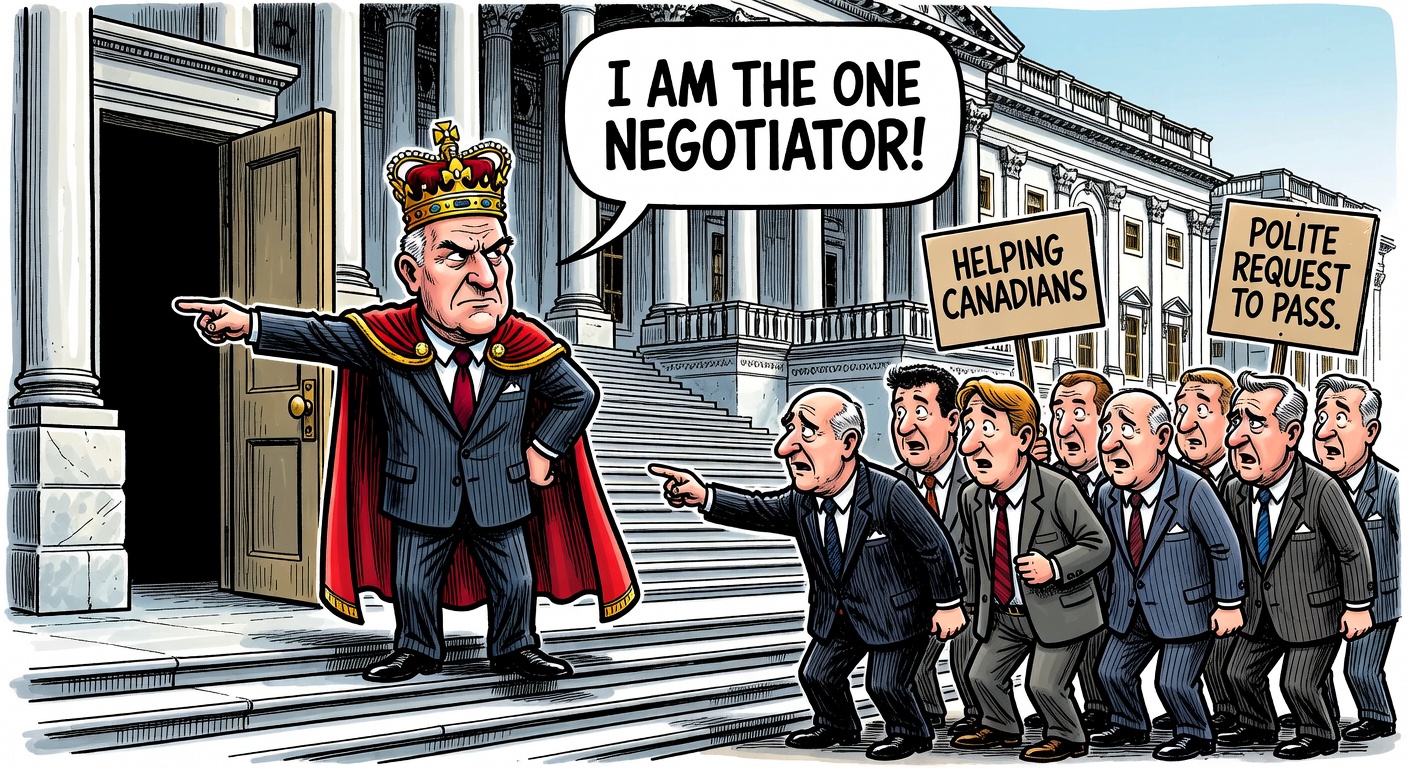
When Conservative MPs went to Washington to fight for Canadian workers and learn what's actually happening in US trade talks, Prime Minister Mark Carney's response was dismissive — and revealing. He declared himself the sole voice of Canada, said Conservative trips "accomplish nothing," and signalled that any Canadian who doesn't work for him has no business representing their country. That's not leadership. That's control.
The Incident
This past week, Conservative MP Jamil Jivani — who attended Yale Law with US Vice-President JD Vance — travelled to Washington alongside Conservative foreign affairs critic Michael Chong and several other MPs. They attended a networking event hosted by the American Chamber of Commerce in Canada and met directly with US Trade Representative Jamieson Greer.
That meeting reportedly produced real information: Greer confirmed the "America First" policy is non-negotiable, and that the US is interested in energy cooperation with Canada. That is substantive intelligence that any competent government should want.
Carney's reaction? Contempt.
"In the end, there's one negotiator for Canada, and that is the Government of Canada... Our interlocutors in the United States are generous people. They're generous with their time... But in the end, they know, and we know that we're the negotiators." — PM Mark Carney, April 30, 2026
Translation: Conservative MPs should stay home, leave the diplomacy to their betters, and trust that Mark Carney has it all under control.
Why This Is a Problem
Canada-US trade negotiations are the defining economic challenge of this era. Hundreds of billions of dollars — and hundreds of thousands of Canadian jobs — hang in the balance. Every useful contact, every relationship, every channel of communication with American officials should be deployed. The idea that only Liberal ministers are permitted to speak with US officials is not a foreign policy — it is a power play.
Jivani's relationship with JD Vance is precisely the kind of back-channel that skilled diplomacy requires. When Canada's foreign affairs bureaucracy has failed to build comparable personal relationships with the new Trump administration, having a Conservative MP who went to law school with the Vice-President is an asset — not a liability. Only an ego-driven prime minister would refuse to use it.
Previous governments — including Liberal ones — understood that opposition party engagement with foreign governments was a normal part of parliamentary democracy. Brian Mulroney was involved in diplomatic back-channels during the first free trade negotiations. Opposition leaders have met with foreign heads of state for decades. This is not controversial. It is standard practice.
The Deeper Pattern
Carney's declaration that there is "one negotiator" fits a broader pattern of Liberal centralization of power. He has already used his newly obtained parliamentary majority to shut down committee investigations, move health spending debates behind closed doors, and steamroll opposition amendments. Now he is claiming exclusive authority over Canada's most important foreign relationship.
This is the same man who was never elected by ordinary Canadians. He was chosen by Liberal party members, given a manufactured majority through floor crossings, and now governs as though dissent is illegitimate.
Conservative Leader Pierre Poilievre pushed back directly: "Dozens of Conservative MPs have travelled to Washington in recent years to fight for tariff-free trade." He's right. And so did Liberal governments, when they were in opposition. The hypocrisy is staggering.
What Canadians Should Ask
If Carney's trade negotiations are going so well, why is he threatened by Conservative MPs meeting with US officials? If his approach is working, why the need to monopolize every channel of communication? Why not welcome additional Canadian voices in Washington — including ones that happen to have direct relationships with the current US administration?
The answer, plainly, is that Carney is more concerned with political control than economic outcomes. He would rather own the file — win or lose — than share the credit with Conservatives who might actually help.
Canadian workers and businesses don't care who gets the credit for a good trade deal. They care whether one gets done. And shutting out the opposition is not how you do that.
- Conservative MP Jamil Jivani attended Yale Law with VP JD Vance — a direct diplomatic asset Carney refuses to use
- The Washington trip produced real intelligence: "America First" is non-negotiable; US wants energy cooperation
- Carney declared himself "one negotiator for Canada" — locking out all opposition engagement with US officials
- Multiple prior governments — Liberal and Conservative — have used opposition back-channels in foreign diplomacy
- Carney has no democratic mandate from ordinary Canadians; he was chosen by Liberal party members and given a majority through floor crossings