"Canada Strong" — Liberals Caught Using Their Own Campaign Slogan in Government Ads, Violating Treasury Board Rules
The Liberal Party ran on the slogan "Canada Strong" during the 2025 federal election. Now MPs on the Commons government operations committee have confirmed that same slogan was used in federally-funded advertising — violating Treasury Board directives against the partisan misuse of public funds. The committee's words: "It literally violates the Treasury Board rules." The Privy Council has promised to investigate.
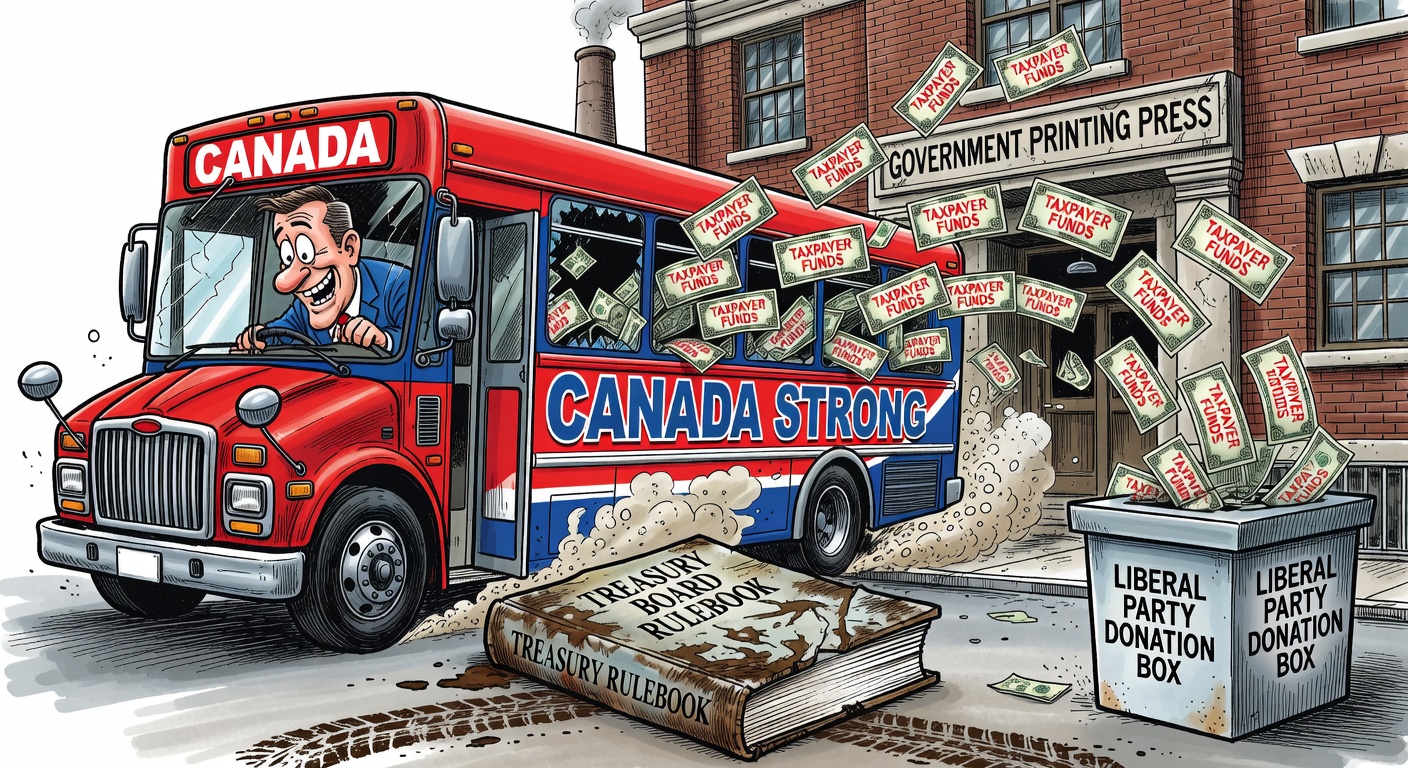
Editorial cartoon — iVoteLiberal.com
When Party Slogans Become Government Propaganda
There is a clear line in Canadian law and Treasury Board policy between government advertising — which must be non-partisan, informational, and paid for by taxpayers — and political advertising, which must be paid for by parties or campaigns using donated funds.
The Liberal Party crossed that line.
According to Blacklock's Reporter, members of the Commons government operations committee confirmed that the phrase "Canada Strong" — the Liberal Party's 2025 federal election campaign slogan — appeared in federal government advertising funded by public money. MPs noted explicitly that this "literally violates the Treasury Board rules" governing the use of public funds for government communications.
The Privy Council Office, which oversees government advertising policy, has promised to investigate.
What the Rules Actually Say
Treasury Board's Communications Policy of the Government of Canada is explicit. Government advertising must:
- Be objective and non-partisan
- Not be designed to promote the political interests of any party or candidate
- Not use slogans, images, or language associated with a political party
- Serve the public interest, not the partisan interest of the governing party
The Liberal Party's "Canada Strong" campaign was built around a specific nationalist framing tied directly to the Liberal election platform, Leader Mark Carney's personal brand, and the party's messaging around tariffs, sovereignty, and economic nationalism. Using that exact slogan in government-funded advertising blurs the line between the state and the party in a way that is not merely sloppy — it is legally problematic.
A Pattern, Not an Anomaly
This is not the Liberals' first rodeo with partisan advertising at taxpayer expense. Consider the history:
- Under Trudeau, the government's ArriveCAN app was promoted with government ads at a time when it was also a signature Liberal political talking point on pandemic management.
- The Canada Child Benefit was promoted in government advertising campaigns timed to pre-election periods in 2019 and 2021, with language closely mirroring Liberal Party campaign material.
- The dental care program was announced and re-announced with taxpayer-funded advertising campaigns bearing Liberal-friendly messaging about government compassion — in the middle of election cycles.
- The Online News Act and the government's broader digital regulatory agenda were also promoted with public funds even as those policies remained contentious and actively tied to Liberal partisan positioning on "big tech accountability."
What makes "Canada Strong" different — and more egregious — is that it was a campaign slogan. There is no ambiguity about its partisan origin. It was coined, trademarked in political usage, and deployed in election advertising. For that phrase to then appear in government communications paid for by taxpayers is not a grey area. It is a textbook violation.
The Investigation That May Go Nowhere
The Privy Council Office's promise to investigate is not reassuring. PCO is not an independent body — it is part of the executive, reporting ultimately to the Prime Minister. An investigation by PCO into advertising approved by the Prime Minister's government is structurally compromised from the start.
What is needed is an independent audit of all federal advertising from the 2025 election campaign through the present, conducted by the Auditor General, to determine:
- How many government ads used Liberal campaign language, imagery, or slogans
- How much public money was spent on those ads
- Who approved the advertising and whether they were aware of the partisan connection
- Whether Elections Canada's rules on third-party advertising were triggered
Canadians are already paying for government programs. They should not also be paying to promote the political party that runs those programs.
"Canada Strong" — But Whose Canada?
There is a rich irony in the Liberals using the "Canada Strong" framing for partisan advertising at the same time Carney is running a $66.9-billion deficit, accumulating $1.333 trillion in federal debt, and presiding over a housing market where the average home costs $817,000.
Canada is "strong" in the sense that its government is strong — powerful, well-resourced, active, and expansive. It is less strong in the sense that ordinary Canadians are falling behind financially, can't afford homes, and are watching their tax dollars disappear into programs like the $300-million failed PrescribeIT electronic prescription service that the Liberals just voted to hide from parliamentary scrutiny.
"Canada Strong" is a marketing slogan. It is not a policy. It is not a plan. And it certainly should not be appearing in government advertising paid for by the same Canadians it is meant to reassure.
The committee members were right: it literally violates the rules. The question is whether the Carney government's PCO investigation will say so — or whether, as is increasingly the Liberals' pattern, the rules will be "investigated" until everyone forgets what they were investigating.
Sources: Blacklock's Reporter, May 1, 2026 — "Misuse Of Slogan Broke Rules" (blacklocks.ca); Treasury Board of Canada, Communications Policy of the Government of Canada.