CSIS Names China and India as Canada's Top Foreign Interference Threats — While Carney Courts Both
Canada's spy agency just released its 2025 Public Report naming China and India as the primary perpetrators of foreign interference and espionage in Canada. Mark Carney's response? A trade deal with China signed in January, a state visit to India in March, and diplomatic courtship of both countries as economic partners. The disconnect is staggering — and dangerous.
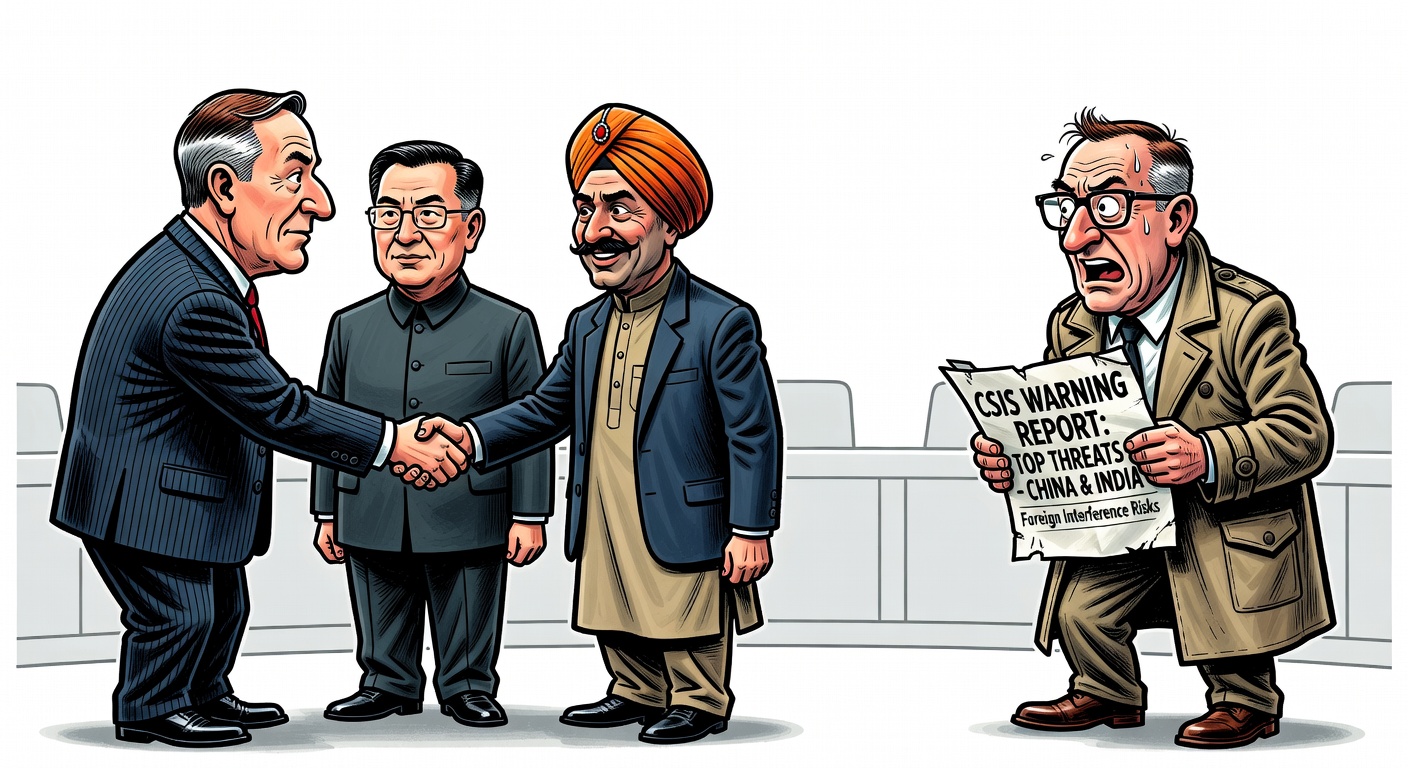
Editorial cartoon — iVoteLiberal.com
Canada's Own Spy Agency Is Sounding the Alarm
On Friday, May 1, 2026, the Canadian Security Intelligence Service released its 2025 Public Report — a 49-page document that is unambiguous in identifying Canada's greatest foreign interference threats. The findings are alarming. The government's response to them is more alarming still.
According to CSIS, China and India are among the "main perpetrators of foreign interference and espionage against Canada." They are joined on that list by Russia, Iran, and Pakistan — but China and India receive the most detailed treatment, with the report noting the sophisticated and ongoing nature of their interference activities.
On China, CSIS warns of clandestine operations targeting Canadian politicians, diaspora communities, universities, and critical infrastructure — threats that have been documented in prior years and that have, thus far, resulted in no meaningful legislative or diplomatic response from the Liberal government.
On India, the language is equally stark: "Historically, India has cultivated covert relationships with Canadian politicians, journalists, and members of the Indo-Canadian community, to exert its influence and advance its interests." CSIS explicitly names "transnational repression" — surveillance and coercion of Canadian residents — as part of India's toolkit on Canadian soil.
A Sikh Activist Warned of a Death Threat — One Month After Carney's India Trip
The CSIS report isn't abstract. One month after Prime Minister Carney's state visit to India — where he met with Prime Minister Narendra Modi on March 2, 2026, at Hyderabad House in New Delhi — BC police warned a prominent Sikh Canadian activist named Narinder Singh Randhawa of an "immediate threat" to his life.
Randhawa is a longtime advocate for Khalistan — a cause that India has worked aggressively to suppress internationally. CSIS's own report notes: "In Canada, advocacy for Khalistan separatism is lawful political activity." And yet, Canadians who exercise that lawful activity are apparently being targeted by a foreign government on Canadian soil.
Where is Carney's outrage? Where is the diplomatic protest? Where are the consequences for India? Instead, Carney flew to New Delhi for photo ops and trade discussions — while CSIS was documenting Indian covert ops targeting Canadian communities.
The China Problem: Brookfield, EVs, and the New Trade Deal
If India's interference ties are politically awkward for Carney, China's are existentially compromising.
In January 2026, barely months into his mandate, Carney announced a trade deal with China — under which Canada agreed to cut restrictions on Chinese electric vehicle imports in exchange for reduced tariffs on Canadian canola seed and other agricultural exports. Carney framed this as trade diversification. Critics called it a capitulation that undercuts both domestic EV manufacturing and Canada's national security posture.
Now, less than six months later, CSIS has released a public report calling China one of Canada's top foreign interference threats. The same China that Carney just gave EV market access to. The same China that Brookfield Asset Management — where Carney spent years as a senior executive and still holds stock options — has deep infrastructure and green energy investments in.
The ethics committee's April 23 report already documented that Carney's ethics screen covers over 103 corporate entities with potential conflicts. Brookfield's extensive China business ties are embedded in that web. Carney's "general application" exemption in his ethics screen explicitly allows him to continue making policy on the very sectors Brookfield profits from.
The Pattern: Warnings Ignored, Threats Welcomed
This is not the first time CSIS warnings have been waved away by a Liberal government. Under Trudeau, CSIS briefed senior officials multiple times about Chinese interference in Canadian federal elections. Those briefings were ignored. Multiple CSIS directors testified to this at the Foreign Interference Commission hearings. The Liberals blamed their own intelligence service rather than holding Beijing accountable.
Under Carney, the pattern is continuing — but with a new twist. Rather than merely ignoring CSIS warnings, Carney is actively rewarding the countries CSIS is warning about with trade deals, diplomatic warming, and economic access.
Canada's National Security and Intelligence Committee of Parliamentarians has noted the "gap between intelligence findings and policy response" in government handling of foreign interference. That gap, it appears, has not narrowed under new management.
What Should Happen — And Won't
A serious government would respond to a CSIS public report naming two of its new trading partners as top national security threats with a formal policy review. It would condition trade discussions on measurable improvements in interference activities. It would introduce and pass the long-promised Foreign Agents Registration Act with teeth — not the toothless version currently in discussion. It would provide full parliamentary briefings on the extent of Chinese and Indian interference in Canadian elections and institutions.
Instead, expect a press conference at which Carney says Canada "takes foreign interference seriously," followed by a trade delegation to Beijing.
CSIS has done its job. The question is whether the Liberal government will do theirs — or whether national security will remain, as it has for a decade, subordinate to the economic and political interests of the Liberal Party and its Bay Street backers.
Sources: CSIS 2025 Public Report (canada.ca/en/security-intelligence-service); National Post, May 1, 2026; National Post, April 2026 (BC police threat warning to Narinder Singh Randhawa); Globe and Mail, July 2025 (Carney ethics screen); Ethics Committee Report, April 23, 2026.