The Liberals Collected $647 Million From Big Tech — Then Had to Give It All Back. Taxpayers Are Out $30 Million for the Privilege.
The Canada Revenue Agency is currently refunding $647 million collected under the Liberal government's Digital Services Tax — a 3% levy on big tech that Ottawa created with great fanfare in 2024, then quietly scrapped when Donald Trump threatened to cut Canada off. The $30 million the government spent building the whole system? That's gone. The interest on what they collected? Also gone. What's left is a cautionary tale about Liberal policy: loud launch, expensive failure, and a bill for ordinary Canadians to pay.
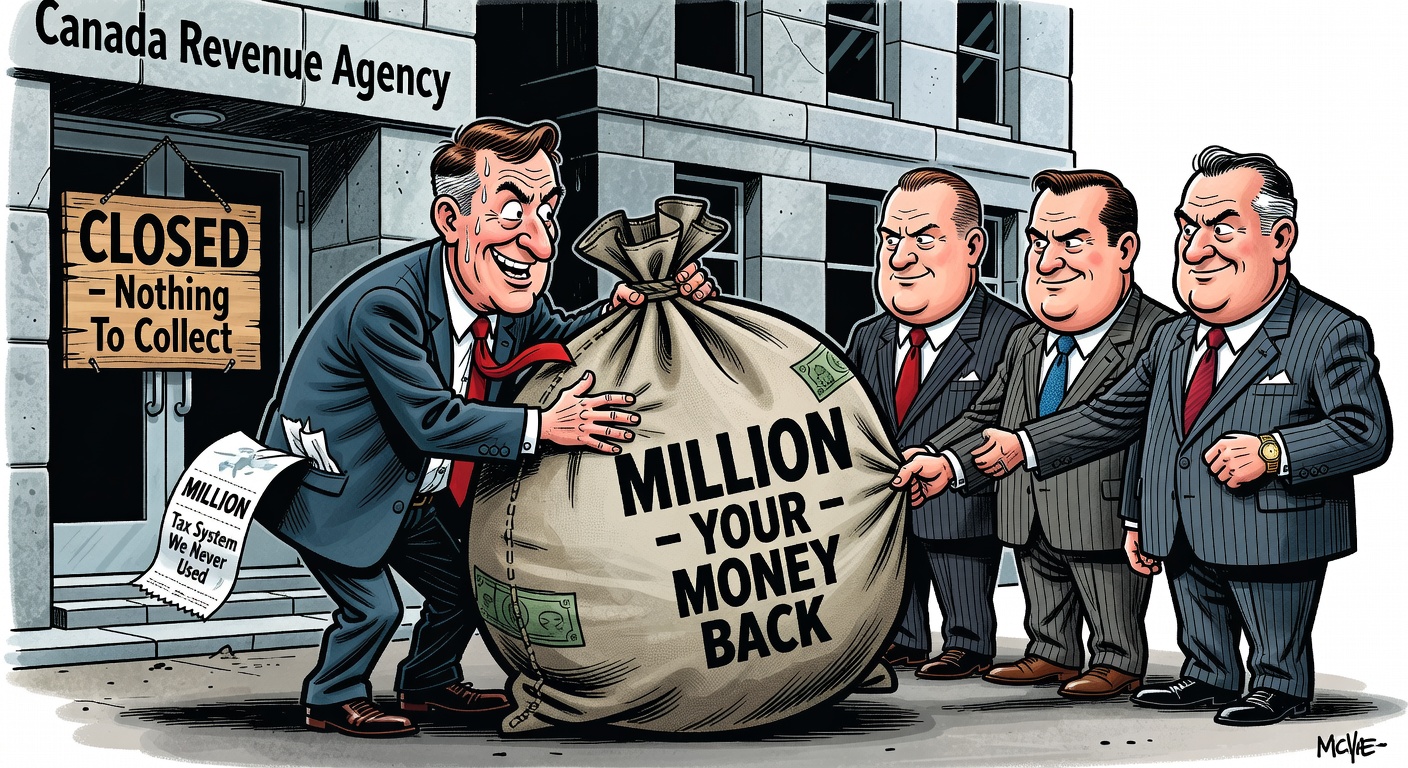
Editorial cartoon — iVoteLiberal.com
What the Digital Services Tax Was Supposed to Be
In 2024, the Trudeau Liberal government launched the Digital Services Tax (DST) — a 3% annual levy on digital services revenue generated in Canada by large multinational technology companies, primarily American firms like Google, Meta, Amazon, and Apple. The stated rationale was that these companies earned billions from Canadian users, paid minimal Canadian tax, and should contribute to the country that made their revenues possible.
On paper, the policy had genuine intellectual support. The OECD had been working on a global framework for taxing digital multinationals for years. France had implemented its own DST. The UK had one too. The Liberals were not inventing something radical — they were implementing a version of what other developed democracies had already done.
The Parliamentary Budget Office projected the DST would add $7.2 billion to federal revenues over five years. That's a significant number — more than enough to fund programs, reduce the deficit, or return money to taxpayers. Ottawa spent $30 million setting up the administrative infrastructure to collect it: systems, forms, IT, staffing, accommodation. The machinery was built. Collection began.
And then Canada blinked.
Trump Threatened. Liberals Caved. The Money Was Returned.
When Donald Trump returned to the White House in January 2025, his administration immediately targeted foreign digital services taxes as discriminatory against American companies. Canada's DST was in the crosshairs. Trump threatened trade consequences. The U.S. trade representative formally protested. Washington made clear: scrap the DST or face tariff retaliation.
The Liberal government — then in the middle of a delicate trade negotiation with an unpredictable American administration — chose to repeal the Digital Services Tax. The legislation to kill the DST was buried inside Ottawa's fall 2025 budget bill, which passed on March 26, 2026.
The repeal was framed publicly as a goodwill gesture to keep trade talks alive. What it actually meant: the government collected $647 million from big tech companies — Google, Meta, Amazon and others — and then had to give it all back.
By late April 2026, approximately $154 million had already been refunded, including nearly $4 million in interest that the government had to pay because it held the money. The rest is in the process of being returned. The $358 million that was applied against "outstanding tax liabilities of the same taxpayers" — offsetting money those companies already owed — also had to be unwound.
The $30 Million Nobody Gets Back
Here is the number that deserves more attention than it's getting: $30 million in taxpayer money was spent building the system to collect the DST. Systems development. Form design. IT infrastructure. Personnel training. Administrative accommodation.
All of it, now useless. The system was built, used briefly, and is being dismantled. The $30 million is not being refunded. It is gone — a sunk cost of a policy that lasted roughly 18 months from creation to repeal.
For context: the ArriveCAN app — the Liberal government's infamous pandemic border-control app that became a national scandal for costing $54 million — was widely condemned as a symbol of Liberal waste and contractor mismanagement. The DST administrative apparatus cost $30 million and produced precisely nothing. No sustainable revenue. No lasting policy. No reform of how Big Tech is taxed in Canada.
Not one mainstream outlet is calling it "DST-Scan." Perhaps they should.
$7.2 Billion That Will Never Arrive
The Parliamentary Budget Office's five-year projection of $7.2 billion in DST revenues will never materialize. That potential revenue stream — not borrowed, not deficit-financed, but earned from companies that genuinely profit from Canadian audiences — has been surrendered.
In its place? Canada is running a $66.9 billion deficit. It is adding $37.5 billion in new spending to the national credit card. Public debt charges are rising toward $80.7 billion per year by 2030. And the tech giants that were going to contribute $7.2 billion to offset some of this are getting their money back.
Meanwhile, Canada's actual citizens — whose digital activity created the platform revenues being taxed — will never see the benefit of that revenue. It was briefly collected. Then surrendered. The bill for running the government falls, as always, to them.
The Pattern: Bold Launch, Quiet Retreat
The DST fiasco fits a familiar Liberal policy pattern: announce with fanfare, frame as bold progressive action, collect political credit, then quietly reverse course when the going gets tough — leaving Canadians with the cleanup costs.
The consumer carbon tax: announced as a climate-fighting mechanism Liberals defended for nearly a decade, then eliminated by Carney days before the election when polling showed it was a political liability. The administrative infrastructure, the rebate programs, the regulatory compliance systems — all wound down. The carbon credit markets that Carney's Brookfield colleagues were positioned to profit from? Still standing, in the form of the industrial carbon tax.
The ArriveCAN app: launched as pandemic security, became a patronage-contractor scandal, quietly buried in a federal audit.
The DST: launched as Big Tech accountability, became a U.S. trade negotiation chip, quietly repealed and refunded.
The common thread: Canadians pay for the launch. They pay for the retreat. And they rarely hear a clear accounting of what it all cost.
The CRA's confirmation that $647 million is being refunded — $154 million already out the door, with $4 million in interest on top — is one of those rare moments of institutional transparency. The total cost of the DST experiment: $30 million in setup costs, plus $4 million in interest, plus the permanent loss of $7.2 billion in projected five-year revenues.
That's a lot of money for a tax that achieved nothing.
Sources: National Post, "CRA refunding $647 million collected from repealed digital service tax," May 2, 2026; Parliamentary Budget Office, Digital Services Tax Revenue Projection (2023); Finance Canada, Fall Economic Statement 2025; Budget Implementation Act, March 26, 2026.