"Fiscal Discipline" That Costs $37.5 Billion: Carney's Spring Update Keeps Canada's Debt Clock Running
Finance Minister François-Philippe Champagne stood before Canadians this week and declared his government was "restoring fiscal discipline." Then, in the same breath, he announced $37.5 billion in brand new spending. The federal debt is on course to hit $1.629 trillion by 2030. By that point, Canadians will be paying $80.7 billion per year — every year — just in interest. This is what the Liberal Party calls restraint.
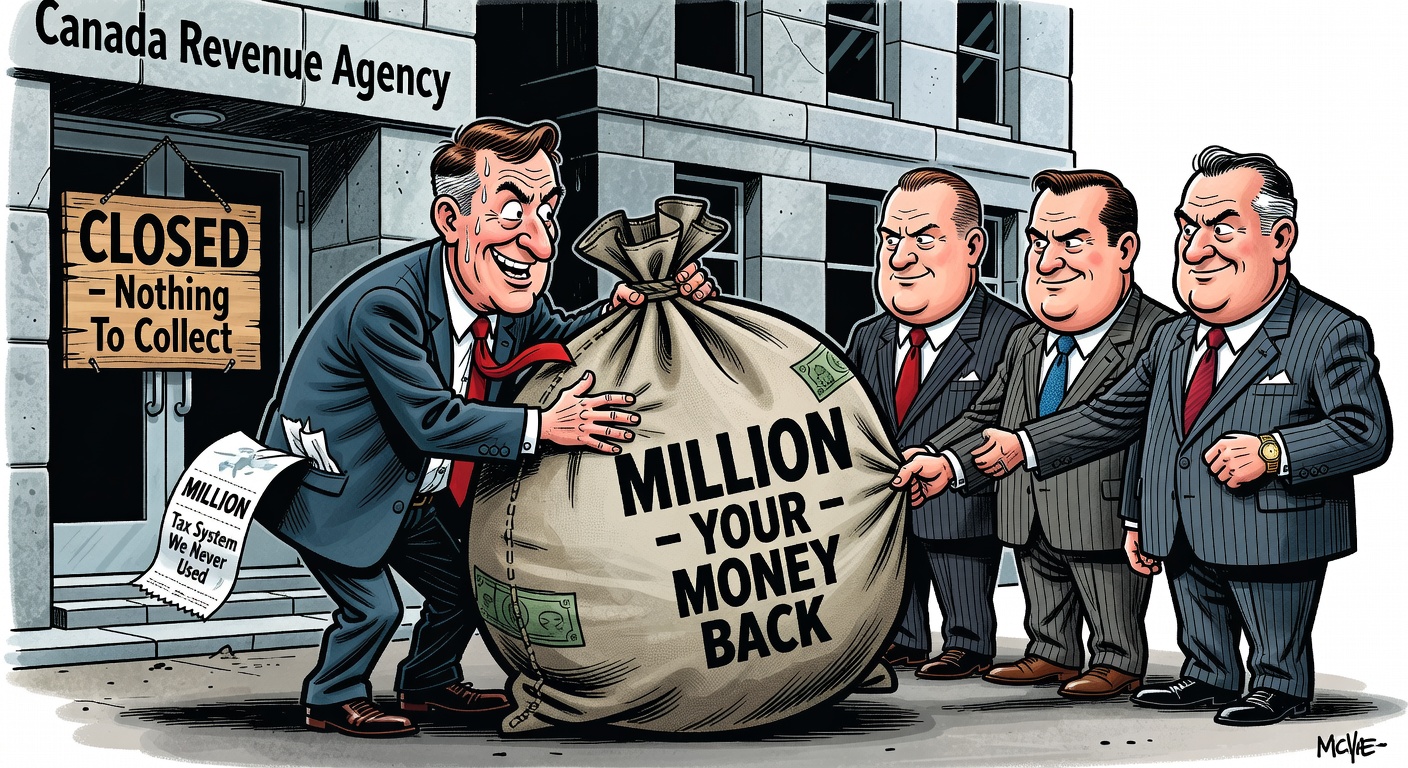
Editorial cartoon — iVoteLiberal.com
The Numbers They Want You to Miss
Let's start with what the Liberal government is celebrating: the 2025–2026 deficit came in at $66.9 billion — a full $11.4 billion below the projected $78.3 billion. That projection, it bears noting, was already the largest peacetime deficit in Canadian history outside of the COVID pandemic years. Coming in $11.4 billion better than a historic low bar is not something that warrants a press conference congratulating oneself on fiscal prudence.
But even that modest improvement was largely accidental. The Iranian conflict drove oil prices higher, boosting resource sector revenues. The Canadian economy performed better than Treasury expected. These were external factors, not Liberal policy. The government stumbled into the improvement — then sprinted to spend the windfall.
Revenue projections over the next five years increased by an average of $7.2 billion per year. A fiscally disciplined government would bank some of that improvement against a rainy day, reduce the deficit more aggressively, or — radical notion — pay down a fraction of the debt.
The Carney government did none of these things. It spent the money. And then some.
$37.5 Billion in New Spending — and That's Just the Start
Tuesday's spring economic update announced $37.5 billion in net new spending over six years. That number alone is startling. But the full picture is worse: when you include all new spending announced since Budget 2025 — a document released less than a year ago — total new commitments exceed $54 billion.
Finance Minister Champagne defended the spending surge by citing "affordability measures." The Liberals are spending more to address problems created, in significant part, by Liberal spending and regulation over the past decade. There is a circular logic here that the government hopes Canadians won't notice: spend heavily → inflation and unaffordability rise → announce new affordability spending → declare yourself a champion of ordinary Canadians.
Conservative Leader Pierre Poilievre put it plainly in the House of Commons: Carney's approach means "more cost, more debt and more bills on the national credit card."
$1.629 Trillion: The Number That Should Haunt Every Canadian
The federal government's own projections put the national debt at $1.333 trillion today. By the end of this decade — 2030–2031 — that figure is projected to swell to $1.629 trillion. That is an additional $296 billion added to the debt in five years. That is roughly $7,400 for every man, woman, and child in Canada — on top of the $33,325 each Canadian already owes on the existing debt.
And the cost of carrying that debt? Public debt charges — the interest Canadians pay just to service the money already borrowed — are projected to reach $58.7 billion this fiscal year, rising to a staggering $80.7 billion annually by 2030–2031.
To put that in perspective: $80.7 billion per year is more than Canada's entire annual defence budget, more than the federal contribution to health care, and more than Ottawa spent on old age security just a decade ago. It is money that builds nothing, heals no one, and employs no Canadian. It is money paid to bondholders — many of them offshore institutional investors — as the price for running permanent deficits.
The Debt-to-GDP Trap: A Promise Already Abandoned
The Carney government has established two "fiscal anchors": balancing operating spending with revenues by 2028–2029, and maintaining a declining deficit-to-GDP ratio. These sound reassuring until you read the fine print.
The debt-to-GDP ratio is projected to rise — from current levels to 41.5 per cent in 2026–2027 — and remain elevated at 41.6 per cent in 2030–2031. A "declining" ratio that declines by 0.1 percentage points over four years, after rising, is not a fiscal anchor. It is window dressing.
More notably: the previous Liberal anchor under Justin Trudeau was to bring the debt-to-GDP ratio down to pre-pandemic levels. Carney has quietly abandoned that commitment entirely. Finance Canada documents confirm there is no commitment to return the ratio to pre-pandemic levels. The goalposts have been moved so far that the field has changed.
Who's Paying for This?
You are. Through income taxes that continue to rise (personal and corporate revenue projections both increased, suggesting higher tax takes). Through inflation driven by deficit spending that pumps money into a fixed-capacity economy. Through the carbon tax — the industrial version of which Carney kept — that adds cost to virtually every product made or shipped in Canada. Through future austerity that becomes mathematically inevitable when debt service alone consumes $80 billion per year.
The Liberals have a genius for spending money they don't have, announcing programs that help people they've made poorer, and calling it a plan. The spring economic update is a masterclass in that tradition. A smaller deficit than projected, celebrated with $37.5 billion in new commitments. Fiscal discipline, they call it.
When a government pats itself on the back for only adding $66.9 billion to the national credit card instead of $78.3 billion — and then immediately charges $37.5 billion more — the word "discipline" has lost all meaning.
Canadians are paying attention. The debt clock is running. And the bill, as always, comes due.
Sources: National Post, "Federal deficit smaller than expected in spring economic update, but with $37.5B in extra spending," April 29, 2026; Finance Canada Spring Economic Statement 2026; House of Commons, Pierre Poilievre statement, April 29, 2026.