Carney's Government Eyes Social Media Ban for Minors — But This Is Really About Control
The Carney Liberal government is now weighing banning social media for Canadians under 16. Framed as child protection, this proposal comes from the same government that passed C-11, killed C-18, and drafted Bill C-63 — a regime with a decade-long, documented obsession with controlling what Canadians can see, say, and share online. The pattern is unmistakable.
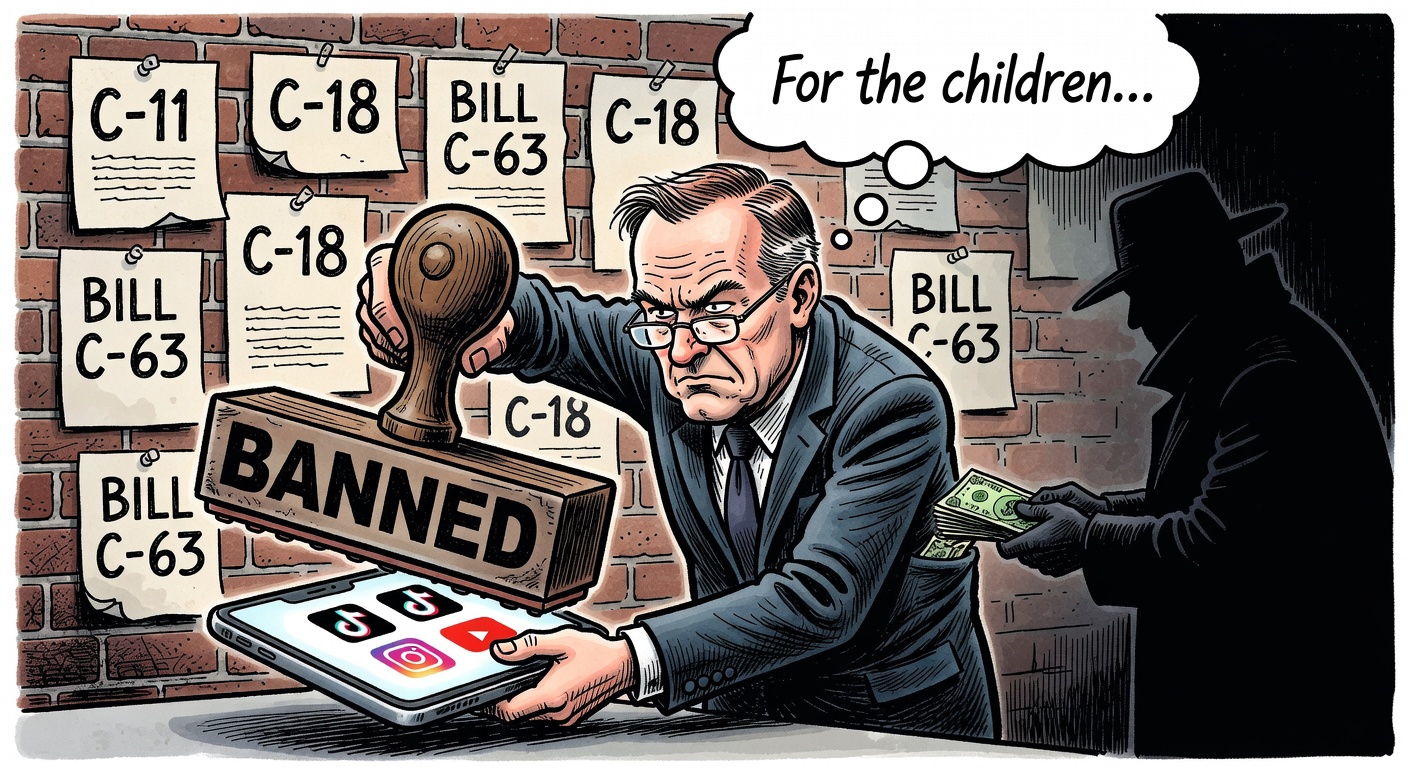
Editorial cartoon — iVoteLiberal.com
The Proposal: Banning Social Media for Under-16s
As reported by the National Post this morning (May 2, 2026), Prime Minister Mark Carney's government is actively weighing legislation to ban social media access for Canadians under the age of 16. The discussions are described as "early" — but the direction is clear, and the Conservatives are already being drawn into the debate, with several MPs expressing openness to the concept.
On the surface, the stated motivation is admirable: protecting children from the documented harms of social media — anxiety, depression, exposure to predators, algorithmic manipulation of young minds. These are real issues, and no reasonable person denies that social media companies have profited enormously from addicting teenagers to their platforms while doing the bare minimum to protect them.
But here's the question Canadians should be asking: Is this government — this specific government — the right one to be given new powers to regulate and restrict online access?
The Liberal Internet Control Record: A Decade of Overreach
Context matters enormously here. The Carney Liberal government is not coming to this issue with clean hands.
Bill C-11 (Online Streaming Act) — passed into law in 2023 under Trudeau — granted the CRTC sweeping powers to regulate online content, including user-generated content. Despite government assurances to the contrary, the bill was widely condemned by legal experts, free speech advocates, and independent creators as a mechanism for government to shape what Canadians encounter in their feeds and what Canadian creators can produce without regulatory interference.
Bill C-18 (Online News Act) — also passed in 2023 — forced tech platforms to pay government-licensed media outlets for linking to news, while simultaneously propping up the same $600 million subsidized media ecosystem that depends on Liberal government goodwill to survive. Independent, critical voices were explicitly disadvantaged. Meta responded by removing Canadian news from its platforms entirely — hurting small independent outlets most of all.
Bill C-63 (Online Harms Act) — introduced by Trudeau's government but never fully passed — would have created sweeping new powers to pre-emptively regulate "harmful" online speech, including retroactive penalties for past speech acts. Civil liberties groups across the political spectrum raised alarms that it would create a federal speech police.
And now, under Carney, a new proposal: restricting under-16s from social media platforms entirely. Each step broadens the government's footprint in the online lives of Canadians.
Who Decides What's Safe for Your Children?
The deeper issue isn't whether social media is harmful to teenagers — it often is. The issue is whether it should be the federal government making that determination and enforcing it through legislation, or whether it should be parents.
Parents in Canada currently have tools: parental controls, device management, family agreements, and — most importantly — conversations with their children. A government ban does not replace parenting. It replaces parental judgment with bureaucratic fiat. And once Ottawa has the infrastructure to verify ages and restrict access to online platforms, that infrastructure doesn't disappear when the next government arrives.
It's worth noting what kind of government would be building this infrastructure: one that has already demonstrated, repeatedly, a willingness to use regulatory powers to shape online discourse in ways that favour its political interests. The CRTC, under Liberal-appointed leadership, is the same body that delayed and complicated the licensing of independent conservative media while fast-tracking government-aligned outlets.
The "Protect the Children" Play Is the Oldest Trick in the Censorship Playbook
Governments around the world — including authoritarian ones — have long understood that "protecting children" is the most politically bulletproof justification for restricting internet access. China's Great Firewall was partly justified on child protection grounds. Australia's social media ban for under-16s, passed in 2024, was applauded globally even as digital rights experts warned of chilling effects and enforcement mechanisms that would inevitably be expanded.
The Carney Liberals are not China. But they are a government with a documented pattern of using each crisis — real or perceived — to consolidate new powers over Canadians' online lives. C-11 was sold as "Canadian culture protection." C-18 was sold as "saving journalism." C-63 was sold as "online safety." Now, a social media ban is being sold as "protecting our kids."
The framing changes. The direction of travel does not.
What to Watch For
As this legislation develops, Canadians should watch for three things: First, whether age verification requirements extend to all online platforms — not just social media — creating a de facto national system of identity verification for internet access. Second, whether the CRTC or another federal body is given enforcement powers, adding to the already considerable regulatory state overseeing Canadian online life. Third, whether the definition of "social media" is written broadly enough to capture news aggregators, comment sections, forums, and other tools of democratic discourse.
This government has earned the public's skepticism on internet regulation. It has not earned the benefit of the doubt.
Sources: National Post, May 2, 2026 — "Conservatives join Liberals in asking whether social media should be banned for kids."