50 Years of History Prove It Won't Work — So Why Is Carney Doubling Down on China?
A new Fraser Institute report finds that Canada has failed to meaningfully diversify trade away from the United States for the past 50 years — despite signing 16 free trade agreements and spending decades trying. The only real beneficiary of previous diversification pushes was China. Carney's response? Give China more access. The definition of insanity, brought to you by the Liberal Party of Canada.
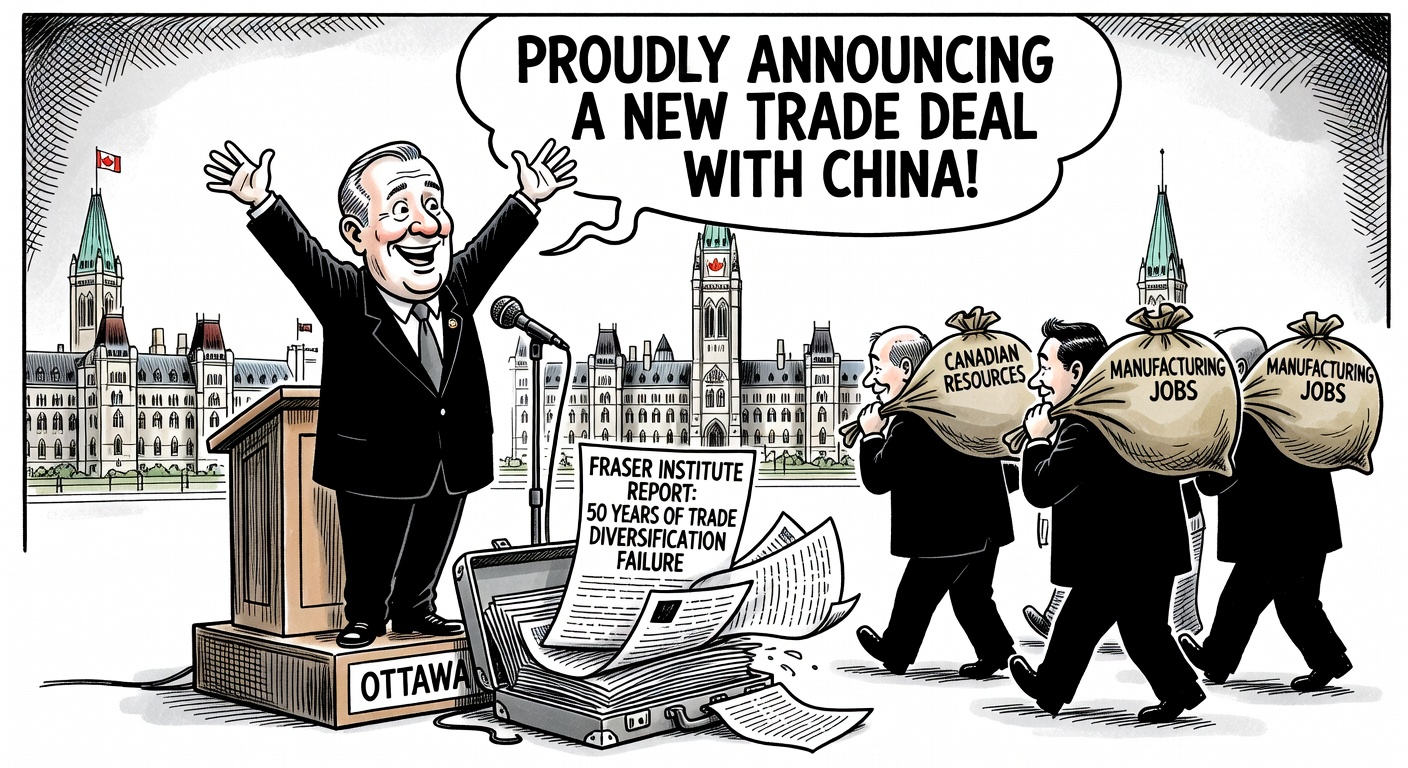
Editorial cartoon — iVoteLiberal.com
The Promise vs. The Record
Mark Carney ran his election campaign on a stark message: Canada must reduce its dependence on the United States. With Donald Trump threatening tariffs and Canada's most important trading relationship under strain, Carney promised to "diversify" — to open new markets in Europe, Asia, and beyond, breaking Canada's 80% reliance on American buyers.
It sounded bold. It sounded pragmatic. It sounded, frankly, like something every Canadian government has promised for the past five decades.
The Fraser Institute — Canada's leading independent economic policy research organization — has just published a report examining 50 years of those exact promises. The conclusion is brutal: Canada has not succeeded in diversifying its trade away from the United States in any meaningful way.
Between 1988 and 2020, Canada signed 16 free trade agreements with non-US countries. After all of that diplomatic effort, paperwork, and political capital, Canada's exports to non-US markets barely moved. Today, nearly 80 per cent of Canada's merchandise exports still go to the United States.
Who Benefited? China.
Here is the part of the Fraser Institute's findings that should make every Canadian pause.
Of all the trade that Canada managed to redirect away from the US in recent decades, virtually all of it flowed to China — not Europe, not Japan, not India, not the developing world. China gobbled up what Canadian diversification efforts produced. Canada became more dependent on China, not less dependent on America.
And now, facing precisely this dynamic, Mark Carney's first major trade move was to sign a new deal with China in January 2026 — cutting Canadian restrictions on Chinese electric vehicle imports in exchange for reduced tariffs on Canadian canola seed and other agricultural products.
Think about that carefully. The country that has historically vacuumed up the benefits of Canada's diversification efforts — at the cost of domestic manufacturing, IP theft, and national security concerns — just got more market access. In exchange, Canada gets tariff relief on farm products that China can and has weaponized as political leverage in the past.
The EV Angle: Undercutting Canadian Industry
The Chinese EV concession in Carney's trade deal deserves particular scrutiny. Canada has been building its own electric vehicle supply chain — supported by billions in government investment in battery plants in Ontario and Quebec, and by existing tariff protections that keep Chinese EVs (which are heavily subsidized by Beijing) from flooding the Canadian market.
By cutting restrictions on Chinese EV imports, Carney has potentially undermined the very domestic industry his government claims to be building. The United States has maintained high tariffs on Chinese EVs. The European Union, after extensive review, imposed its own tariffs in 2024. Canada — uniquely — is now moving in the opposite direction.
One might ask why. One answer, documented extensively, is that Brookfield Asset Management — where Carney spent five years as a senior executive — has extensive green energy and infrastructure investments in China. Brookfield Renewable Partners operates Chinese renewable energy assets. Carney holds unexercised Brookfield stock options worth millions. His ethics screen covers over 103 corporate entities. Brookfield's success in China is directly connected to Chinese government policy on the very sectors Carney is now regulating.
We are not saying there is a provable direct link between Carney's trade deal and his Brookfield holdings. We are saying the appearance of conflict is overwhelming, and the Parliament's own ethics committee agrees — it called for Carney to divest from Brookfield entirely. He has refused.
CSIS Just Called China a Top Threat. On the Same Day.
On May 1, 2026 — the same week the Fraser Institute published its trade diversification findings — Canada's own spy agency CSIS released its 2025 Public Report naming China as one of Canada's top foreign interference and espionage threats.
CSIS documented Chinese interference in Canadian elections, universities, diaspora communities, and critical infrastructure. This is not new intelligence — it has been documented for years. What is new is the simultaneity: CSIS warns about China on Friday; Carney's government champions deeper economic integration with China the rest of the week.
No serious democracy should be deepening economic ties with a state its own intelligence agency has publicly identified as a national security threat — not without extraordinary safeguards, parliamentary oversight, and public justification. Canada is doing none of these things.
Carney's Churchill Port Promise: Same Fantasy, New Packaging
Among Carney's other trade diversification promises is fast-tracking a new port in Churchill, Manitoba — designed to ship natural resources to Asian markets via the Arctic. On paper, it sounds visionary. In practice, the Churchill port has been part of Canada's trade diversification fantasy for decades. The infrastructure challenges, climate risks, and shipping economics have consistently made it unworkable as a major commercial corridor.
The Fraser Institute's 50-year survey would suggest skepticism is warranted. Diversification promises in Canada have a long track record of expiry without delivery — but they are reliably useful at election time.
What Accountability Looks Like
Canadians deserve a trade policy that is honest about what 50 years of evidence shows. They deserve a government that doesn't respond to a national security warning about China by offering China more market access. They deserve a prime minister whose financial ties to a company with extensive Chinese government-linked business do not create the appearance — or reality — of a conflict when he sets trade policy.
What they have instead is a Davos economist who believes this time will be different — that the right deal with China, the right port in Manitoba, the right speech in Brussels will finally break the gravitational pull of the US market. History says no. CSIS says be careful. The ethics committee says divest.
Carney says: watch me.
Sources: Fraser Institute, "Canada's Trade Diversification: 50 Years of Limited Progress" (April 2026); National Post, April 30, 2026; CSIS 2025 Public Report, May 1, 2026; Globe and Mail, January 2026 (Canada-China EV trade deal); Ethics Committee Report, April 23, 2026; Globe and Mail, July 2025 (Carney ethics screen, 103 entities).