Ethics Committee Said Sell Your Brookfield Stock. Four Days Later, Carney Announced a $25B Fund in the Same Sectors.
On April 24, 2026, the House of Commons Ethics Committee concluded that Prime Minister Mark Carney's blind trust is "insufficient" and formally recommended he divest his Brookfield Asset Management holdings. On April 27 — exactly four days later — Carney announced the $25-billion Canada Strong Fund, a government investment vehicle targeting infrastructure, natural resources, and green energy. The same sectors Brookfield operates in. The same sectors that make Carney wealthy. This is what conflict of interest looks like in plain sight.
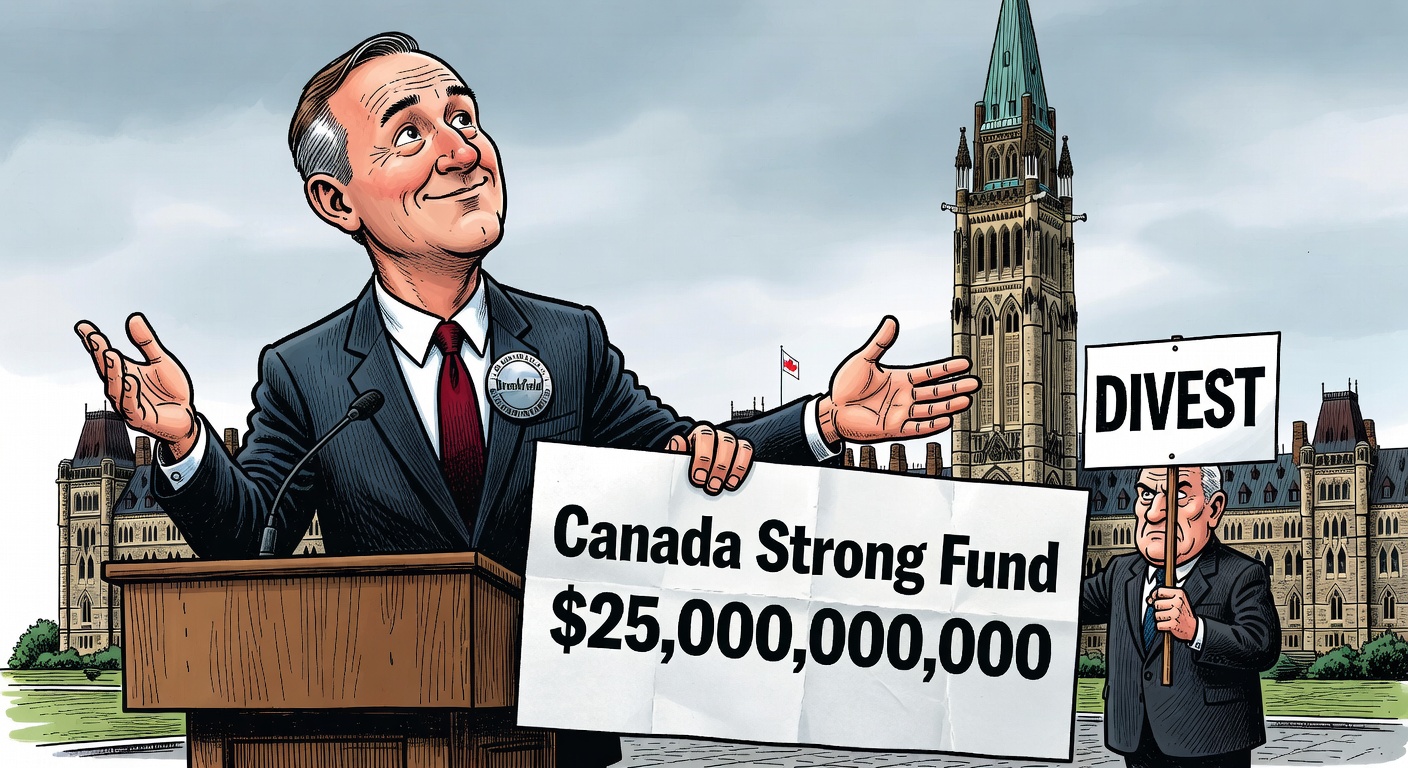
Editorial cartoon — iVoteLiberal.com
What the Ethics Committee Actually Found
Canada's House of Commons Standing Committee on Access to Information, Privacy and Ethics released its report on April 24, 2026. Its core finding was unambiguous: Prime Minister Carney's use of a blind trust to manage his extensive business holdings — including his significant stake in Brookfield Asset Management, one of the world's largest alternative asset managers — does not meet the standard required of someone in his position.
The committee's recommendation was clear: Carney should sell his Brookfield holdings outright. A blind trust, they found, is "insufficient" when the PM is actively setting policy in the very sectors where his assets generate returns. The conflict is not hypothetical. It is structural and ongoing.
Carney came to power from Brookfield, where he served as Head of Transition Investing. His personal holdings in the firm are estimated at over $10 million. Brookfield invests heavily in infrastructure, renewable energy, real estate, and natural resource projects — many of which receive or are eligible for federal government contracts, grants, and regulatory favours. His ethics screen covers over 103 corporate entities.
Four Days Later: The $25B Canada Strong Fund
Rather than comply with the committee's recommendation, Carney doubled down.
On April 27, 2026, Carney announced the Canada Strong Fund — a government-backed investment vehicle seeded with $25 billion in federal money, explicitly designed to invest in infrastructure, ports, natural resource projects, and strategic Canadian assets. The announcement described it as Canada's answer to sovereign wealth funds like Norway's Government Pension Fund Global.
There is one critical difference. Norway's fund was built over 30 years from oil profits. Canada is running a $78.3-billion deficit. The $25 billion seeding the Canada Strong Fund is not savings — it is borrowed money. Canada has no surplus. The fund is 100% debt-financed.
More troubling: the sectors the Canada Strong Fund will invest in — infrastructure, green energy, natural resources, and real asset management — are precisely the sectors in which Brookfield Asset Management, and by extension Carney's personal portfolio, operates. Carney dismissed the conflict by noting the fund will be managed "independently." But he is the Prime Minister. He sets the mandate. He appoints the board. He controls the budget. And he still holds the stock.
The "General Application" Loophole
Carney's defenders point to his ethics screen — the arrangement under which his office, in theory, recuses him from decisions that would directly and specifically benefit his holdings. But as the Ethics Committee's report documents, the screen includes a "general application" exemption. This exemption allows him to make policy decisions on entire sectors — infrastructure spending, green energy regulation, natural resource frameworks — as long as those decisions are not uniquely tailored to Brookfield.
In practice, this means he can announce a $25-billion government investment fund that systematically channels public capital into the asset classes Brookfield specializes in — and his ethics screen won't catch it, because the benefit is "general" rather than "specific." It is a loophole large enough to drive $25 billion through.
A Pattern, Not a Coincidence
This is not the first time questions about Carney's Brookfield ties have surfaced. In his first weeks as Prime Minister, Carney made major announcements about federal infrastructure investment — all in sectors where Brookfield is a major player. He fast-tracked environmental approvals for certain large-scale energy transition projects. He met with major pension funds and alternative asset managers to discuss co-investment frameworks with the federal government.
CarneyWatch.ca, which tracks the Prime Minister's policy reversals and conflicts, summarizes the pattern bluntly: "When asked to divest, the Prime Minister responded by announcing a fund in the same sectors that enrich him."
It's hard to argue with that framing. The Ethics Committee said divest. Carney said: watch me invest.
What Accountability Looks Like — And Doesn't
A Prime Minister with genuine respect for conflict-of-interest rules would have done one of two things when the Ethics Committee released its report: comply with the divestiture recommendation, or at minimum pause any new policy announcements affecting the relevant sectors while responding formally to the committee's findings. Carney did neither.
Instead, he held a press conference four days later announcing a $25-billion government fund that will operate in the asset classes he personally profits from — using money borrowed against the future of every Canadian taxpayer.
The media largely covered the Canada Strong Fund as an economic policy story. It is. But it is also something else: a Prime Minister responding to an ethics finding not with compliance, but with escalation.
Canadians deserve a Prime Minister who, when told "your financial interests conflict with your public duties," responds by resolving the conflict. Not by deepening it.
Sources: CarneyWatch.ca (April 24–27, 2026); National Post — Jesse Kline, "Carney's 'sovereign wealth fund' an admission of Liberal failures" (April 28, 2026); House of Commons Standing Committee on Access to Information, Privacy and Ethics report (April 24, 2026); federal government Canada Strong Fund announcement (April 27, 2026).