67% of Canadians Say Carney Is Failing on Housing. 70% on Cost of Living. Even His Own Supporters Are Disappointed.
A new Angus Reid Institute poll of 2,013 Canadians finds the two issues that matter most to voters — housing affordability and cost of living — are the exact two areas where the Carney government is falling furthest short. Two-thirds of Canadians say he's failed on housing. Seventy per cent say he's failed on affordability. And roughly half of Liberal voters agree. After ten years of broken Liberal promises, Canadians have noticed the pattern.
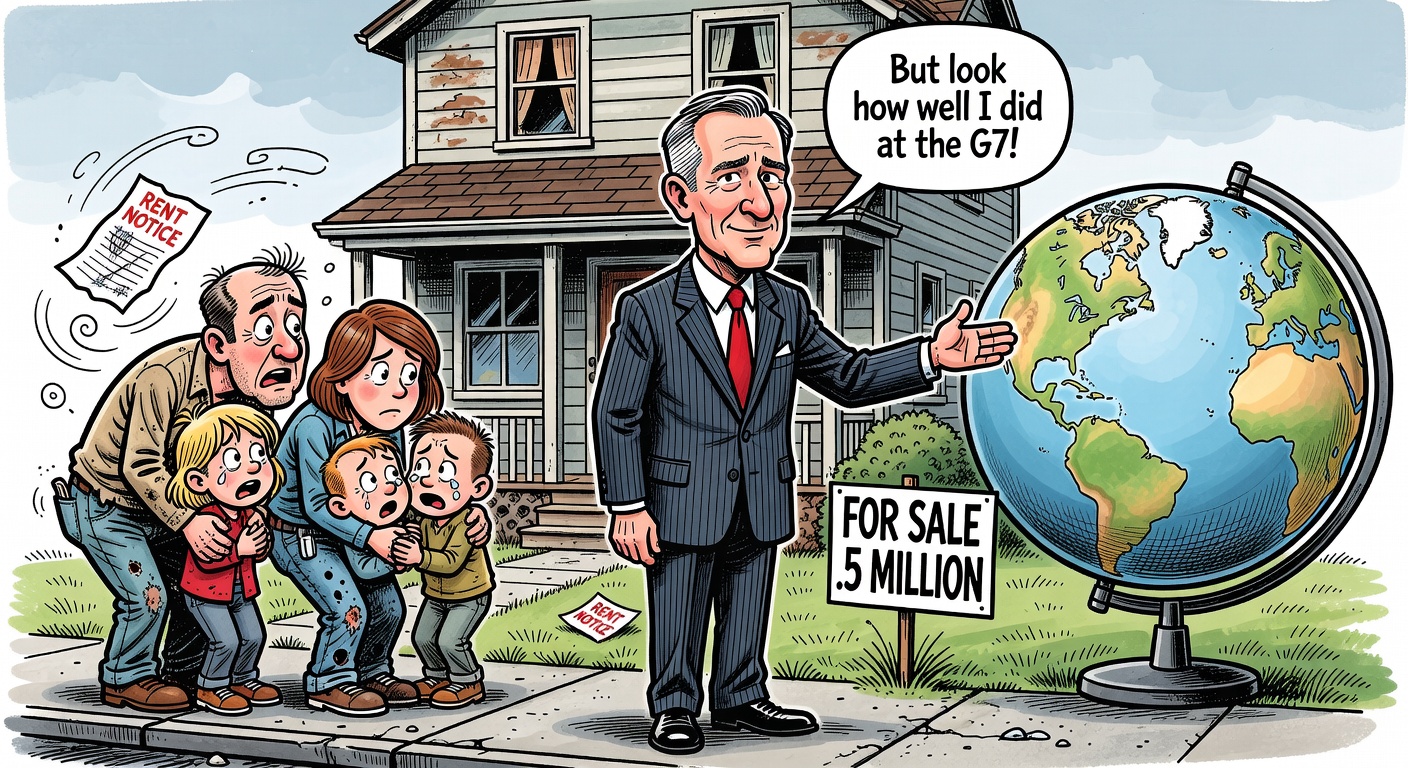
Editorial cartoon — iVoteLiberal.com
What Canadians Actually Care About
When Mark Carney won his minority government in the 2025 federal election — a result that has since been converted into a majority through three by-election wins and a remarkable five MPs crossing the floor — he inherited a clear mandate from voters. The Angus Reid Institute tracked voter priorities going into that election. The results were unambiguous.
Cost of living and inflation were the top concern for Canadians. Housing affordability was second. Health care was third. Relations with the United States under Donald Trump, while important, ranked considerably lower.
Carney's "Elbows Up" campaign zeroed in on the US relationship — correctly reading the emotional temperature of the moment. But as ARI now notes pointedly: "It is concerns from Canadians over pocketbooks that linger."
A year of international summits, trade diversification speeches, and G7 diplomacy later — the mortgage is still unaffordable. The groceries are still expensive. And Canadians have noticed.
The Poll Numbers Are Damning
The Angus Reid survey of 2,013 Canadians, conducted in late April 2026, found:
- 67% of Canadians say the Carney government has fallen short on housing affordability
- 70% say it has fallen short on cost of living and inflation
- 44% say the government has fallen short on climate change and environmental policy
- More Canadians overall say the country is not on the right track under Carney
- Only 12% of 2025 Liberal voters say Carney has exceeded their expectations
- 59% of Liberals say he has merely "met" expectations — a low bar, not a ringing endorsement
- 17% of Liberal voters say they're not sure or couldn't say — polite polling language for disappointment
Perhaps most striking: among self-identified Liberal supporters, 50 per cent said Carney's government has fallen short on housing affordability, and 54 per cent said it has fallen short on cost of living. When half your own voters think you're failing on the issues they care most about, the word "majority" becomes a shield rather than a mandate.
Ten Years and Nothing Has Moved
The Trudeau Liberals came to power in 2015 promising to address housing affordability. They created a National Housing Strategy in 2017. They launched a Housing Accelerator Fund. They announced a Foreign Buyer Ban. They pledged to double the pace of homebuilding. Over ten years, the average Canadian home price went from roughly $450,000 to over $817,000. Rental vacancy rates hit historic lows. Homeless encampments appeared in every major city. The housing strategy had a $70 billion price tag and produced a crisis worse than the one it was supposed to fix.
Carney inherited this record. His response has been to promise more of the same: more government funds, more targets, more strategies. But the structural problems — restrictive zoning laws controlled by municipalities, environmental assessment delays, the financialization of housing driven in part by low interest rate policy that Carney himself championed at the Bank of Canada — have not been touched.
The Angus Reid numbers reflect a population that has been promised housing solutions by Liberal governments for a decade and has watched those promises evaporate. Fool me once.
Cost of Living: The War in Iran Made It Worse
The ARI survey notes that the cost of living crisis has been "made considerably worse since war in the Middle East has sent gas prices soaring worldwide." This is true — and it is a global phenomenon, not a uniquely Canadian one. But several cost-of-living drivers in Canada are entirely domestically manufactured.
The industrial carbon tax — which Carney kept even after eliminating the consumer version — adds costs to every business that produces, manufactures, ships, or heats anything in Canada. Those costs are passed to consumers. The regulatory burden on homebuilding, resource extraction, and small business has increased under a decade of Liberal government. Immigration levels that added nearly 1.5 million people to Canada in a single year put extraordinary pressure on rental markets and services without a matching increase in supply.
These are policy choices. They have consequences. Polls like this one are how those consequences manifest in public opinion — lagging the decisions by months or years, but arriving eventually.
While Ottawa Talks, Your Rent Goes Up
Mark Carney spent the weeks following his election at international forums — G7, G20, bilateral meetings with European leaders, speeches at global climate conferences. This is not without value; managing Canada's relationship with the United States during a period of unprecedented trade hostility matters enormously. But it is a form of optics management. The foreign policy stage flatters a certain type of politician. It generates photographs. It generates headlines about Canada's "respected voice on the world stage."
Meanwhile, in Vancouver, Toronto, Calgary, and Halifax, the average renter pays more than half their take-home income on rent. In Victoria, the average home requires 93% of median household income just to qualify for the mortgage. Canada's homeownership rate for Canadians under 35 has collapsed to levels not seen since the 1970s.
Carney knows these numbers. He has access to every statistic in the Finance Department. And yet his spring economic update — with $37.5 billion in new spending — did not produce a housing revolution. It produced affordability measures: means-tested credits, targeted transfers, incremental programs. These help at the margins. They do not build 3.5 million homes.
A Majority Built on Floor-Crossers and By-Elections
One detail in the ARI reporting deserves examination: the Carney government's minority has become a majority through three by-election wins and five floor-crossers — four from the Conservative Party of Canada and one NDP MP. This majority was not earned through a fresh mandate from voters. It was assembled through political maneuvering.
A government with a genuine democratic mandate to govern would feel the urgency that 70 per cent disapproval on cost of living demands. A government that assembled its majority through backroom conversions and safe by-elections may feel, correctly, that its grip on power is structurally secure regardless of polling.
That security is exactly the wrong thing for a government facing a housing crisis, a cost-of-living crisis, and a population that is increasingly angry. Complacency is not a governing strategy. It is a countdown.
Sixty-seven per cent of Canadians are watching. The clock is running.
Sources: Angus Reid Institute, "Carney One Year: Approval, Campaign Promises, Liberals" (April 2026); National Post, "Majority of Carney's Liberals have faith in his leadership. Here are the ones who don't," April 28, 2026; CMHC Housing Market Outlook 2026; Statistics Canada, homeownership rate data.