Lost Generation: Canada's Youth Unemployment Hits Near-Record Highs Under Liberal Watch
A new report from the Fraser Institute reveals that youth unemployment in Canada surged from 10% to 13.8% between 2022 and 2025 — the fastest three-year increase on record outside of a recession. On International Workers' Day, Canada's young people are facing a jobs crisis that politicians in Ottawa aren't talking about.
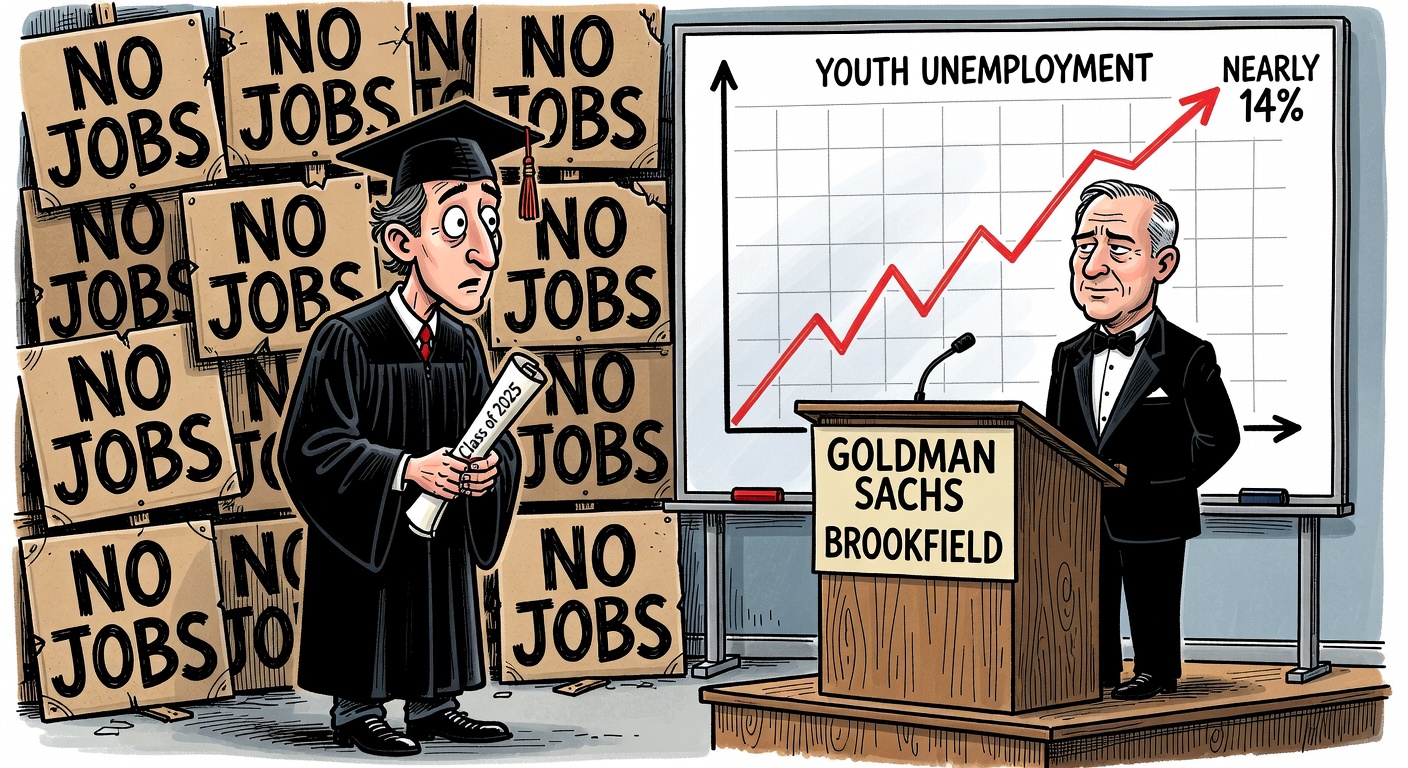
Editorial cartoon — iVoteLiberal.com
The Numbers Tell a Damning Story
According to a new study by the Fraser Institute, the unemployment rate for Canadians aged 15 to 24 climbed from 10% in 2022 to 13.8% in 2025. That is a 3.8-percentage-point increase in just three years — the fastest non-recession increase in youth unemployment on record.
To put that in context: Statistics Canada data shows the trend has continued into 2026, with youth unemployment hovering around 13.8% in March, after peaking as high as 14.6% in late 2025.
While Carney's Liberals talk about "building Canada's future" and "investing in growth," the future — young Canadians — can't find jobs at a rate that rivals recession-era levels. The Liberals don't appear to have noticed, or care.
Canada Now Worse Than the United States
For years, Canadian politicians have criticized American economic inequality. Here is an uncomfortable fact: Canada's youth unemployment rate has exceeded that of the United States for nearly a decade.
In 2025, Canada's youth unemployment rate was 3.8 percentage points higher than its American counterpart. That gap is not closing — it is widening.
Under Liberal governance, young Canadians are measurably worse off, relative to young Americans, than they were a decade ago. This is not a talking point. It is a documented trend from Statistics Canada and the Fraser Institute.
The Gap Between Young and Old Is Near Historic Levels
The disparity between young Canadians and older workers has never been wider outside of a formal recession. In 2025, youth unemployment stood at 13.8% while adult unemployment (25+) sat at 5.7% — a gap of 8.1 percentage points. That differential is near historic highs.
What this means in plain terms: young Canadians are entering a labour market that is structurally hostile to them. They are competing with a massive influx of newcomers for entry-level positions, facing minimum wage hikes that have made employers reluctant to hire inexperienced workers, and dealing with a housing market so unaffordable that many cannot move to where jobs exist.
These are the direct consequences of Liberal policy choices:
- Record immigration levels that flooded the entry-level labour market, increasing competition for the very jobs young Canadians were competing for
- Aggressive minimum wage increases that, while well-intentioned, raised the cost of hiring inexperienced workers — making employers more selective about who they bring in
- A housing crisis so severe that young Canadians cannot afford to live in the cities where jobs exist, reducing geographic mobility for workers under 25
- A regulatory environment that suppresses small business growth — the sector that historically absorbs young workers first
A PM With No Answer
Mark Carney spent 13 years at Goldman Sachs. He served as governor of two of the world's most powerful central banks. He managed a $1-trillion asset portfolio at Brookfield. He has never, in his professional life, built a company that employed young Canadians at entry-level wages.
His economic worldview is shaped entirely by the perspective of capital — of money moving between large institutional players. The concerns of a 22-year-old in Winnipeg who can't find a full-time job, can't afford a one-bedroom apartment, and is wondering whether Canada is worth staying in — these are not concerns that appear on the Carney government's dashboard.
In his spring economic update, Carney promised "green growth" and "transformation." He committed to $575 billion in federal spending by 2030. He promised to cut 40,000 public service jobs — mostly through attrition — while adding billions in new program spending. Not once did a coherent plan for youth employment emerge from the document.
May 1st Is Labour Day. Where Is Labour?
Today is International Workers' Day — the day governments pay tribute to workers and their contributions to society. Carney will give speeches. His ministers will tweet solidarity. The government-subsidized CBC will run flattering coverage.
Meanwhile, nearly one in seven young Canadians who wants a job can't find one. That number was one in ten three years ago. The trajectory is unmistakable.
Happy Labour Day from the Liberal Party of Canada — the party that spent 10 years making Canada unaffordable, uncompetitive, and increasingly unlivable for the generation that will have to pay for it all.
- 10% — Canadian youth unemployment rate in 2022
- 13.8% — Canadian youth unemployment rate in 2025 (Fraser Institute / StatsCan)
- 14.6% — Peak youth unemployment rate, late 2025
- 5.7% — Adult (25+) unemployment rate in 2025
- 8.1 pp — Gap between youth and adult unemployment — near historic high
- 3.8 pp — Canada's youth unemployment rate above the United States in 2025
- ~10 years — Duration over which Canada's youth unemployment has consistently exceeded the US rate
Sources: Rebel News / Sheila Gunn Reid, May 1, 2026 — rebelnews.com; Fraser Institute Study on Youth Unemployment; Statistics Canada LFS data, March 2026.