The Ethics Screen That Doesn't Screen: How Carney's Brookfield Loophole Works — And Why It Matters
An investigative analysis of the actual legal text of Mark Carney's ethics screen reveals a loophole large enough to drive a $1-trillion asset manager through. While the screen blocks him from matters specifically involving 103 named Brookfield entities, a "general application" exemption allows Canada's Prime Minister to set sweeping green energy, carbon market, and infrastructure policy — the very policies that directly enrich his former employer.
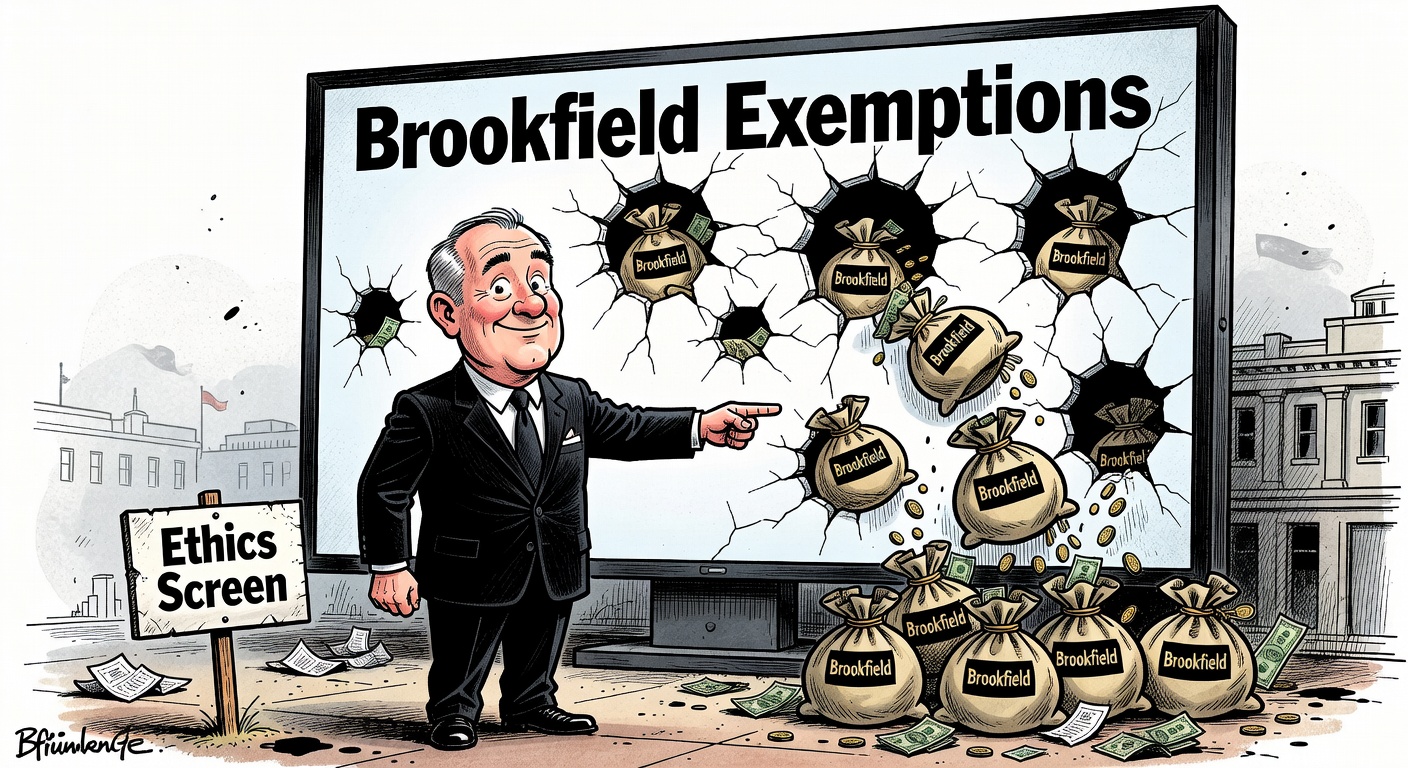
Editorial cartoon — iVoteLiberal.com
What the Screen Actually Says
On July 11, 2025, the Office of the Conflict of Interest and Ethics Commissioner published Prime Minister Mark Carney's ethics screen. Most Canadians have never read it. Most media coverage cites it secondhand through press conferences and talking points. But the actual text — analyzed in a detailed investigative series by conservative commentator Stephen Taylor — tells a different story than what the government has been selling.
The screen states, in part:
"This screen will prevent me from giving preferential treatment to any of the Companies while I exercise my official powers, duties, and functions... I may, however, participate in a discussion or decision on a matter that is of general application or that affects the Companies' interests as a member of a broad class of persons unless those interests are disproportionate to the other members of the class."
Read that clause carefully. Carney is blocked from one-on-one meetings, specific contracts, or targeted regulatory decisions involving the 103 named Brookfield-connected entities. But he is explicitly permitted to participate in any policy discussion or decision that affects Brookfield's interests "as a member of a broad class."
The Loophole in Practice
Here's why this matters: Brookfield Asset Management is one of the world's largest investors in green energy infrastructure, carbon credit markets, and large-scale real assets. Its portfolio spans wind farms, solar installations, hydroelectric dams, toll roads, and fibre optic networks — all assets that benefit directly from government policy.
When Carney sets national green energy policy — as a "general" environmental initiative affecting the whole industry — that's a "broad class" decision. Brookfield benefits. But Carney isn't recused.
When Carney endorses voluntary carbon markets or maintains an industrial carbon pricing framework — again, a policy affecting many companies, not just Brookfield — that's "general application." Brookfield benefits enormously. But Carney isn't recused.
When the Liberals announce a $25-billion Canada Strong Fund to invest in infrastructure — ports, clean energy, natural resources — that's a broad-class investment policy. Brookfield is ideally positioned to manage or benefit from such flows. But Carney isn't recused.
Ethics watchdog Democracy Watch's Duff Conacher, who has tracked Carney's conflicts closely, put it bluntly: "Prime Minister Carney has as many financial conflicts as Trump."
The 103-Entity List Is Not the Whole Picture
The ethics screen covers 103 named corporate entities in Annex A — Brookfield Asset Management, Brookfield Corporation, Stripe Inc., and scores of subsidiaries. This sounds comprehensive. But it only covers entities Carney was aware of at the time his blind trust was established. Brookfield's complex web of subsidiaries, SPVs, and investment vehicles extends far beyond any list that can be captured in a 350-word screen document.
More critically, the screen is administered by Carney's own Chief of Staff and the Clerk of the Privy Council — not by an independent officer. The Ethics Commissioner is notified of decisions after the fact. There is no real-time independent auditing of what matters cross Carney's desk and whether Brookfield's interests are implicated.
The Committee Called for Divestment. The Liberals Said No.
The House of Commons Ethics Committee, chaired by Conservative MP John Brassard, tabled a report in late April 2026 recommending 20 reforms to the Conflict of Interest Act — including requiring all future prime ministers to fully divest their investments within 60 days of taking office. The report was specifically designed to address Carney's situation.
The Liberal majority government has shown no indication it intends to implement these recommendations. Carney has not sold his Brookfield stakes. He has not recused himself from the broad-class policy decisions that enrich his former employer. And the screen that was supposed to ensure his integrity contains, by design, the very exemption that lets him avoid doing so.
"Will he continue to blow smoke about his ongoing financial conflicts and hide behind a loophole-filled ethics law," asked Conacher, "or will he implement the changes needed to effectively prevent conflicts of interest?"
Based on everything Canadians have seen so far, the answer is clear.
Canada's Prime Minister built his career at the world's largest infrastructure asset manager — and his ethics compliance document explicitly allows him to set the very policies that make that industry profitable. This isn't a technicality. It's the whole ballgame.
Sources: Stephen Taylor, "Mark Carney's Ethics Screen Has A Huge Hole" (stephentaylor.ca, April 27, 2026); Office of the Conflict of Interest and Ethics Commissioner — Carney Declaration; National Post, April 23, 2026; Democracy Watch / Duff Conacher; The Walrus, "Carney's Wealth Tests the Limits of Canada's Ethics Laws."