Rewarding Loyalty: Carney Ships Trudeau's Energy Minister to Brussels as EU Ambassador
Mark Carney has tapped Jonathan Wilkinson — Justin Trudeau's Natural Resources Minister and architect of Canada's Net Zero legislation — as Canada's next Ambassador to the European Union. Wilkinson says he'll vacate his Vancouver-area federal seat "in the coming months." The appointment is being sold as a diplomatic asset. What it actually is: the oldest Liberal tradition in Canadian politics — a soft landing for a departing loyalist, gift-wrapped with a Brussels office and a diplomatic passport.
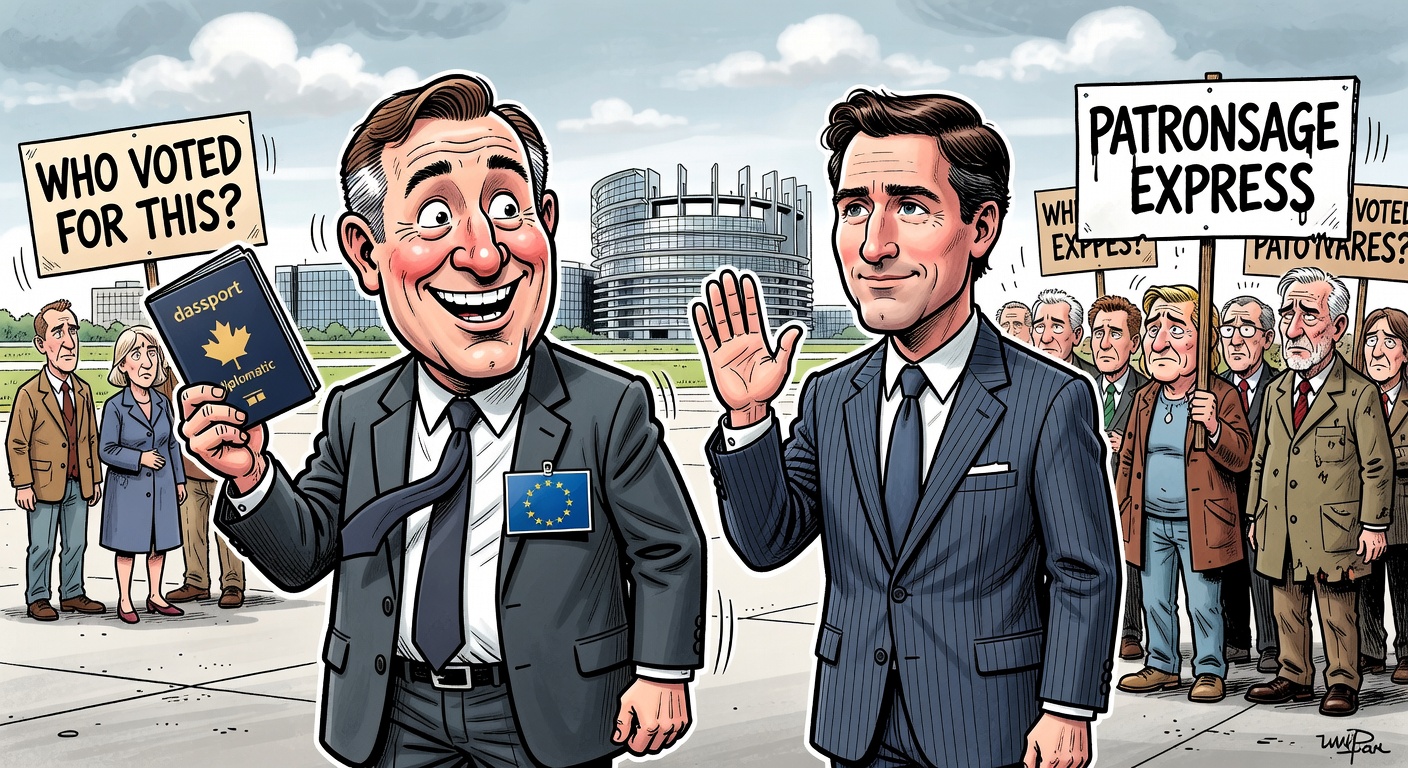
Jonathan Wilkinson served as Justin Trudeau's Minister of Natural Resources from 2021 to 2025. Before that, he was Minister of Environment and Climate Change — the man who pushed Canada's Net Zero Emissions Accountability Act through Parliament. He was, in short, one of the key architects of the Liberal government's decade-long energy policy agenda: the one that drove up Canadian electricity costs, stalled pipeline approvals, and applied ideological pressure on the oil and gas sector while Western Canada watched with growing fury.
Now he's going to Brussels, reportedly to represent Canada in trade and diplomatic negotiations with the European Union — at a moment when Canada's relationship with the EU is more consequential than ever, with tariff volatility, critical minerals agreements, and NATO commitments all on the table.
The Pattern Is the Problem
The Wilkinson appointment is not an isolated event. It is the continuation of a pattern so well-established it barely registers as news: Liberal ministers who lose their seats, decide not to seek re-election, or quietly indicate their political careers are winding down get rewarded with high-paying appointed positions. Ambassadorships. Senate seats. Tribunal chairmanships. Crown corporation boards.
The positions require no election, often minimal public scrutiny, and carry six-figure salaries, generous pensions, and executive perks. The only qualification, it seems, is having served loyally in a Liberal cabinet at some point in the preceding decade.
Wilkinson told reporters he will be leaving his North Vancouver federal seat "in the coming months" — meaning taxpayers will pay for a by-election, plus his salary and expenses as he transitions from elected MP to appointed diplomat. The crossover period, the dual compensation structures, and the timing are all at the government's discretion. No competitive process. No public posting. No requirement to demonstrate specific EU trade expertise.
The Optics Are Difficult to Ignore
Canada is currently navigating one of the most complex trade environments in its history. The United States remains Canada's dominant trade partner, but the Canada-United States-Mexico Agreement (CUSMA) faces a review process loaded with uncertainty. Meanwhile, the federal government has made rhetorical commitments to diversifying trade relationships — including with the European Union under CETA, the Comprehensive Economic and Trade Agreement.
In that context, appointing a veteran politician to head Canada's EU mission is not automatically wrong. But the question that never gets asked in the $600-million-subsidized Canadian media establishment is this: Was Wilkinson the best available candidate? Or was he merely available — and loyal?
There is no publicly documented competitive search. There is no disclosure of other candidates considered. There is no articulation of why Wilkinson's background — Net Zero legislation, carbon pricing advocacy, energy transition policy — makes him the optimal representative for Canada's commercial and diplomatic interests in the EU at this particular moment.
What there is: a departing Liberal minister, a prime minister who owes his government to the Liberal establishment Wilkinson represents, and a Brussels posting that needed to be filled.
A Decade of Liberal Revolving Doors
The Wilkinson appointment lands in a long line of similar arrangements. Chrystia Freeland, after her dramatic resignation as Finance Minister, was positioned as a candidate for potential international roles. Former Environment Minister Catherine McKenna moved into the high-paying world of international climate boards and advisory positions. Former Cabinet ministers routinely migrate into Senate seats or lucrative Order-in-Council appointments within months of leaving elected office.
The revolving door isn't unique to Liberals — every government practices some version of it. But the Liberal version has a particular character: it tends to reward ideological alignment with the party's climate-finance-globalist agenda, and it tends to place those loyalists in positions with real influence over international agreements, regulatory bodies, and policy frameworks that affect ordinary Canadians.
Wilkinson helped design the Net Zero framework. Now he goes to Brussels — where the EU's own carbon border adjustment mechanism and critical minerals partnerships are being negotiated. The overlap between his policy history and his new posting is not coincidental. It is the point.
What Accountability Would Look Like
An accountable government would publish the selection criteria for ambassador appointments. It would disclose whether other candidates were considered and why they were passed over. It would define what measurable outcomes it expects from the posting over a set timeline. It would require ambassadors appointed from political backgrounds to be confirmed through at least a parliamentary committee review.
Canada does none of these things for Order-in-Council appointments. The Prime Minister can appoint anyone he wants, to virtually any diplomatic or Crown body position, with no required justification and no public accountability mechanism beyond the eventual Access to Information Act request — which arrives, typically, years after any meaningful scrutiny would matter.
Wilkinson may do a fine job in Brussels. He may not. The problem is that Canadians will never know whether he was the right choice — because the system is designed to prevent that question from being asked in a way that demands an answer.
The Real Question
Mark Carney ran on a promise of competent, professional governance — a break from the perceived chaos of the Trudeau years. He pointed to his own Goldman Sachs and Bank of England pedigree as evidence that he would bring a merit-based, results-oriented approach to public administration.
The Wilkinson appointment suggests something different. It suggests that the fundamental Liberal operating model — reward the loyal, place the trusted in positions of influence, and manage the transition of political allies out of elected life with soft landings funded by taxpayers — remains fully intact under the new management.
Different prime minister. Same Liberal Party. Same playbook.
- National Post: "Carney taps Trudeau-era cabinet minister Jonathan Wilkinson as EU ambassador," April 30, 2026
- National Post: "Ottawa won't summon departing Air Canada CEO over French-language controversy," April 29, 2026
- House of Commons: Jonathan Wilkinson, MP for North Vancouver-Burnaby (former Natural Resources Minister, 2021–2025)
- Government of Canada: Net Zero Emissions Accountability Act (S.C. 2021, c. 22)
- CarneyWatch.ca: Documented patronage and floor-crossing appointments