Carney Says Affordability Has Never Been Better. Statistics Canada Says 9.8 Million Canadians Disagree.
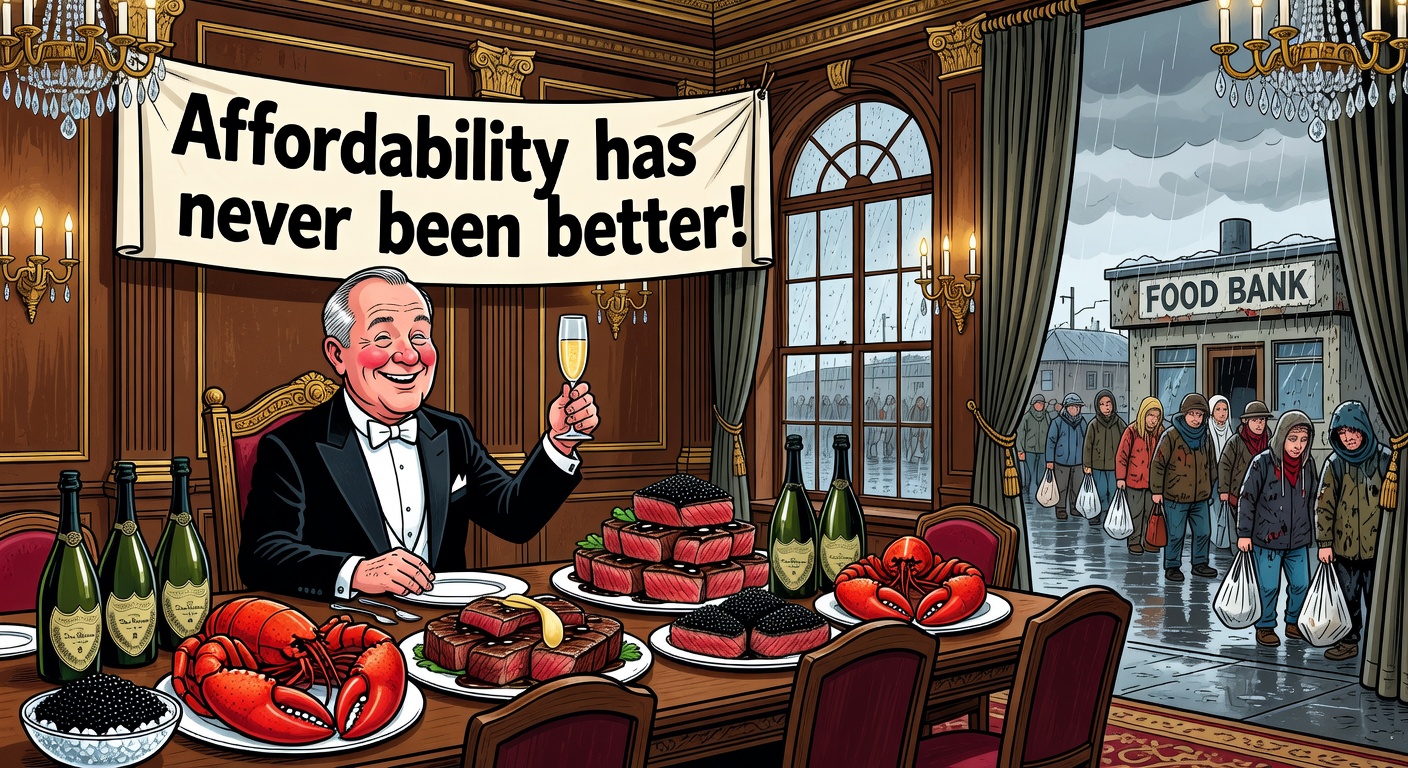
Last week, Mark Carney stood in the House of Commons and told Canadians that "affordability is the best it's been in over a decade." This week, Statistics Canada published a report showing that 9.8 million Canadians — nearly one in four — live in food-insecure households. One of these statements is a Liberal illusion. The other is federal data.
The Numbers Carney Won't Say Out Loud
The Statistics Canada report is not ambiguous. It is not a matter of interpretation. The numbers are stark:
- 9.8 million Canadians live in food-insecure households
- 24% of Canadians now report household food insecurity
- 11.9% report moderate food insecurity
- 6.5% are severely food insecure — they are going without meals
- 47.4% of single mothers report food insecurity
- 30.8% of children — 2.4 million kids — live in food-insecure households
- 30.4% of single non-seniors can't reliably afford food
These are not the statistics of a country experiencing its best affordability in over a decade. These are the statistics of a country in crisis — a crisis built, brick by brick, over ten years of Liberal economic mismanagement.
Dalhousie's Groceries Report Makes It Worse
Dalhousie University's Agri-Food Analytics Lab — one of Canada's most respected food-sector research groups — added more damning data. Their findings:
- 34% of respondents had to draw from savings or borrow money to buy food in the last year
- 81.1% say their food expenses have increased the most of any spending category over the past year
- 56.7% report a significant increase in food costs — not just a slight uptick, but a major hit
- Over 20% of Canadians now spend more than $600 per month on groceries
- Canadians are paying $23 more per month on food — a 4.6% increase year-over-year
- 30.7% expect prices to rise another 5–7% over the next year
Carney says affordability is the best it's been in a decade. Dalhousie says Canadians are raiding their savings to buy groceries. Someone in Ottawa is living in a different country than the rest of us.
How Did We Get Here?
The answer isn't complicated. It's ten years of compounding Liberal policy failures:
The industrial carbon tax — which Carney kept when he eliminated the consumer version — drives up the cost of food production, transportation, and packaging at every step of the supply chain. Farmers pay it on fuel. Truckers pay it on diesel. Grocery chains pay it on distribution. The cost lands on your bill at checkout.
The fuel standard adds another layer of costs on top of the carbon tax, forcing up the price of every litre of fuel used in the farm-to-table supply chain. 87.7% of Canadians support eliminating taxes on food. The Liberals know this. They don't care.
A decade of inflationary spending — $78.3 billion in new deficit spending this year alone — pumped money into an economy without increasing productive capacity. That's the textbook recipe for inflation. Food prices don't lie.
Supply management — Canada's dairy, poultry, and egg cartel system — adds a hidden tax to every Canadian's grocery bill by maintaining artificially high prices through import tariffs as high as 313%. Carney inherited this system from Trudeau and has shown zero appetite to touch it.
"Affordability Is the Best It's Been in Over a Decade" — Let That Sink In
Think about what Carney is actually saying. He's claiming that by his measurements, things are better than they were when the Liberals first took power in 2015. In 2015, Canada's federal debt was $612 billion. The average home cost $450,000. The carbon tax didn't exist. There was no industrial fuel standard. The ArriveCAN app had not yet consumed $54 million of taxpayer money. Justin Trudeau had not yet racked up $700 billion in new debt.
If that's Carney's baseline for comparison, it proves the Conservative case more effectively than any opposition press release could. The Liberals broke Canada's affordability, and now they're celebrating incremental improvements against the catastrophe they caused as though it represents genuine progress.
Nearly 10 million Canadians can't reliably feed themselves. 2.4 million children live in food-insecure households. A third of Canadians are dipping into savings at the grocery store. The Prime Minister's answer is to tell them affordability has never been better.
Canadians can't eat Liberal illusions.
- 9.8 million Canadians in food-insecure households (Statistics Canada)
- 34% of Canadians borrowed money to buy groceries in the last year (Dalhousie)
- 56.7% say food costs have significantly increased
- Carney's deficit this year: $78.3 billion
- 87.7% of Canadians want taxes eliminated on food