The Enemy Within: Carney's Regulatory Overkill Is Destroying Canada's Economy Faster Than Trump Ever Could
Two damning analyses arrived this morning. The first: Carney's spring economic update isn't fiscal discipline — it's an acceleration of Trudeau-era spending, with $536 billion in program costs this year alone, $25 billion above last year's projections, and no path to balance ever. The second: Canada's real economic enemy was never Donald Trump. It was, and remains, the Liberal government's decade-long regulatory chokehold — the one Carney inherited, defends, and is now deepening.
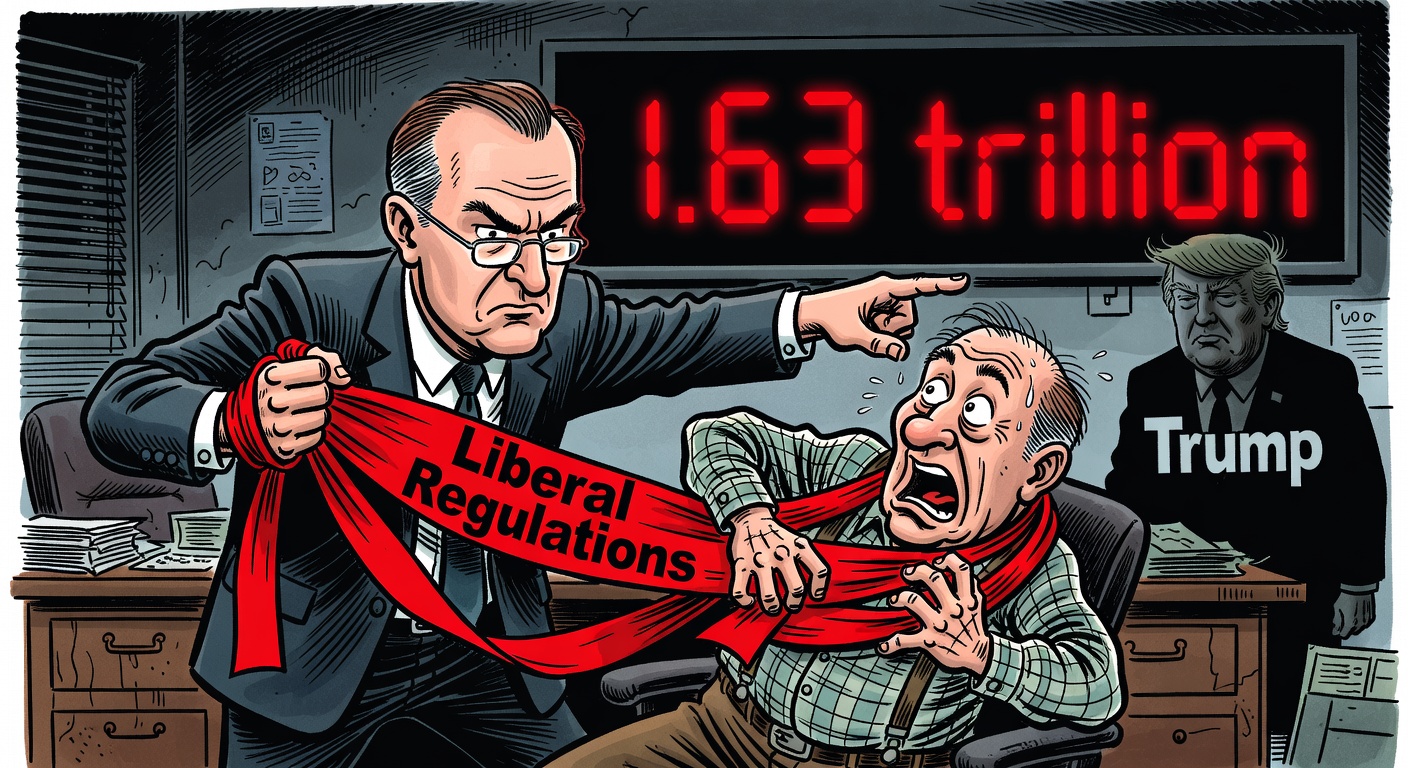
Mark Carney has spent much of his first year as Prime Minister pointing south. Every economic disappointment, every shortfall, every missed target comes packaged with a reference to U.S. tariff uncertainty, American protectionism, or the unpredictability of the Trump administration. It is a useful rhetorical tool — and it is, increasingly, a dishonest one.
The deeper story is the one being told in Canada's own fiscal documents. The spring economic update tabled last week reveals that Carney's government will spend $536.2 billion on program expenditures in 2026–27 — a figure that is $7.6 billion above the fall budget projection, and $25.8 billion above what Trudeau's own final fiscal document projected for the same year. As analysts at the Fraser Institute concluded, this is "a continuation — or even an acceleration — of Trudeau's policy approach."
The Math That Doesn't Lie
Carney's defenders point to the deficit falling to $66.9 billion — down from the $78.3 billion projected in November's budget — as evidence of fiscal progress. What they do not mention is that the reduction came largely from higher-than-expected oil and gas revenue, not from spending restraint. The government spent more, not less, than it planned. It just got lucky on resource royalties.
Across the entire four-year fiscal window, the Carney government's spring update raises cumulative program spending by $25 billion compared to the fall budget. The trajectory ends at $575.4 billion in annual program spending by 2029–30 — a number that represents total federal program costs equivalent to roughly $14,500 per Canadian, every year.
There is no path to a balanced budget in the document. The deficit runs above $50 billion annually through 2030–31. The federal debt will approach $1.63 trillion by decade's end. And debt servicing costs — the compound interest bill on a decade of Liberal borrowing — will hit $80 billion per year by 2031, more than the entire Canada Health Transfer to all provinces.
The Liberals keep spending more while claiming to spend less. The numbers say otherwise.
The Regulatory Chokehold Nobody Wants to Talk About
But the fiscal picture, as alarming as it is, may not be the most damaging part of the Liberal legacy. A parallel analysis published today in the National Post by economist Adam Pankratz lays out a case that should alarm every Canadian who believes in building things, starting businesses, or extracting resource wealth from Canadian soil.
Canada's regulatory environment — a decade in the making under Liberal governments — has become one of the most burdensome in the developed world. Major project approvals now take an average of 10 to 12 years. Environmental assessment processes have been layered with new requirements under Bills C-69 and C-48. The industrial carbon tax creates compliance costs that fall disproportionately on capital-intensive industries like mining, energy, and manufacturing. Impact Assessment Act reviews insert federal authority into projects that historically fell under provincial jurisdiction.
The result: Canadian investment in real productive capacity — mines, pipelines, refineries, manufacturing plants — has stagnated relative to our peer nations. The C.D. Howe Institute has documented that Canada's business investment per worker fell to approximately 70 cents for every dollar of comparable U.S. investment. The productivity gap with the United States has widened every year for a decade.
Carney points to Trump's tariffs as the reason Canadian businesses are struggling. But the tariffs are new. The productivity collapse is a decade old. The regulatory burden existed before Trump took office the first time. The capital flight from Canadian projects to American and Australian alternatives began under the Harper-to-Trudeau transition and accelerated through the Trudeau years. Carney inherited it — and his spring update contains no serious plan to dismantle it.
The $25 Billion "Wealth Fund" That Will Make It Worse
Among the spring update's headline items is the $25 billion "Canada Strong Fund" — the government's proposed sovereign wealth fund. Rather than deregulating the private sector so that Canadian businesses can attract capital on their own merits, the Liberal response to the investment gap is for the government to borrow $25 billion and direct it into sectors of the government's choosing.
This is the antithesis of productivity reform. It substitutes political capital allocation for market-driven investment. It picks winners in advance. It layers another government-controlled institution over a private sector already struggling under regulatory weight. And it does all of this while the government simultaneously borrows at a $66.9 billion annual rate, increasing the debt burden on every future Canadian taxpayer.
As Conservative MP Michelle Rempel Garner noted, it is comparable to "an individual investor who is already in serious debt borrowing more money to buy stocks." Except it is worse: the government is borrowing money to buy stocks in sectors that overlap almost perfectly with the holdings of the Prime Minister's own investment portfolio.
Spend More, Regulate More, Borrow More
The consistent throughline of Liberal economic governance — from Trudeau to Carney — is a simple formula: spend more government money, regulate more private activity, borrow the difference, and describe it all as progress. The Fraser Institute's conclusion that Carney is continuing and accelerating Trudeau's approach is not an opinion. It is a mathematical description of what the fiscal documents show.
The spring economic update was Canada's first real look at what a Carney government looks like in practice, independent of campaign rhetoric. What it shows is a government that is:
- Spending $7.6 billion more than it budgeted six months ago
- Running a structural deficit that has no projected end date
- Borrowing $25 billion to fund a "wealth" fund that is actually a debt fund
- Making no meaningful regulatory reform to unlock private investment
- Projecting $80 billion in annual interest payments within five years
Donald Trump's tariffs are a headwind. Canada's regulatory overkill is a structural wall. One of those problems, Canada controls entirely. Carney is choosing not to address it — while pointing at the other one as the cause of every problem.
That choice has a name. It's called deflection. And it has a cost. Canada is paying it.
- National Post / Matthew Lau: "Carney accelerates Canada's fiscal collapse," April 30, 2026
- National Post / Adam Pankratz: "Canada's real economic enemy isn't Trump. It's the Liberals' regulatory overkill," April 29, 2026
- Finance Canada: Spring Economic Statement 2026, tabled April 28, 2026
- Fraser Institute: Analysis of Carney spring economic update, April 2026
- Office of the Parliamentary Budget Officer: "Budget 2025: Issues for Parliament," 2025
- C.D. Howe Institute: Canadian business investment per worker data, 2024–2026
- CarneyWatch.ca: Canada Strong Fund conflict of interest documentation