$54 Billion in New Spending: Carney's Mini-Budget Sends Canada's Debt Racing Toward $1.63 Trillion — While Champagne Calls It "Fiscal Discipline"
Finance Minister François-Philippe Champagne stood at a podium Tuesday and declared Canada was "restoring fiscal discipline." The same document he was reading from showed $37.5 billion in brand-new spending, a total of $54 billion added since Budget 2025, a federal debt now at $1.333 trillion on its way to $1.629 trillion, and annual interest payments projected to hit $80.7 billion by 2031. That is what Liberals call discipline. That is what the rest of us call a spending addiction with a press release.
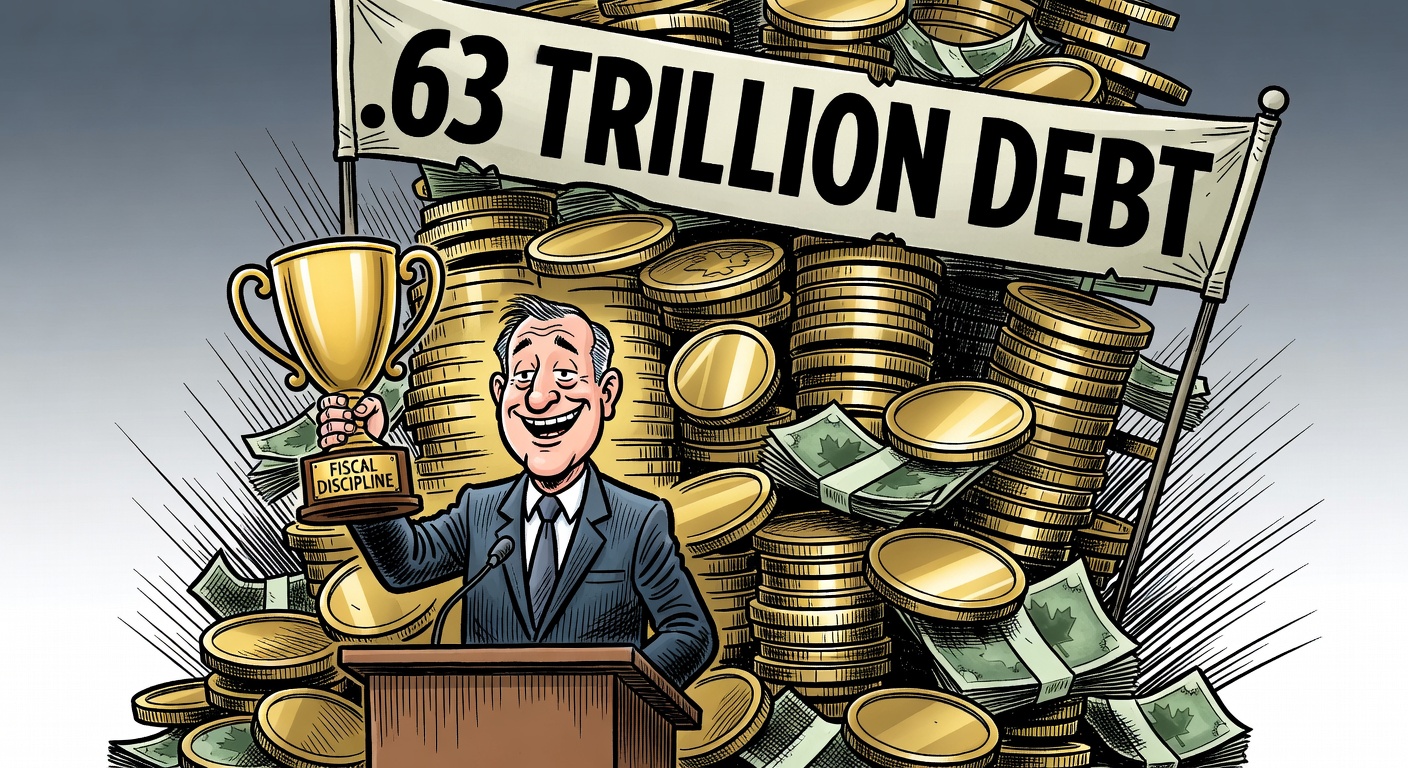
Mark Carney's spring economic update — released Tuesday, April 29 — came with the headline that Canada's deficit for the fiscal year just ended came in at $66.9 billion. The government was quick to point out this was $11.4 billion less than the $78.3 billion originally projected in Budget 2025. Better than expected, the Liberals said. Responsible stewardship, they said. Fiscal discipline, Champagne said.
What they did not lead with: the moment the government realized it had more revenue than projected, it decided to spend almost all of it.
The Numbers the Government Buried in the Footnotes
Revenue projections are up — an average of $7.2 billion more per year than projected in Budget 2025, thanks to a resilient Canadian economy and higher oil prices linked to Middle East instability. That is genuinely good news. The question, as always with this government, is what they chose to do with it.
The answer: spend it.
The spring update includes $37.5 billion in net new spending over six years. When combined with measures announced since Budget 2025 was tabled, total new spending reaches over $54 billion. This is not legacy debt being managed. This is new spending being added to a debt pile that was already the largest in Canadian history.
The federal debt now stands at $1.333 trillion. By 2030–2031, it is projected to reach $1.629 trillion — an increase of nearly $300 billion over five years, in the absence of a pandemic or a major recession. Just the cost of governing the Liberal way.
The Interest Payment Nobody Is Talking About
Buried in the fiscal tables is the number that should define every conversation about Canadian government spending for the next decade: public debt charges.
In 2026–2027, the federal government will pay $58.7 billion in interest on its debt. By 2030–2031, that figure rises to $80.7 billion per year.
Eighty billion dollars a year. Every year. Just in interest.
To put that in context: Canada's entire defence budget is approximately $40 billion. The federal government's healthcare transfer to the provinces is roughly $49 billion. By the end of this decade, Canadians will be paying more to service Liberal debt than we spend on national defence and roughly as much as we transfer to fund provincial healthcare — just in interest, with nothing to show for it.
Pierre Poilievre put it plainly in the House of Commons: Carney's fiscal track record brings "more cost, more debt and more bills on the national credit card." The spring update confirms that characterization with the government's own numbers.
The Deficit Isn't Going Away Anytime Soon
The Liberals project the deficit will decline from $66.9 billion last year to $65.3 billion this fiscal year, then gradually shrink to $53.2 billion by 2030–2031. That is seven consecutive years of deficit spending, with no projected return to balance.
The debt-to-GDP ratio will hit 41.5 per cent in 2026–2027 and stay elevated across the entire projection window — finishing at 41.6 per cent in 2030–2031. Unlike previous fiscal anchors, the Carney government has made no commitment to bring this ratio down. The previous Trudeau government at least maintained a declining debt-to-GDP ratio as a stated goal. Carney has quietly abandoned even that modest commitment.
"Affordability Is 50 Per Cent of It"
Champagne's defence of the new spending was that it is "targeted at affordability." He said "affordability is 50 per cent of it."
This is the central Liberal logic trap: the government creates affordability problems through years of inflationary spending and regulatory burden on housing, energy, and food supply — then justifies more spending as the cure. The national debt grows. The interest payments grow. Future tax burdens grow. And the government announces another affordability measure to address the consequences of the last one.
It is not fiscal discipline. It is a feedback loop — and ordinary Canadians are the ones trapped inside it.
What Was Not In the Update
The spring fiscal update contained no commitment to meaningful public sector restraint. No serious comparison to peer countries that are actually reducing debt-to-GDP ratios. No acknowledgment that Canada's debt-to-GDP comparison with G7 nations — a number the Liberals cite frequently — excludes provincial debt, which is where a significant portion of Canada's total government borrowing sits.
When you add federal and provincial debt together, Canada's picture looks considerably less flattering than what Finance Canada presents at press conferences. That consolidated number is not included in the spring update because it would complicate the narrative.
The National Post noted what's missing from the document: "More public sector cuts, real comparisons, and details." That is a polite way of saying the update is designed to be reassuring rather than transparent.
The Bill Is Coming
Canada's debt did not reach $1.333 trillion because of COVID alone, and it will not stop climbing at $1.629 trillion unless the spending pattern changes. There is no sign it will. The spring update — presented as a moment of fiscal responsibility — actually added $54 billion in new commitments to a government already running a $66-billion deficit.
Every dollar of that debt will be repaid by Canadian workers, by their children, and by their grandchildren — through taxes, through reduced public services, and through the slow erosion of living standards that compound interest on national debt guarantees over time.
Champagne called it "fiscal discipline."
$80.7 billion a year in interest by 2031 calls it something else entirely.
- National Post: "Federal deficit smaller than expected in spring economic update, but with $37.5B in extra spending," April 29, 2026
- National Post: "What you won't find in Carney's mini-budget: More public sector cuts, real comparisons and details," April 29, 2026
- Finance Canada: Canada's 2026 Spring Economic Update (full text)
- Conservative Leader Pierre Poilievre — Statement in the House of Commons, April 29, 2026
- Finance Minister François-Philippe Champagne — Press conference, Ottawa, April 29, 2026