Glenn Beck’s Canada Corruption List: What Checks Out, What Needs Proof, and the Timeline Canadians Should Audit
A Glenn Beck video circulating on Facebook has pushed Canada’s Liberal-era scandals into a U.S. conservative media frame. Some claims are rhetorical. Some are compressed. But the bigger story is real: Canada’s trust crisis did not appear overnight. It was built through a decade of secrecy, conflicts, foreign-interference warnings, speech controls, surveillance bills and institutions asking Canadians to accept slogans instead of receipts.
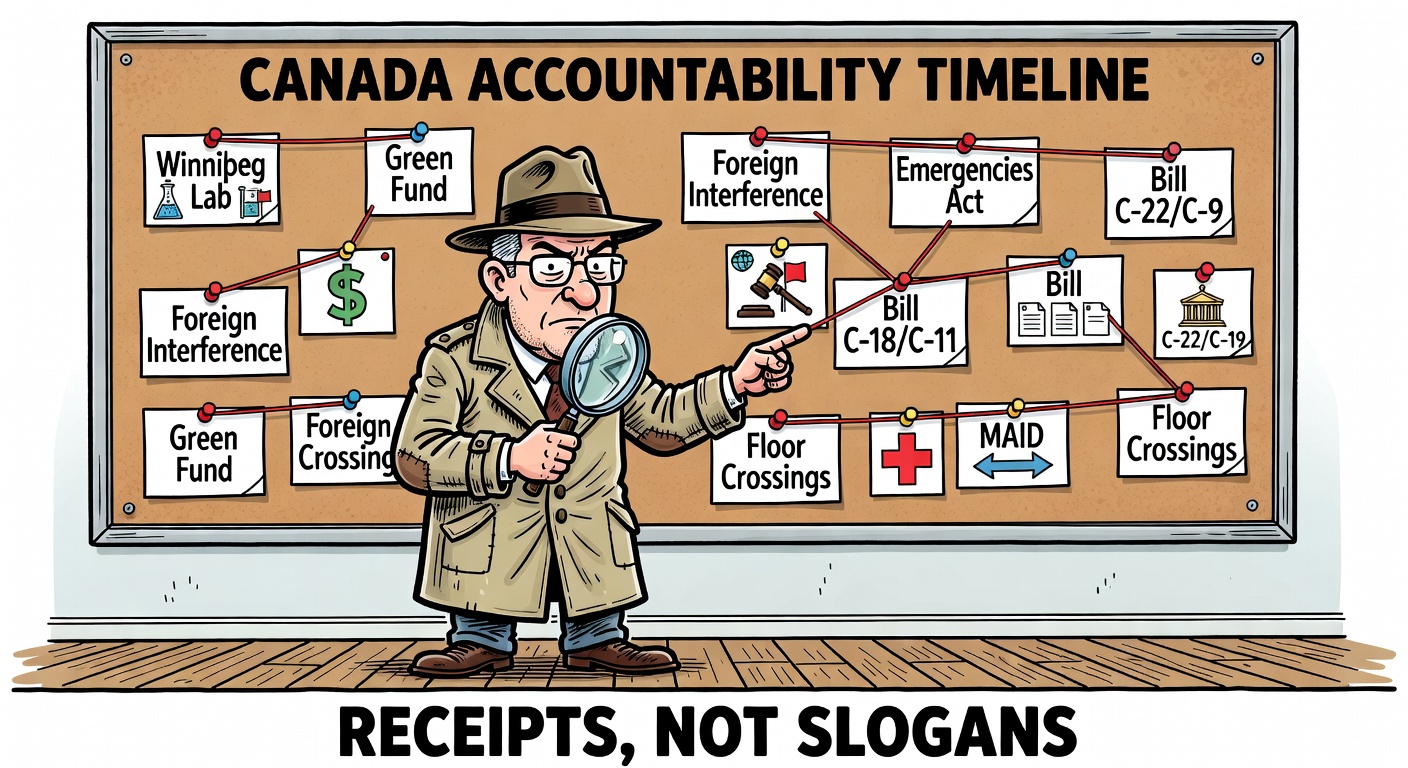
The Facebook reel points to Glenn Beck’s larger argument that Canada has become a warning sign for the West. The useful way to handle it is not to repeat every phrase as gospel. It is to audit the claims one by one and build the timeline.
The timeline
- 2015: Justin Trudeau’s Liberals take power promising “open by default” government. That promise becomes the standard against which the next decade should be judged.
- 2018–2019: Ottawa introduces and expands major media-support measures. Supporters call it a journalism rescue package; critics see a structural conflict when government subsidizes the industry that covers it.
- July 2019: Scientists Xiangguo Qiu and Keding Cheng are escorted out of Canada’s National Microbiology Laboratory in Winnipeg. The public does not get the full story for years.
- 2020–2022: COVID-era controls, speech fights, mandates and institutional trust battles accelerate. The political culture becomes more comfortable with emergency language.
- February 2022: The Trudeau government invokes the Emergencies Act against the convoy protests. A later Federal Court ruling finds the invocation unreasonable and unconstitutional; the Federal Court of Appeal later overturns that ruling, leaving a major national dispute over emergency power and civil liberties.
- 2021–2024: Foreign-interference warnings grow, especially around China, election influence, diaspora intimidation and the government’s handling of intelligence.
- 2023–2024: Bill C-11 and Bill C-18 reshape online broadcasting and news bargaining. Supporters call them cultural and media policy; critics call them state leverage over speech and distribution.
- February 2024: Long-withheld Winnipeg Lab documents are released after years of parliamentary pressure. The core scandal becomes secrecy: why did Canadians have to fight so long to see national-security material Parliament demanded?
- June 2024: The Auditor General reports serious conflict-of-interest failures inside Sustainable Development Technology Canada, the so-called green-slush-fund scandal. The issue is not merely bad optics; it is public money and conflict controls.
- 2024–2026: MAID remains one of Canada’s most morally explosive policy areas, with repeated concern about safeguards, eligibility expansion, vulnerable Canadians and state incentives.
- 2025–2026: Mark Carney inherits the Liberal brand while carrying his own conflict questions from Brookfield, climate finance, global institutions and Liberal policy influence.
- 2026: Bill C-22, the Lawful Access Act, becomes the new privacy flashpoint. Meta, civil-liberties groups and privacy companies warn that Part 2 could push private companies into government surveillance infrastructure.
Claim audit: what checks out?
| Issue | Status | What the evidence supports |
|---|---|---|
| Winnipeg Lab secrecy | Checks out | Scientists were removed in 2019 and fired in 2021. Parliament fought for years over documents. The released material raised serious questions about security screening, China-linked collaboration and why the government resisted disclosure. |
| Green “slush fund” / SDTC conflicts | Checks out | The Auditor General found conflict-of-interest controls failed at Sustainable Development Technology Canada. This is one of the strongest documented corruption/accountability lines because it rests on audit findings, not opinion. |
| Foreign interference | Checks out | Canada has official reporting and public inquiry material confirming foreign-interference concerns. The accountability question is whether the Liberal government acted fast enough, told Canadians enough, and protected diaspora communities enough. |
| Emergencies Act overreach | Legally contested, politically real | The Federal Court ruled the invocation unreasonable and unconstitutional; the Federal Court of Appeal later disagreed. Even with the appeal outcome, the episode remains a central civil-liberties warning about freezing bank accounts and emergency powers. |
| C-11 / C-18 internet and media controls | Real bills, disputed effect | The laws are real. Critics warned they increase state leverage over online content and news distribution. Supporters argue they protect Canadian culture and journalism. Either way, they belong in a timeline about government power over information flows. |
| Bill C-22 surveillance warnings | Checks out | Meta publicly warned Part 2 could conscript private companies into surveillance infrastructure. Civil-liberties groups and privacy companies are raising similar concerns. The government says the bill is about public safety; Parliament must prove the safeguards. |
| MAID expansion / vulnerable Canadians | Real policy fight | Canada’s assisted-dying system has expanded and remains controversial. Some claims online overstate motives, but the moral and safeguard questions are real and deserve serious scrutiny. |
| Carney corruption | Conflict questions, not criminal proof | Carney’s Brookfield, climate-finance and Liberal-policy connections create serious conflict and disclosure questions. That is different from proving criminal corruption. The defensible argument is transparency, recusal records and who benefits from policy. |
| Floor crossings / manufactured mandate | Political accountability issue | Floor crossings can be legal while still raising democratic accountability questions. The key demand is disclosure: what conversations, commitments or incentives preceded any switch that changes power in Parliament? |
The pattern: secrecy first, disclosure later
The recurring pattern is not that every scandal is identical. It is that Canadians are repeatedly asked to trust the government first and wait for the evidence later.
That happened with the Winnipeg Lab files. It happened with foreign-interference briefings and intelligence leaks. It happened with the Emergencies Act. It happened with the green fund. It is happening now with Bill C-22, where the government’s public-safety language is being challenged by people who understand the technical consequences of forced access and metadata retention.
This is why the Glenn Beck clip resonates. It compresses too much, but it catches a mood: Canadians can feel that the country’s institutions now demand trust while offering fewer receipts.
The Carney question
Mark Carney’s problem is that he presents himself as the adult reset while carrying the same Liberal institutional reflex: trust the experts, trust the process, trust the global framework, trust Ottawa.
But Carney is not a blank page. He is a former central banker, former Brookfield executive, former UN climate-finance envoy, Liberal economic adviser and now Prime Minister. That does not make every decision corrupt. It does mean Canadians deserve a higher disclosure standard around green finance, infrastructure funds, carbon-market policy, industrial subsidies, asset sales, and any policy area where public authority and private capital meet.
The right question is not “can we prove a secret conspiracy?” The right question is simpler and stronger: who benefits, who knew, who disclosed, who recused, and where are the documents?
What Parliament should do now
- Release clear conflict and recusal records for Carney, ministers and senior advisers tied to finance, Brookfield, climate funds and infrastructure policy.
- Complete a public accounting of SDTC approvals, conflicts, repayments and governance failures.
- Strengthen foreign-interference transparency so Canadians are not dependent on leaks to learn what government knew.
- Write explicit encryption and metadata protections into Bill C-22 or split Part 2 for a full rewrite.
- Require plain-language public-interest tests before government expands control over online platforms, news distribution or speech-adjacent regulation.
- Publish a floor-crossing disclosure standard when MPs change party alignment in a way that materially affects parliamentary power.
Canada does not need more slogans. It needs the timeline, the documents and the receipts.