Aaron Gunn’s CBC Prank-Show Allegation Demands Answers
A new Aaron Gunn video puts CBC back in the accountability spotlight: did a CBC/APTN entertainment project use false pretences to pull Canadians into a prank-style show about Sir John A. Macdonald, residential-school politics and Canadian history?
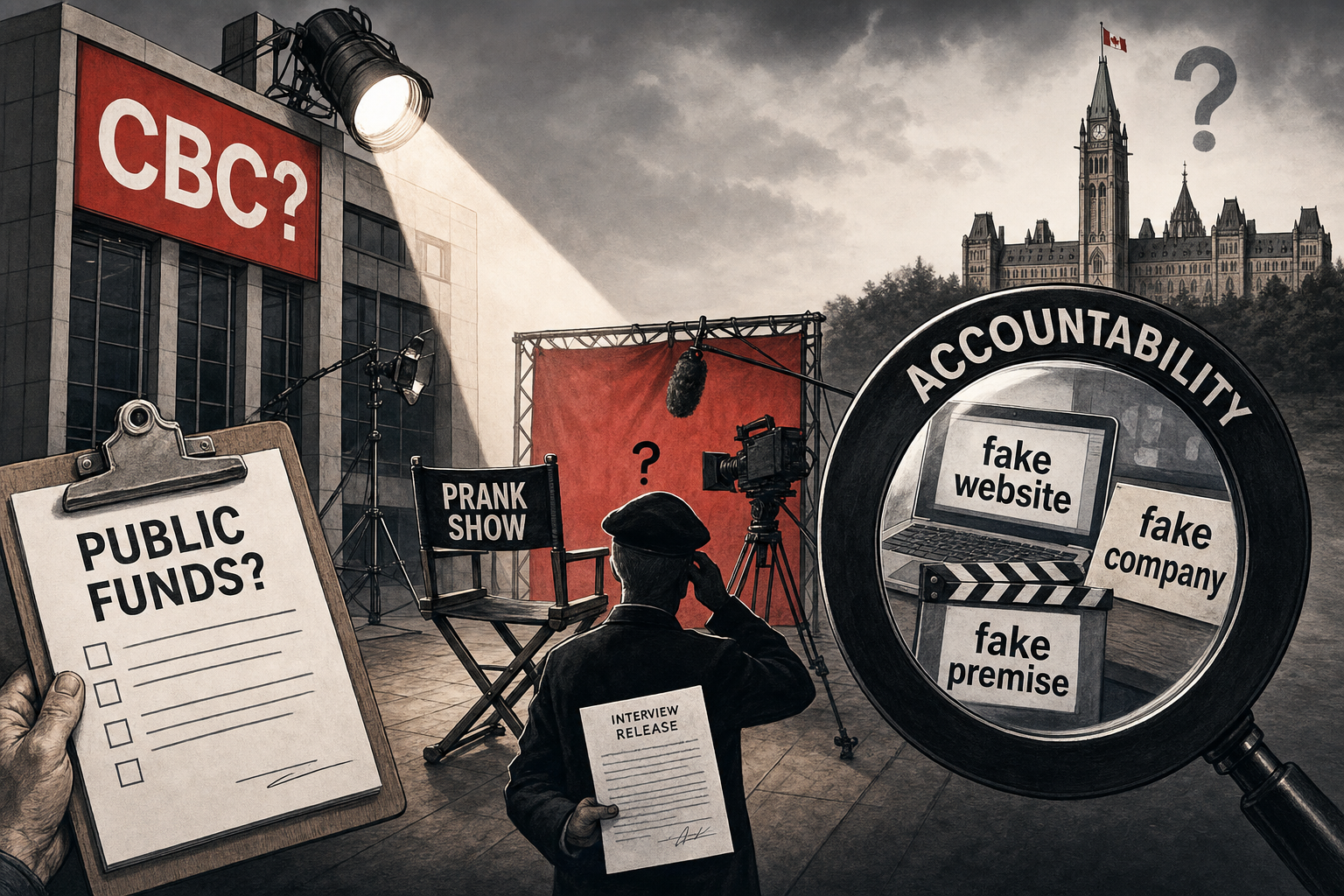
The allegation is serious, so it has to be handled carefully. Gunn’s Facebook post says taxpayer money was used to “mislead, deceive and outright lie” to Canadians, including retired RCMP veterans, in order to trick them into a political propaganda film. That is Gunn’s charge. It is not the same thing as a court finding, an ombudsman ruling or a completed public audit.
But the public record does confirm enough to justify hard questions.
What checks out
- Canadian Press/APTN reported that Northland Tales is being produced for CBC and APTN.
- CBC public affairs said the project is in early production for CBC Entertainment and APTN, not CBC News.
- The Indigenous Screen Office publicly listed Counting Coup / Northland Tales among supported television projects.
- Gunn says his office was approached and ultimately did not grant an interview.
What still needs proof
- The full budget and exact public-funding path.
- All fake company names, fake identities and scripts used to approach targets.
- Whether retired RCMP veterans were misled and under what release terms.
- What CBC executives knew, approved and funded before production began.
The CBC defence does not solve the accountability problem
CBC’s reported defence is that social-experiment and satirical-prank formats are established television devices, and that this was an entertainment project, not a news project. That distinction may matter inside CBC’s org chart. It does not answer the taxpayer question.
To the public, CBC is CBC. If the broadcaster’s entertainment arm commissions or carries a project that uses fake premises to draw politically targeted Canadians into interviews, then the public deserves to know who approved the method, who paid for it, and whether the people filmed understood the true nature of the production before their reputations were put at risk.
History is not a hidden-camera toy
The topic is also not harmless reality-TV fluff. Sir John A. Macdonald, the RCMP, residential schools, unmarked graves, reconciliation and Canadian historical memory are among the most explosive issues in the country. People can disagree fiercely about Macdonald’s legacy. They can condemn residential schools, defend historical nuance, debate monuments and argue over public memory. But that argument should be open and honest.
If CBC wants to fund a satire series, say so. If producers want to challenge “denialism,” say so. If the show is designed to ambush or prank people, disclose that before asking citizens, veterans, authors, activists or MPs to sit for filmed interviews.
The minister should ask for the paper trail
This is not about banning satire. It is about standards for a public broadcaster that receives public money and trades on public trust.
Ottawa should require answers to four basic questions:
- How much public money is attached to Northland Tales / Counting Coup, directly or indirectly?
- What did CBC and APTN know about the use of false premises, fake entities or fake identities?
- Were participants told the true format before their footage could be used?
- Will CBC’s ombudsman or an external reviewer examine whether the production method damaged public trust in the broadcaster?
Bottom line: Gunn’s strongest point is not that every claim in a Facebook post is already proven. The strongest point is that a taxpayer-funded broadcaster should not need ambiguity, aliases or hidden motives to make political television. If CBC is confident in this project, it should publish the paper trail.