Carney's Trade Pivot Fantasy: 50 Years of History Prove Canada Can't Escape U.S. Dependence
Mark Carney built his election campaign on a promise to fundamentally "recast" Canada's economy away from American trade dependence. A landmark new Fraser Institute report now shows that every Canadian government for the past 50 years made the same promise — and every single one failed. Meanwhile, Carney's China pivot is alarming the very security experts warning us not to trade one dangerous dependence for another.
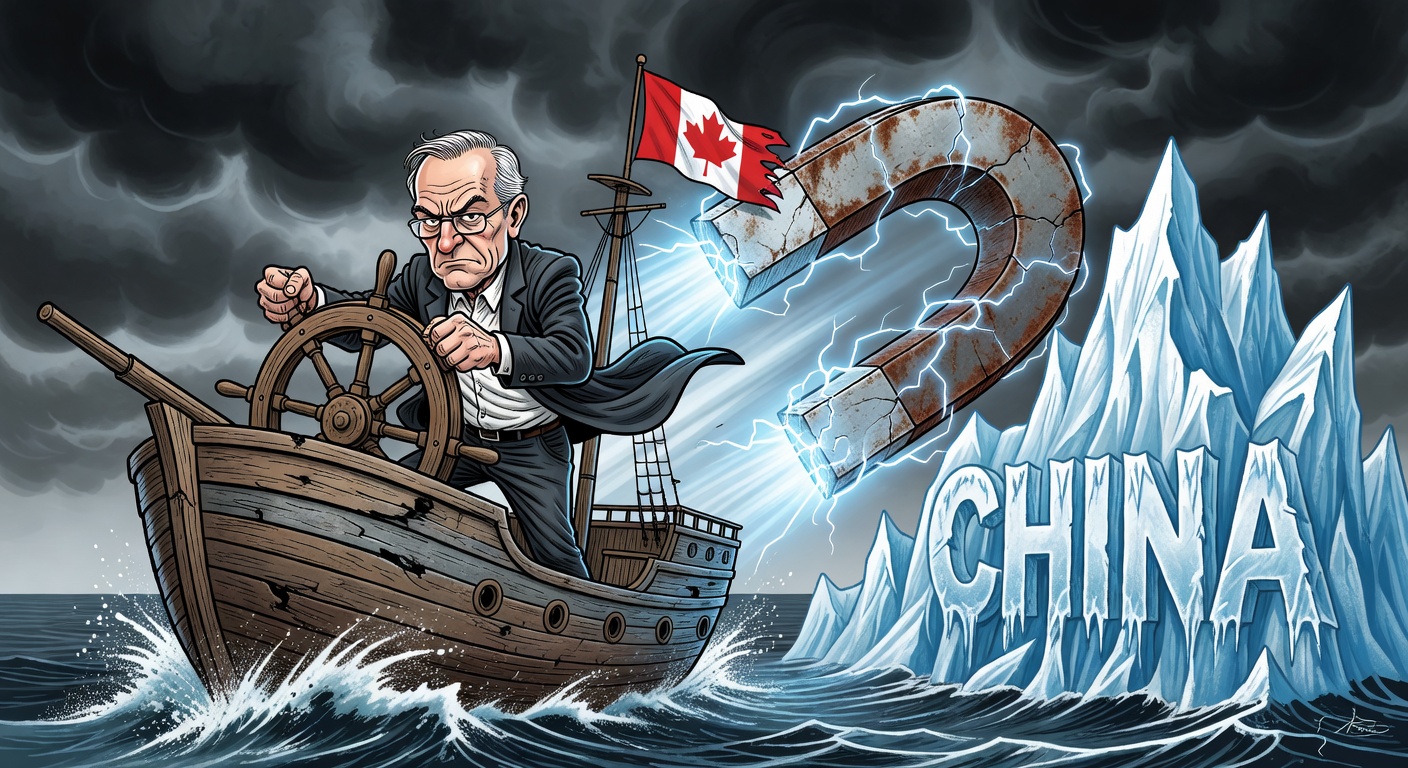
When Mark Carney won the federal election in April 2026, his signature economic promise was bold: Canada would diversify its trade away from the United States, reduce vulnerability to Donald Trump's tariffs, and forge new partnerships with Europe, Asia, and beyond. He called the old relationship with Washington "over" and declared the shift "permanent."
There's just one problem: 50 years of Canadian prime ministers said essentially the same thing. None of them succeeded.
A new report from the Fraser Institute — one of Canada's most respected economic research organizations — studied every major Canadian trade diversification effort dating back to 1984. The verdict is damning: despite 16 free trade agreements signed with non-U.S. countries, Canada barely moved the needle on its dependence on American markets.
The Numbers Don't Lie
Today, approximately 80% of Canada's merchandise exports go to the United States. That figure has barely budged across five decades of trade policy, multiple agreements, and repeated government pledges to diversify.
The Fraser Institute data shows that between 1990 and 2011, an average of 17.5% of Canadian exports went to non-U.S. countries. In the period from 2012 to 2024 — covering both the Harper Conservative years and the entire Trudeau decade — that number increased by a modest seven percentage points, to 24.2%.
That modest gain comes with a catch: essentially all of the non-U.S. export growth went to China. China's share of Canadian exports nearly tripled, from 4.2% to 10.4%. Exports to Japan actually fell. Diversification, on closer inspection, meant substituting one geopolitical dependency for a potentially far more dangerous one.
Every PM Made This Promise. Every PM Failed.
The pattern is consistent across governments of all stripes:
- Brian Mulroney (1984–1993): Signed the Canada-U.S. Free Trade Agreement, actually deepening American dependence — exports to the U.S. surged from $108B to $206B in seven years.
- Jean Chrétien (1993–2003): U.S. trade dependence continued to increase throughout his tenure.
- Stephen Harper (2006–2015): Launched the most ambitious diversification push in decades — began EU trade talks, negotiated CETA, pursued trans-Pacific agreements. The U.S. share of exports barely changed.
- Justin Trudeau (2015–2025): Promised to boost non-U.S. trade by 50% in ten years. His government fell "dramatically short" of that target, according to the Fraser Institute. CETA was finalized. CPTPP was signed. Canada is still 80% dependent on the U.S.
"Canada's merchandise and services exports and imports have become slightly more diversified away from the United States," the report's authors wrote. "However, the extent of such incremental diversification has been limited."
This isn't a criticism of effort. The Liberals, Conservatives, and every trade minister in between genuinely tried. The problem is geography, economics, and the brutal logic of continental integration: the United States is Canada's only land neighbour, and it is the world's largest consumer market, right next door. No amount of policy can fully override that reality.
The China Problem
Carney's initial answer to the U.S. dependence problem is a trade deal with China — announced in January 2026. Under the agreement, Canada cut restrictions on some Chinese EV imports in exchange for reduced Chinese tariffs on Canadian canola and other agricultural products.
The problem, as security experts have immediately pointed out, is that Canada is not trading U.S. dependence for safety. It is trading it for a different and potentially more dangerous dependency on an authoritarian state that has demonstrated willingness to weaponize trade relationships — as Canada experienced during the Meng Wanzhou affair, when China arbitrarily detained two Canadians in what was widely described as diplomatic hostage-taking.
Intelligence officials and security analysts have warned that deepening trade ties with China creates leverage Beijing can exploit — in Canadian critical mineral supply chains, in telecommunications infrastructure, in university research partnerships. Diversifying into China is not a geopolitical escape from the U.S. It is a geopolitical trap of a different kind.
The Honest Answer Carney Won't Give
The Fraser Institute's conclusion is blunt: "There are and will continue to be substantial frictions that limit the geographical trade diversification sought by some Canadian political leaders and policy makers."
What Carney owes Canadians is an honest conversation about what trade diversification can realistically achieve, on what timeline, at what cost — and what it cannot achieve at all. Promising to "recast" the Canadian economy away from the U.S. makes for a good campaign slogan. But if five successive governments couldn't do it across 50 years of genuine effort, the sixth prime minister promising it deserves scrutiny, not applause.
The U.S. will remain Canada's dominant trading partner for the foreseeable future. Every prime minister who promised otherwise was wrong. Carney should tell Canadians the truth — and focus on managing that relationship intelligently, rather than selling an illusion that has already failed five times.