"Just Another Liberal": Poilievre's QP Verdict on Carney's $80B Interest Bomb
Carney's spring fiscal update landed Tuesday with lower-than-expected deficit numbers and $37.5 billion in new spending. On Wednesday, the Opposition delivered its verdict in Question Period. Pierre Poilievre called it exactly what it is: more debt, more costs, more bills on the national credit card. From a different man — but just another Liberal.
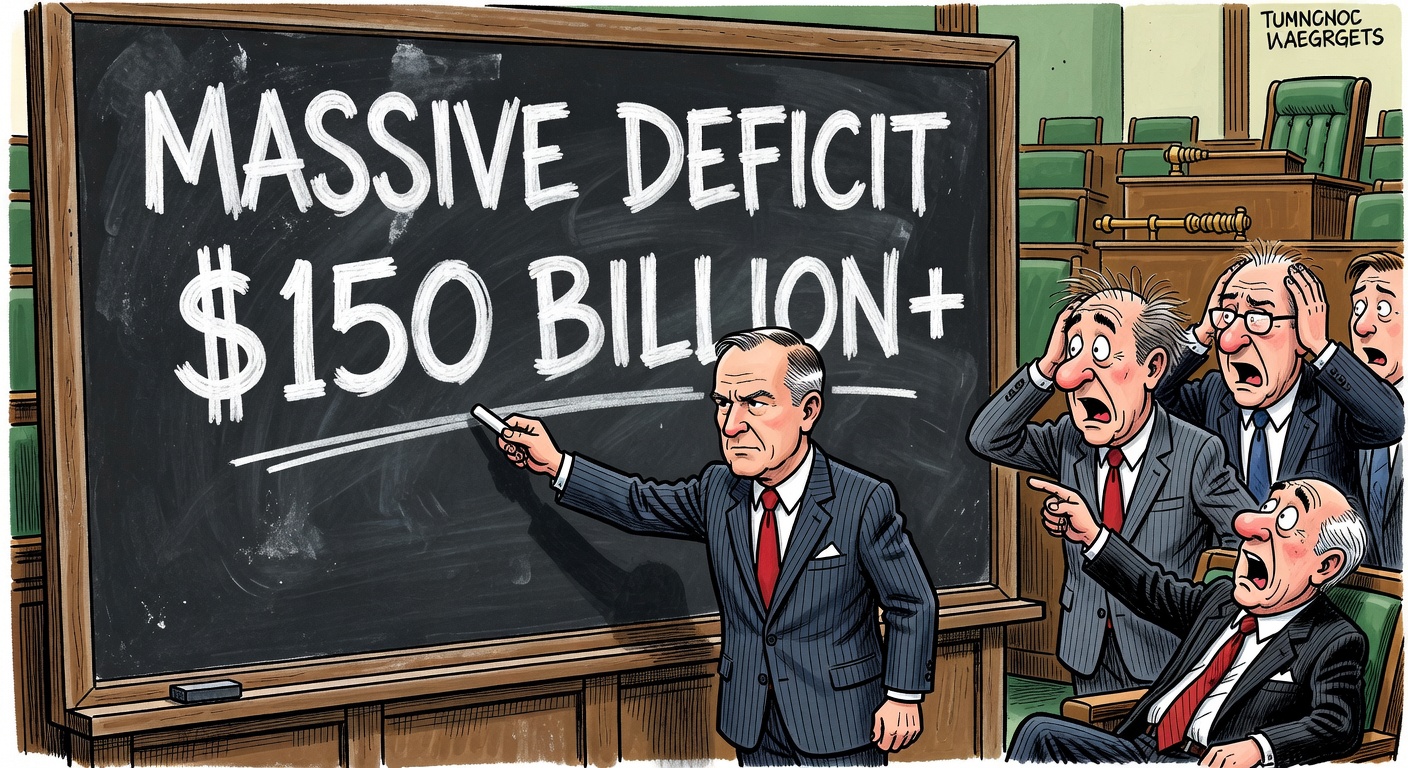
Finance Minister François-Philippe Champagne tabled the Carney government's spring economic snapshot on Tuesday afternoon, April 28. The headline number was better than many expected: a $66.9 billion deficit for the 2025–26 fiscal year, down from the $78.3 billion projected in November's budget.
Champagne called it "restoring fiscal discipline." Carney pointed to higher-than-expected oil revenue as proof that his economic management is working.
Pierre Poilievre was not impressed.
Poilievre in Question Period: "Just Another Liberal"
Rising in the House of Commons, the Conservative Leader led with the line that defined the day's debate:
"Today's Liberal fiscal update brings more costs, more debt and more bills on the national credit card. This Prime Minister is just another Liberal."
He went further, connecting the deficit spending directly to kitchen-table consequences for Canadians:
"Young families are staring down mortgage increases as inflationary government spending drives up their mortgage costs, and all of this, Mr. Speaker, is leading to real misery in people's lives."
NDP Leader Avi Lewis echoed the concern from a different direction: "The Liberal government had a big opportunity today to actually address the everyday emergency of the crisis of the cost of living for Canadians with concrete measures, new programs that would actually make people's everyday lives better. It didn't do that."
Both opposition parties landed on the same conclusion: a $66.9 billion deficit, however improved from its forecast, is still a $66.9 billion deficit — and it is being spent on things that don't put money back in Canadians' pockets today.
The $80 Billion Interest Bomb
Lost in the spin over the "better-than-expected" deficit is the number that should alarm every Canadian: the cost of servicing the federal debt is projected to hit $80.7 billion per year by 2030–2031.
To put that in context: $80.7 billion in annual interest payments is more than the entire Canada Health Transfer to all provinces combined. It is money that goes directly to bondholders — not to hospitals, not to housing, not to any Canadian program. It is the compound interest charge on a decade of Liberal deficit spending.
In the 2025–26 fiscal year, debt servicing already cost $54 billion. Under the trajectory outlined in Tuesday's update, that number climbs by roughly $5 billion per year, every year, through 2031.
The federal government will spend more on debt interest than on national defence, more than on seniors' benefits, and roughly as much as it collects in EI premiums and CPP contributions combined — just to pay the carrying cost of Liberal borrowing.
No Path to Balance. Ever.
The spring update makes the Carney government's fiscal trajectory explicit: Canada will run deficits of over $50 billion annually every year through 2030–2031. The document does not project a balanced budget at any point in the foreseeable future.
Carney has argued this is defensible because he distinguishes between the "operating deficit" — day-to-day government expenses — and the "capital deficit" used to fund investments. The operating budget, he says, will be balanced within three years. But the overall deficit doesn't balance. The debt keeps growing. And the interest keeps compounding.
It is a rhetorical sleight of hand that would never survive scrutiny in a corporation's annual report, let alone at a household kitchen table.
The federal debt will reach approximately $1.63 trillion by the end of this decade — adding nearly $300 billion more to the tab in five years. That debt will be carried by every Canadian worker, every small business, every first-time homebuyer trying to afford a mortgage in one of the most expensive housing markets on earth.
The Canada Strong Fund: Borrowed Billions Dressed Up as Savings
Among the update's splashier announcements is the $25 billion "Canada Strong Fund" — Carney's proposed sovereign wealth fund, seeded entirely with borrowed money during a $66.9 billion deficit year. There is no surplus to invest. The $25 billion doesn't exist yet; it will be borrowed.
Every real sovereign wealth fund in history was built on surplus capital: Norway's $1.7 trillion fund from 30 years of oil profits, Kuwait's from petroleum revenue since 1953, the UAE's from petroleum exports. Not one was built from borrowed money during structural deficits.
The fund's investment mandate — energy, infrastructure, AI, critical minerals, renewables — is a near-perfect match for the business sectors of Brookfield Asset Management, the company Carney still holds over $10 million in personally. The House of Commons Ethics Committee told Carney to sell those holdings four days before he announced the fund.
One Moment of Bipartisanship
In a rare moment, Poilievre opened his QP response by praising the government on one specific measure — the streamlining of the disability tax credit application process for Canadians with long-term medical conditions.
"As a father, thank you for his commitment to simplify the disability tax credit. Our people should be spending their times living their lives rather than filling out forms."
It was the only applause line in an otherwise bleak accountability session. Which is itself a statement about how much the spring update delivered — or didn't.
What Carney Promised vs. What He Delivered
During the 2025 federal election, Mark Carney positioned himself as the fiscally responsible alternative to Justin Trudeau's runaway spending. He promised to return Canada to "fiscal sustainability" and treat a "return to balance" as "the anchor of any credible economic plan."
What Canadians got: a $66.9 billion deficit, $37.5 billion in new spending commitments, a $25 billion borrowed "sovereign wealth fund," and a debt servicing bill that will hit $80 billion per year before the decade ends.
Poilievre's one-liner may be simple — but it's accurate. Just another Liberal.
- CBC News: "7 key takeaways from the Liberal government's spring economic snapshot," April 28, 2026
- CBC News: "Liberals on better-than-expected ground, plan to spend billions on skilled trades in economic update," April 28, 2026
- Pierre Poilievre, Question Period, House of Commons, April 28, 2026
- Avi Lewis, NDP Leader, statement on spring economic update, April 28, 2026
- Finance Canada: Spring Economic Statement 2026, tabled April 28, 2026
- CarneyWatch.ca: Documented policy reversals and Brookfield conflict timeline