Canada's Dairy Cartel: The 313% Tariff Scheme Carney Won't Touch — Even as Americans Demand Its End
A bipartisan coalition of 74 U.S. Congress members — including Trump critics — is demanding Ottawa dismantle supply management. The U.S. Trade Representative calls it the top trade irritant with Canada. And yet Mark Carney refuses to touch it. The reason: dairy board votes in rural Quebec and Ontario. Meanwhile, Canadian families pay double for milk protected by tariffs reaching 313.5%.
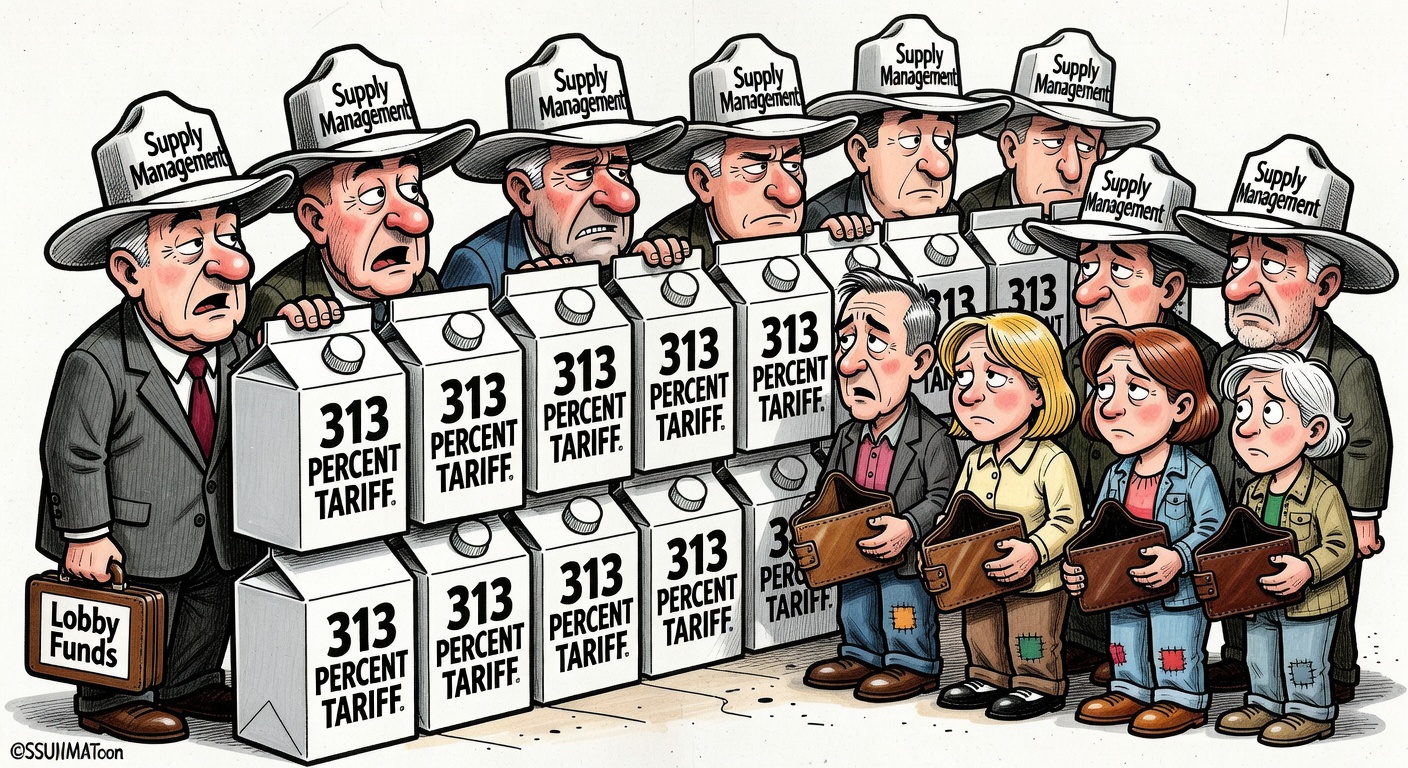
If you're wondering why Canadian groceries are so expensive, part of the answer sits in a 1970s policy most Canadians have never heard of: supply management. And as Canada faces the most serious trade confrontation with the United States in its history, this obscure system has quietly become the single biggest irritant in the relationship — demanded by Democrats, demanded by Republicans, and steadfastly defended by every federal government too afraid of dairy board votes to do anything about it.
What Is Supply Management?
Supply management is a government-enforced production cartel for dairy, poultry, and eggs. Provincial marketing boards set strict production quotas for Canadian farms. Under law, any milk produced beyond those quotas must be destroyed. This isn't a free market — it's a government-managed system that keeps supply artificially low so prices stay artificially high.
The import controls that hold this cartel together are extraordinary. Foreign dairy is subject to some of the highest tariff rates imposed by any developed country:
- Cheese curds: 245.5% tariff
- Concentrated milk: 259% tariff
- Dairy-derived butters: Up to 313.5% tariff
These are not minor trade barriers. These are walls designed to make it economically impossible for foreign dairy to compete in Canada — and they work exactly as intended. Canadian families pay roughly double what Americans pay for dairy products as a direct result.
A Bipartisan American Demand
The United States has been complaining about Canadian supply management for decades. What's new — and what Carney has so far refused to acknowledge — is that the pressure is now coming from both sides of the American political divide.
A letter signed by 74 members of the U.S. House of Representatives — including vocal Trump critics — was recently sent to U.S. Trade Representative Jamieson Greer demanding a hard line on Canadian dairy protectionism. "Canada has a long history of unfairly restricting imports of U.S. dairy products while simultaneously offloading artificially low-price nonfat milk solids onto the global market," the letter reads.
The U.S. Trade Representative has made it unambiguous: "We have raised it repeatedly and frequently over the past year. They have made no commitments on this front." Greer told Congress that supply management can be addressed in CUSMA renegotiations — or through "enforcement actions." That last phrase is diplomatic language for more tariffs.
Even the Biden administration — which bent over backwards to maintain good relations with Ottawa — spent nearly three years litigating Canada's tariff-rate quota allocation before an independent CUSMA panel. Canada was found to have met the letter of its trade commitments while deliberately channeling quotas to domestic firms who didn't use them — effectively nullifying the spirit of what was agreed.
Who Supply Management Actually Protects
Proponents of supply management argue it protects small family farms. The reality is more complicated. The quota system has concentrated dairy production in fewer and larger operations over time, as quota licenses — worth hundreds of thousands of dollars each — have been bought up by larger operators. The farmers who benefit most from supply management are not the struggling small-scale operations the system is supposedly designed to protect. They are established quota-holders sitting on licences worth millions of dollars.
The people who pay the price are the 40 million Canadians who buy milk, cheese, butter, and yogurt at prices dramatically higher than what our trading partners pay. Supply management is, in effect, a hidden regressive tax on food — paid disproportionately by lower-income families who spend a larger share of their income on groceries.
At a moment when Carney is loudly promising to bring down the cost of living, he is simultaneously defending the most visible example of a government-enforced pricing scheme that makes everyday Canadians poorer.
The Political Calculus
The reason no federal government has touched supply management is simple: dairy and poultry quota-holders are heavily concentrated in rural Quebec and Ontario — provinces that decide federal elections. The Liberal Party in particular has historically been the protector of the dairy cartel, because dairy farmers and their associations are reliable donors and political allies.
Mark Carney knows that eliminating or significantly reforming supply management would hand him a major concession in CUSMA renegotiations — potentially removing the single biggest U.S. trade grievance against Canada. He also knows that doing so would cost him politically in key ridings. So far, he has chosen political calculation over national interest.
The result: Canadian families keep paying 313% tariff-inflated prices for butter, the Americans keep adding supply management to their list of grievances, and the next CUSMA renegotiation gets harder every year Carney refuses to address it honestly.
Protecting a 1970s dairy cartel while claiming to be a free-market reformer isn't fiscal discipline. It's politics — and ordinary Canadians are paying for it at the grocery store.